Case study · A tenant on Intelligent Operations
Tommy Saunders
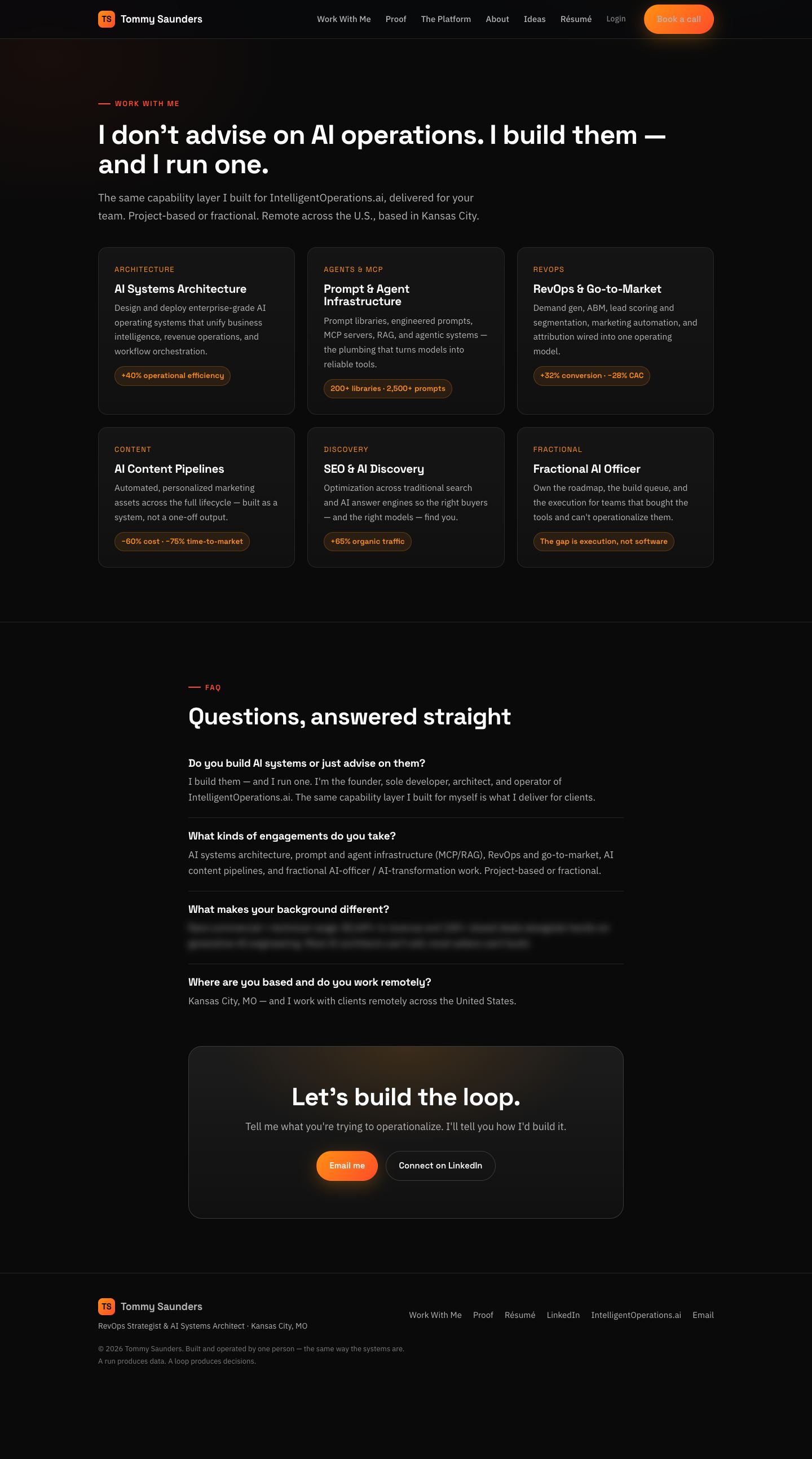
I don't advise on AI operations. I build them, and I run one.
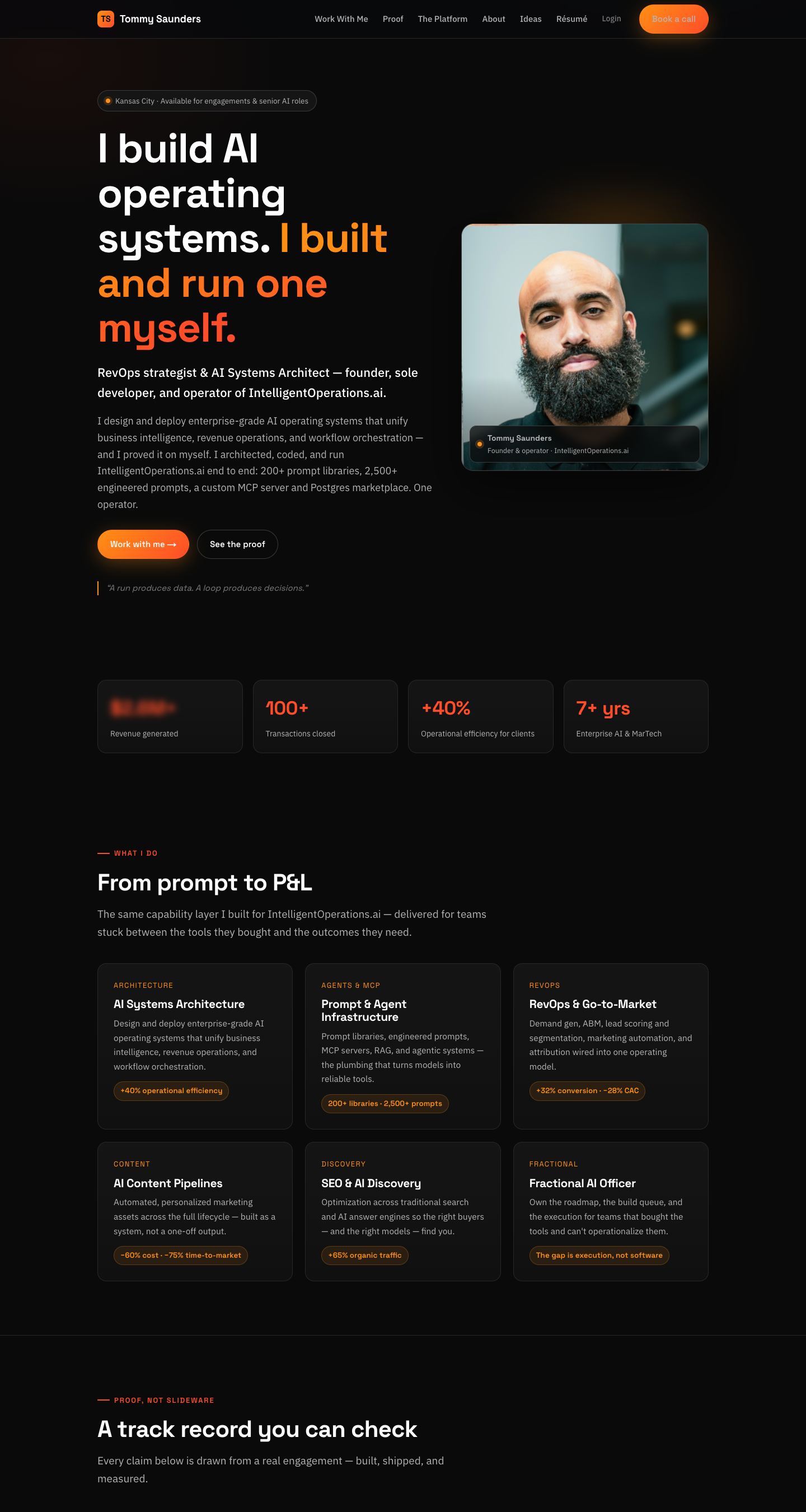
Tommy Saunders is a RevOps strategist and AI systems architect, and the founder and operator of Intelligent Operations. His tenant runs his site, essays and the content that goes with them.
- 51screens
- 20prompt libraries
- 285column prompts
- 1,134variables filled
The business
- Offer: AI Systems Architecture, Prompt and Agent Infrastructure, RevOps and Go-to-Market, AI Content Pipelines, SEO and AI Discovery, and Fractional AI Officer.
- Published record: 200+ prompt libraries and 2,500+ engineered prompts; $2.6M+ revenue generated.
- Background: Mizzou D1 football, Detroit Lions 2009, USA Rugby Sevens 2010.
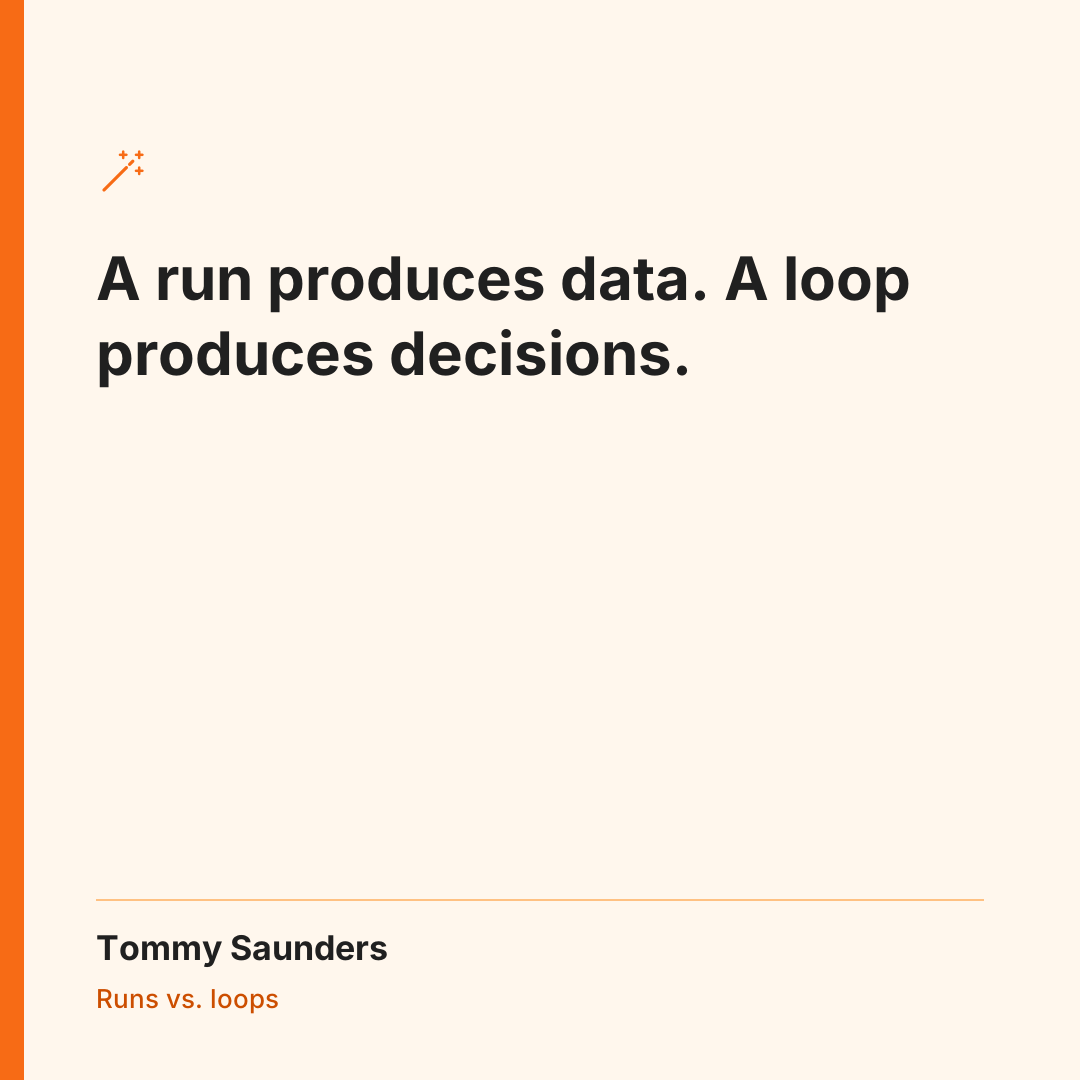
- Thesis: a run produces data; a loop produces decisions.
- Based in Kansas City, working remotely across the U.S.
/
/work-with-me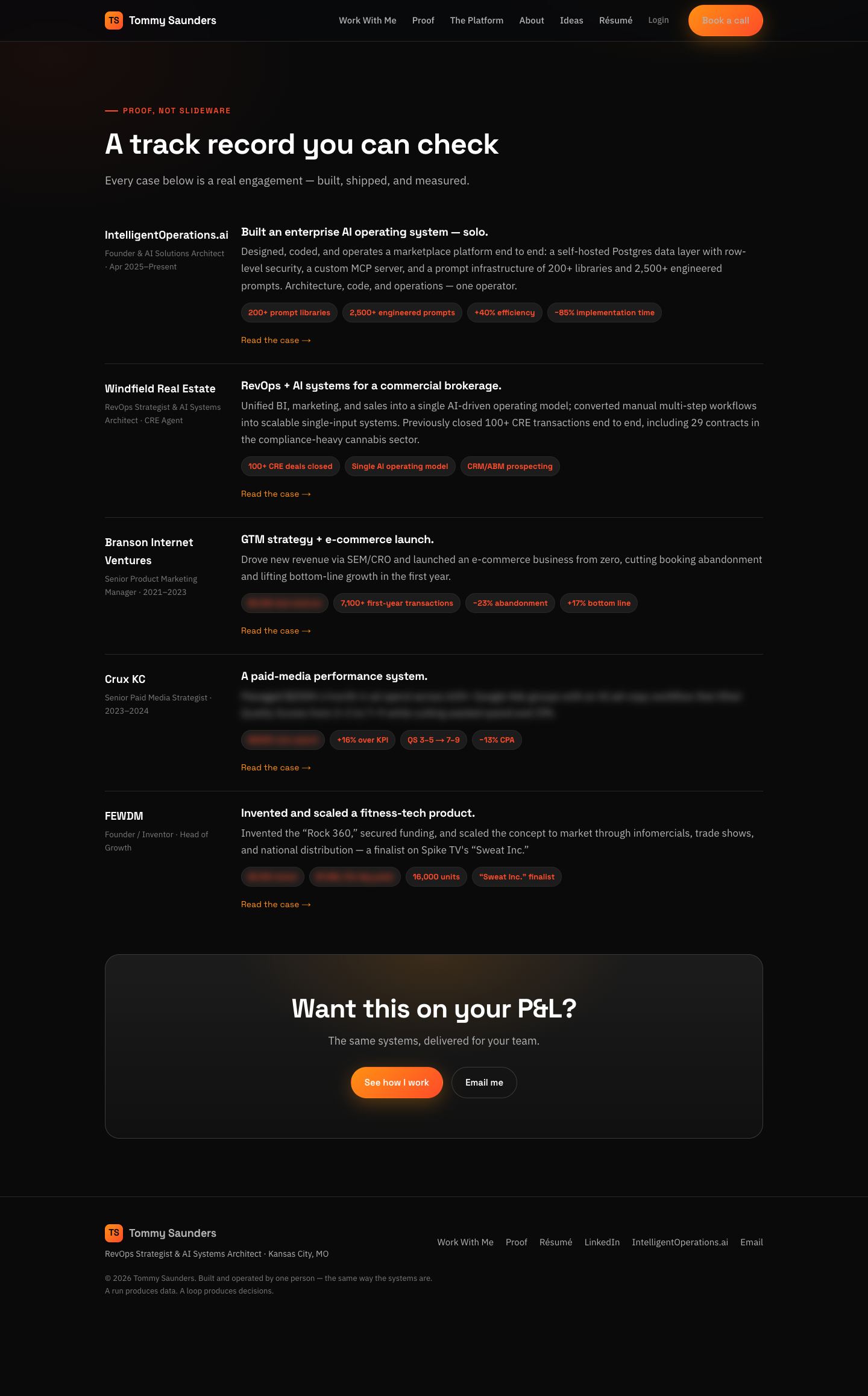
/proof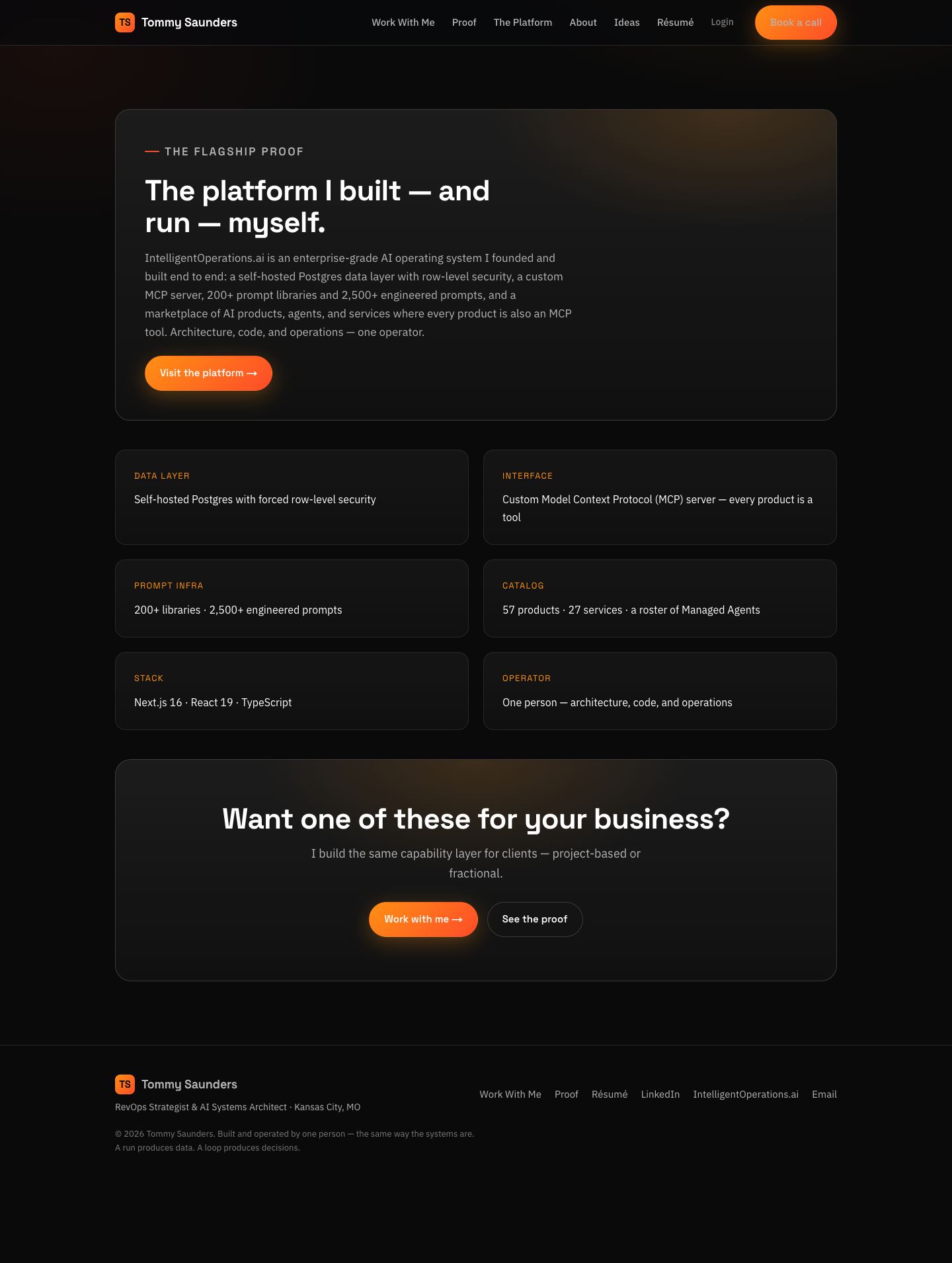
/intelligent-operations
/about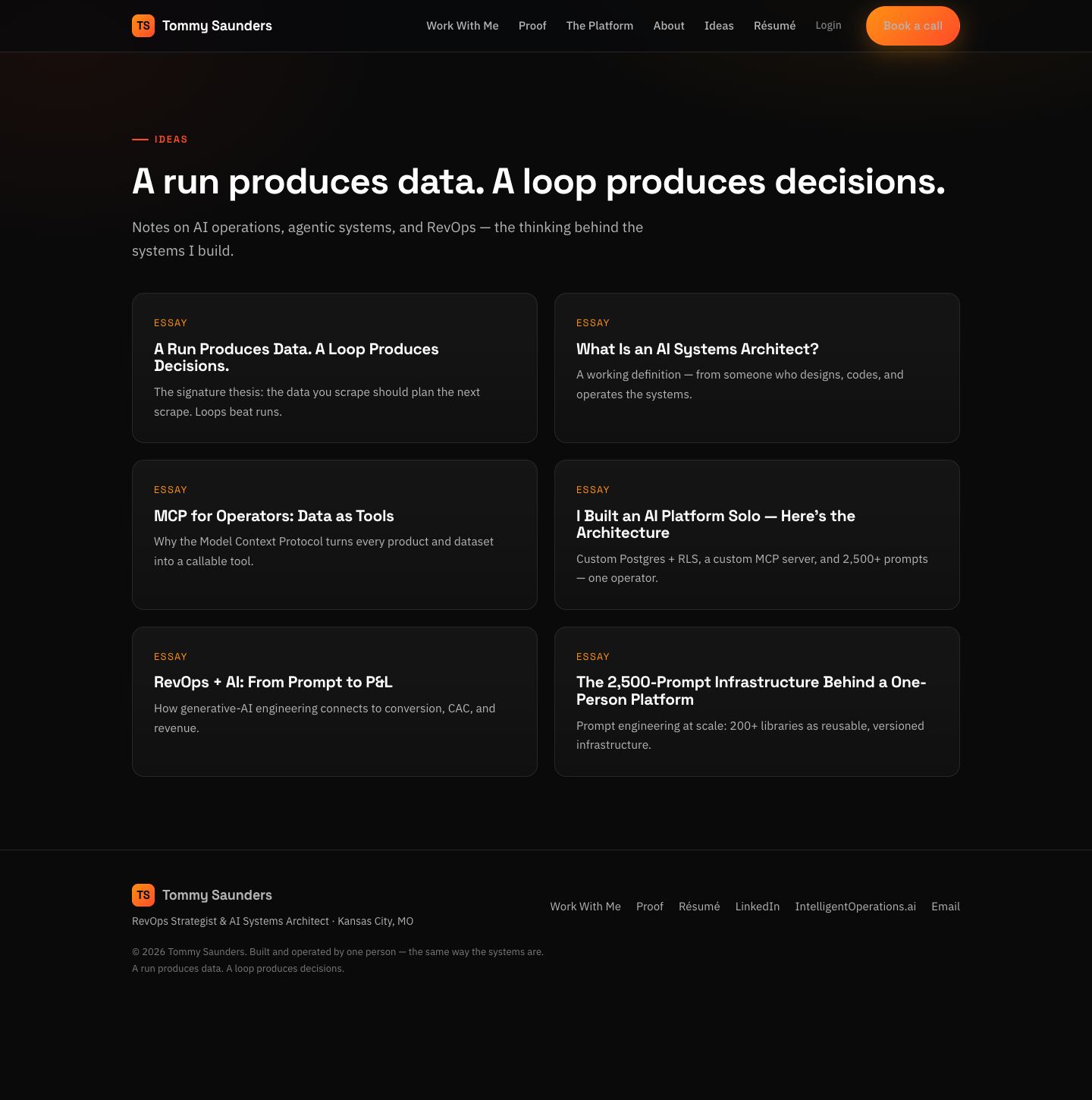
/ideas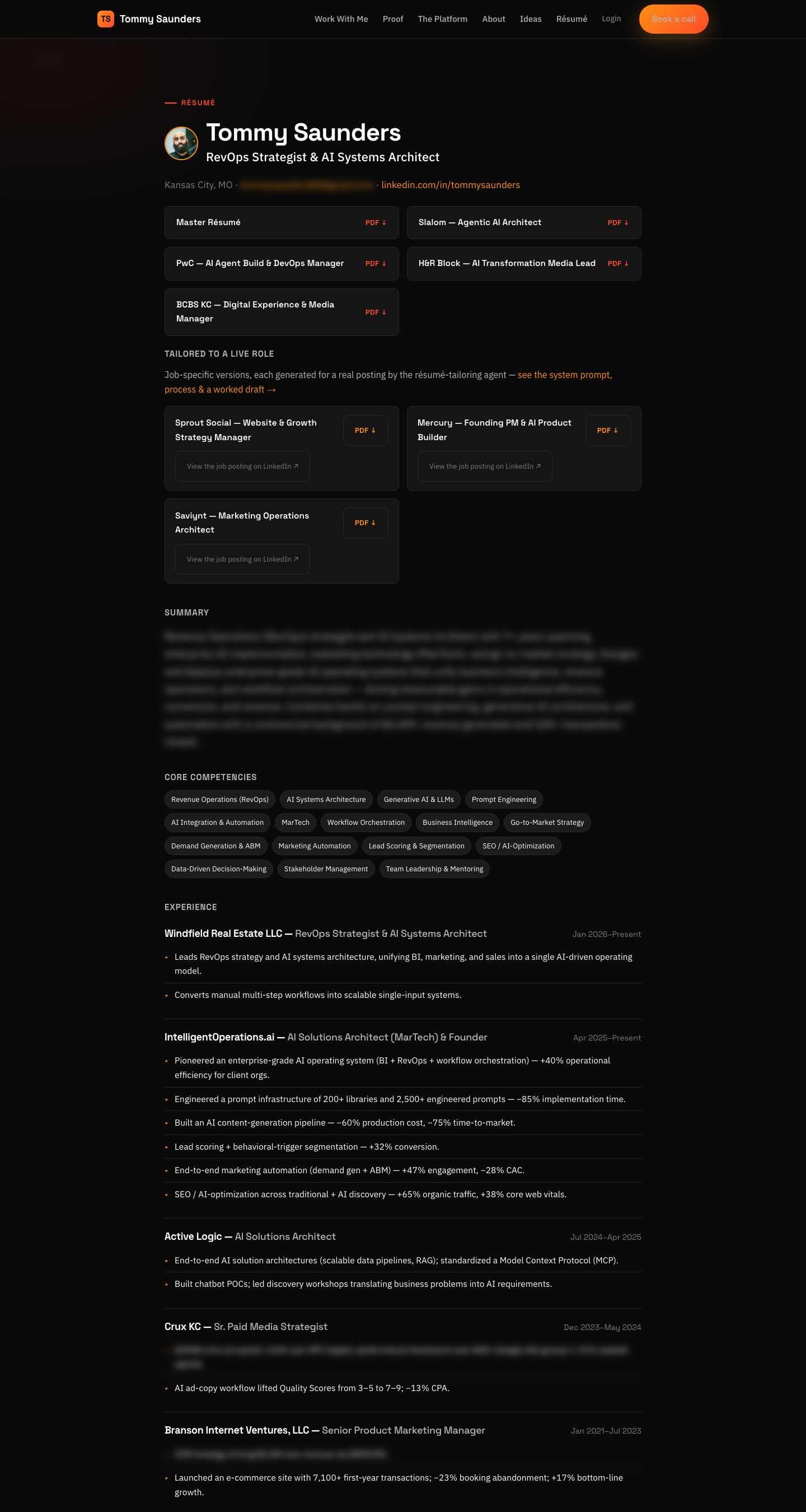
/resume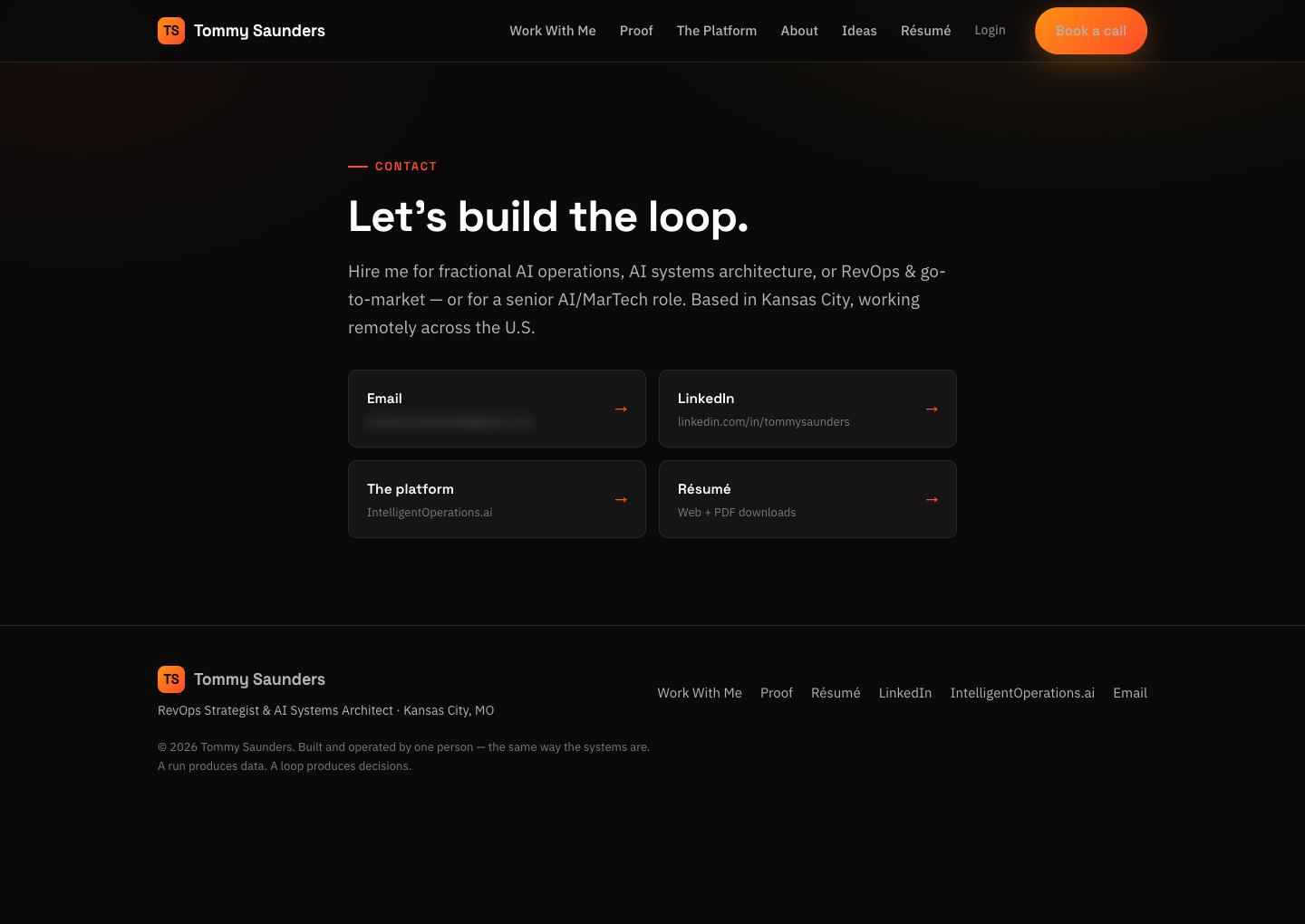
/contact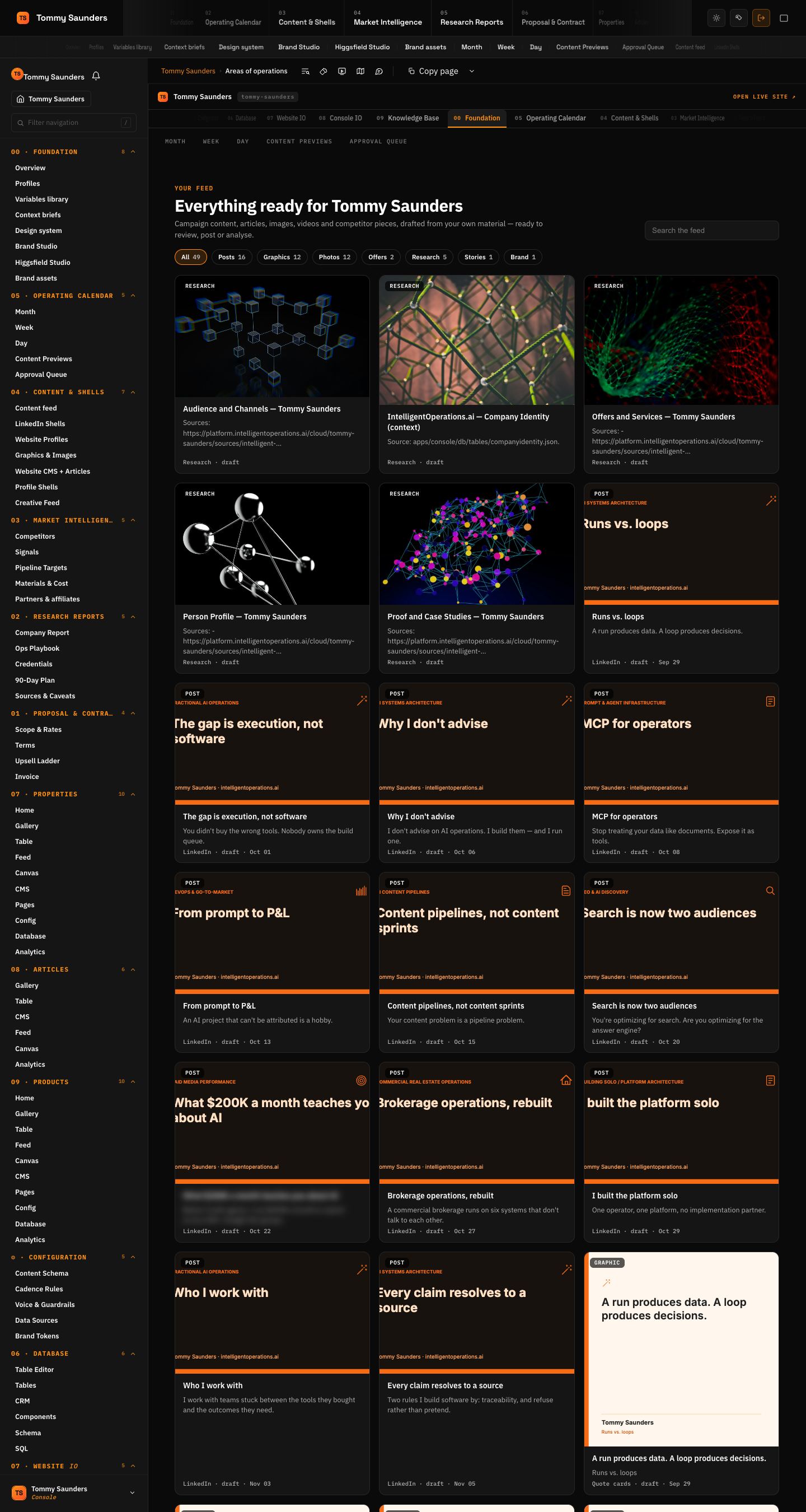
/tenant/tommy-saunders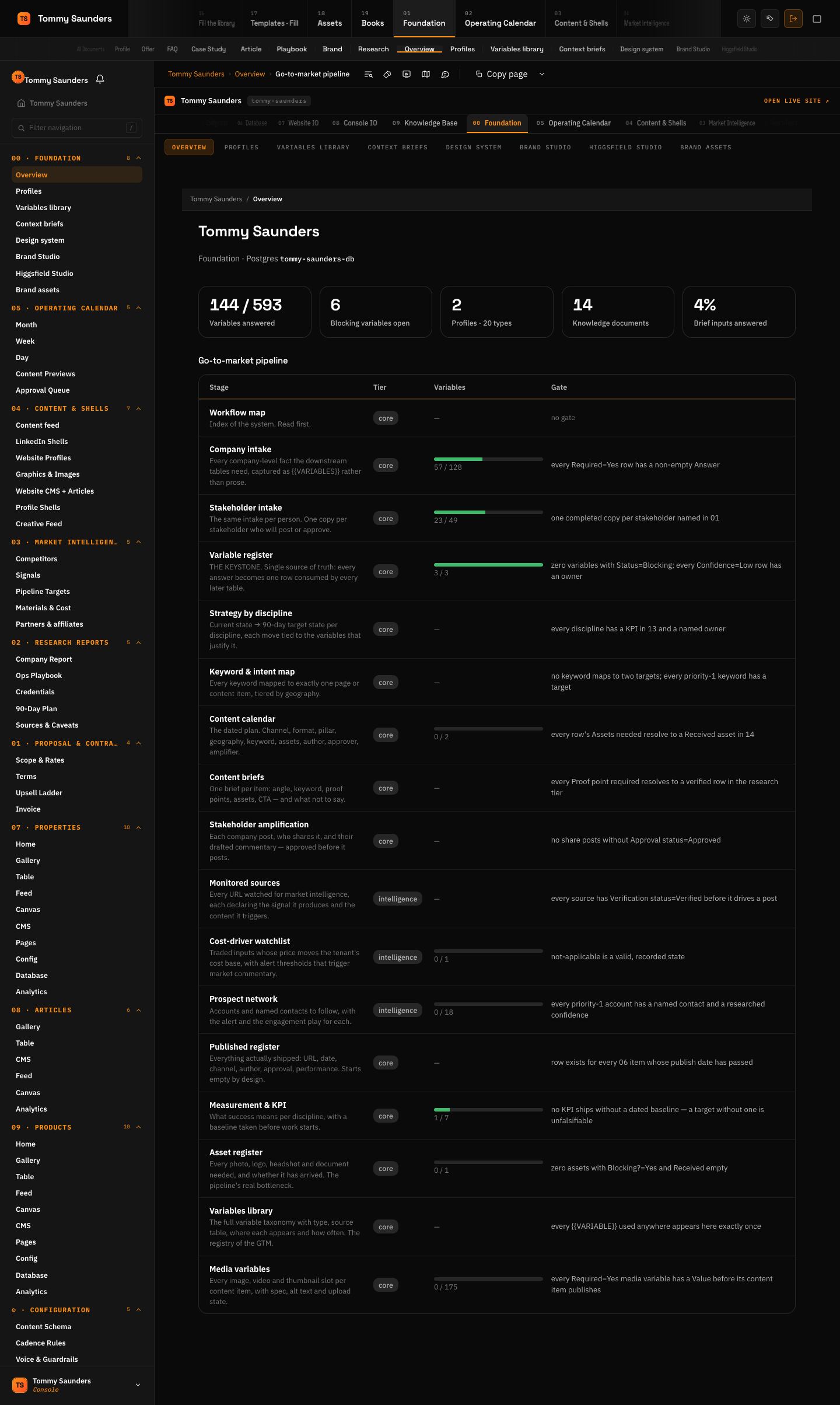
/tenant/tommy-saunders/foundation/overview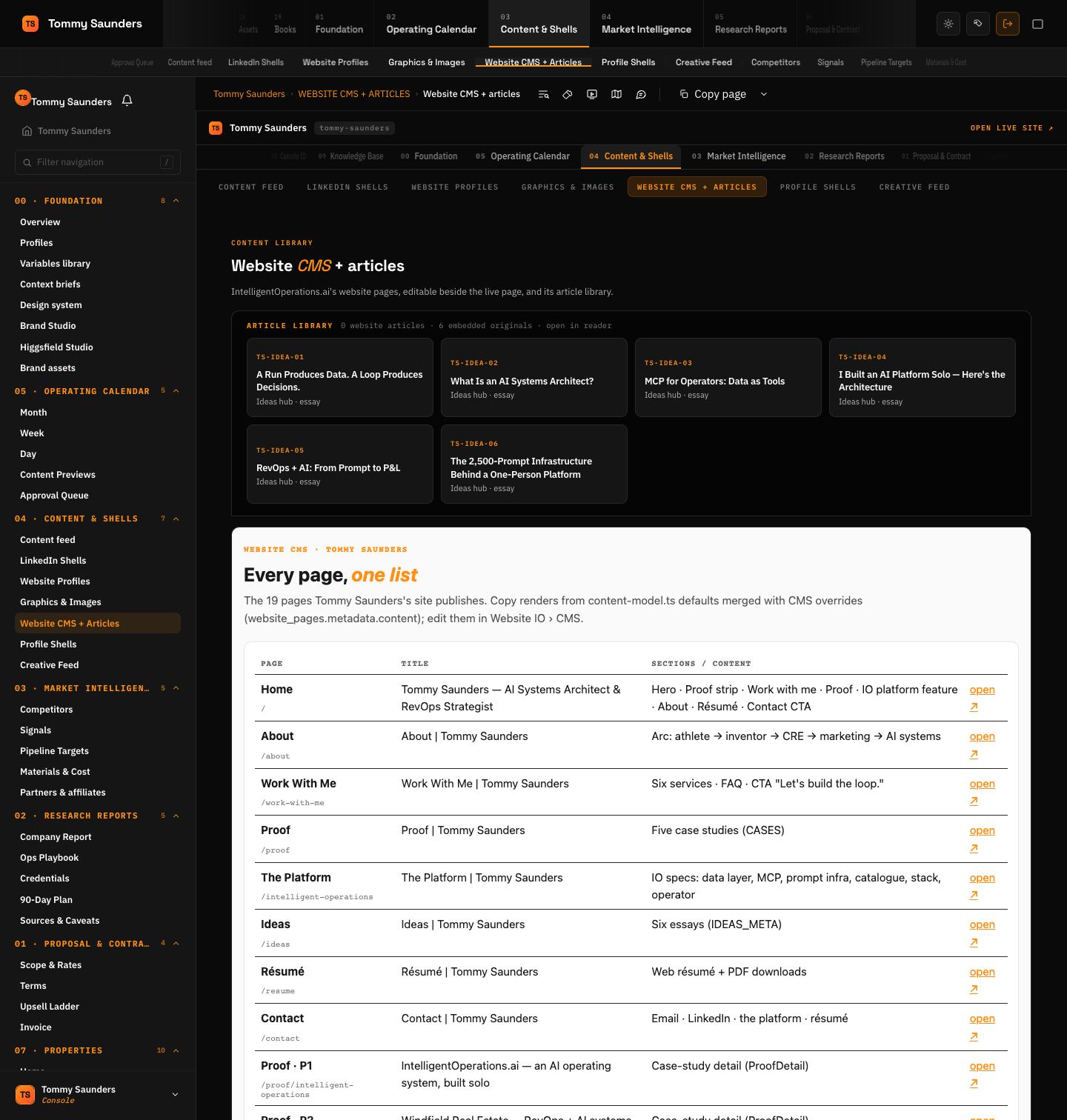
/tenant/tommy-saunders/content/cms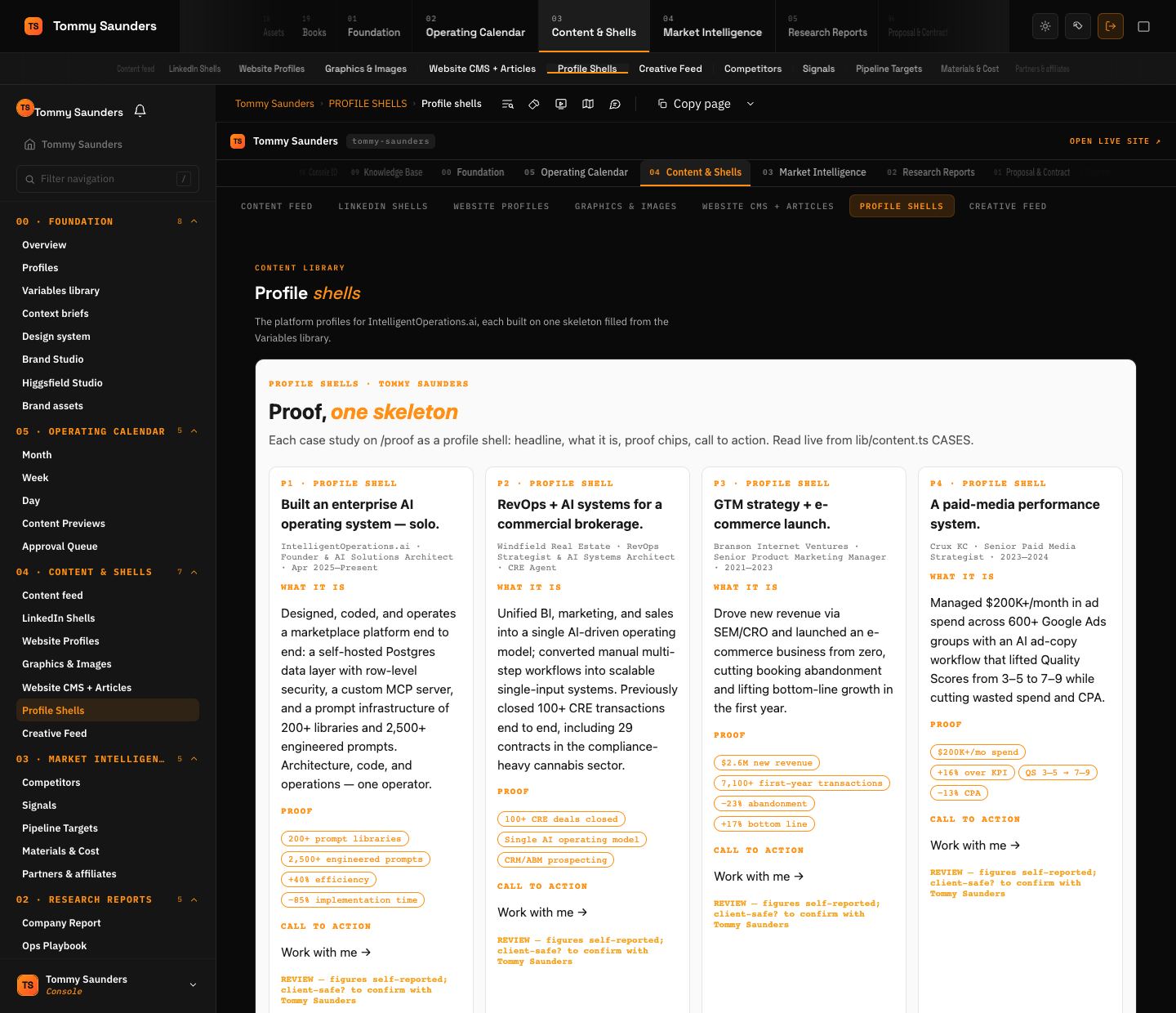
/tenant/tommy-saunders/content/shells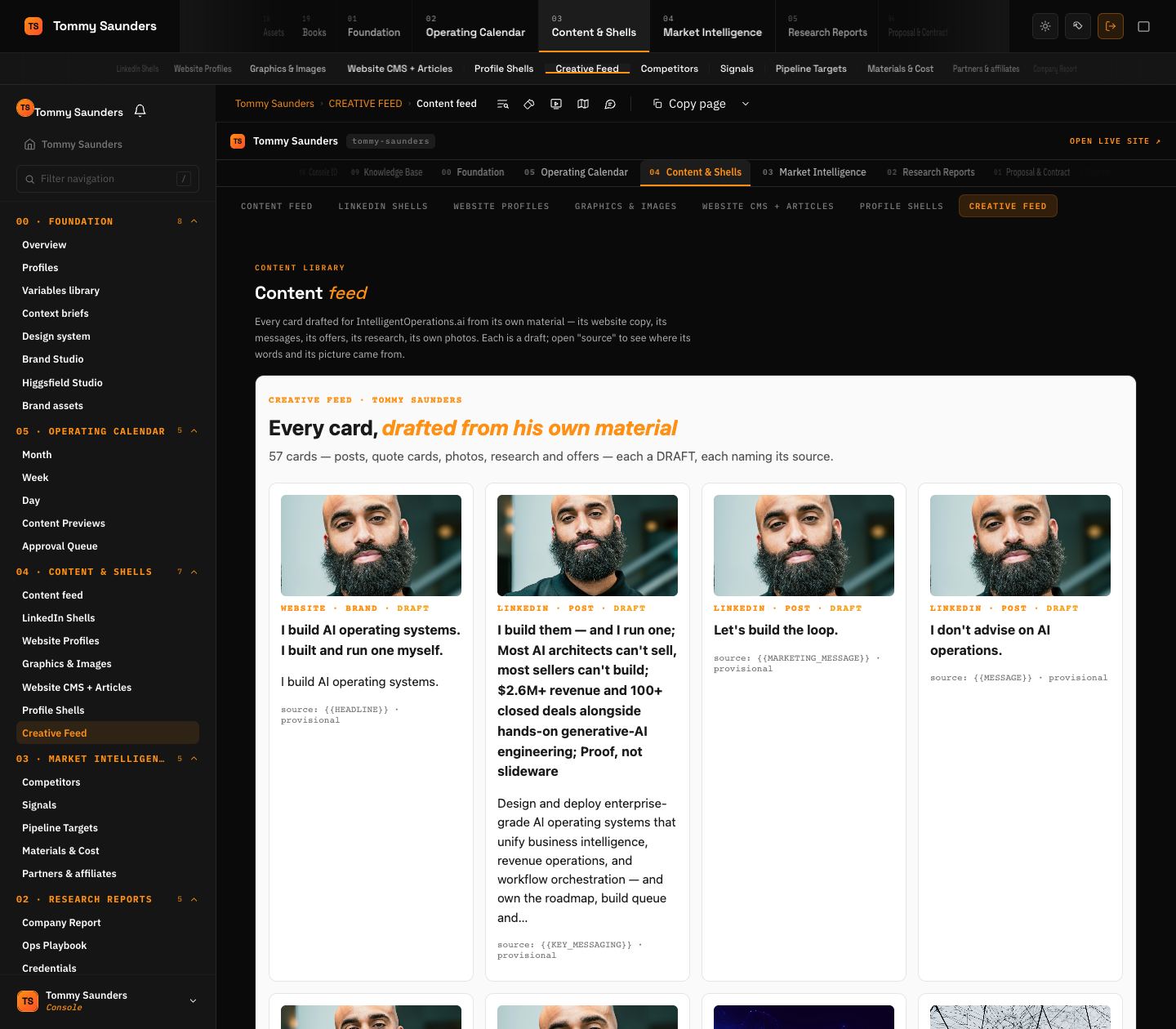
/tenant/tommy-saunders/content/feed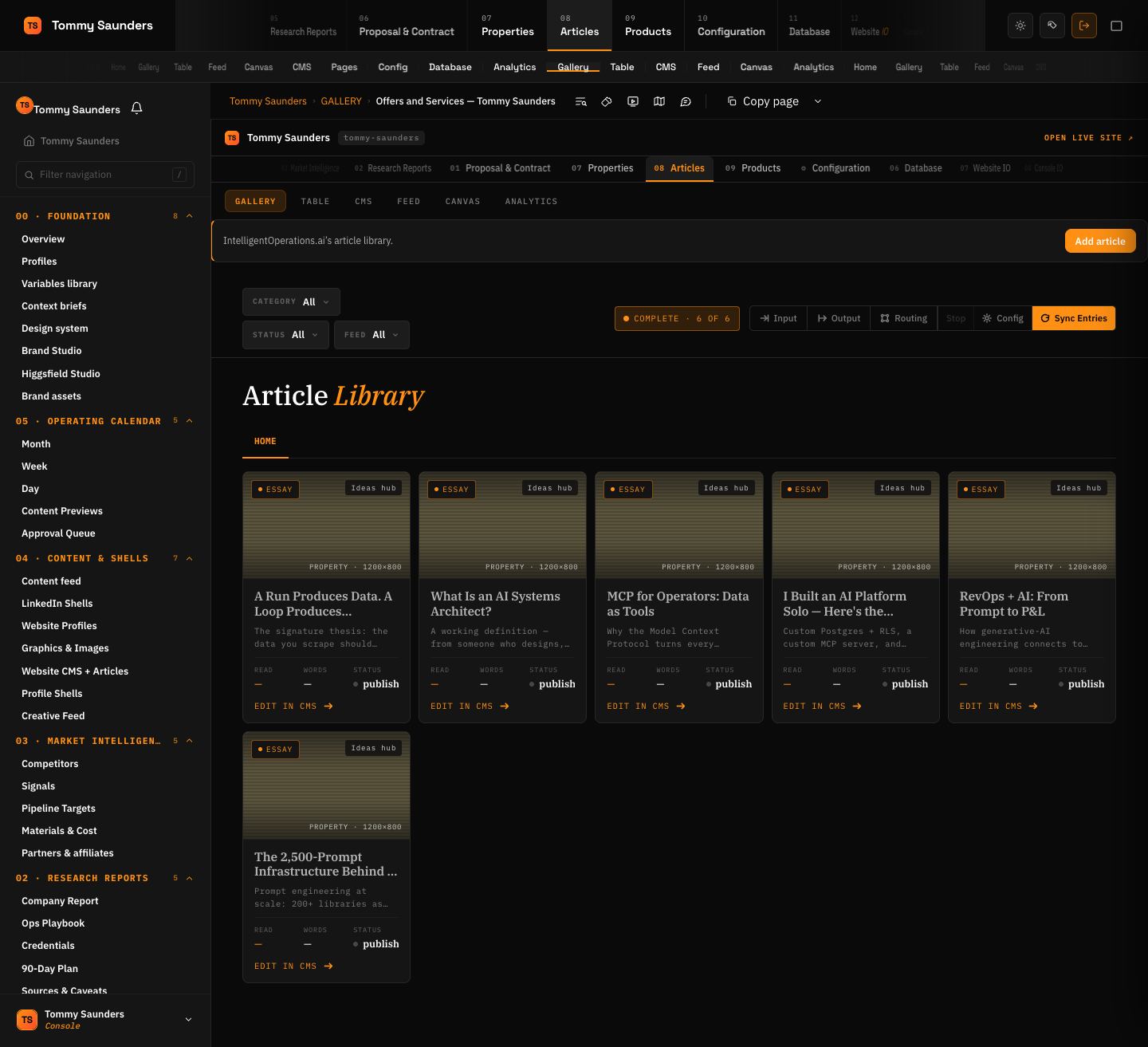
/tenant/tommy-saunders/articles/gallery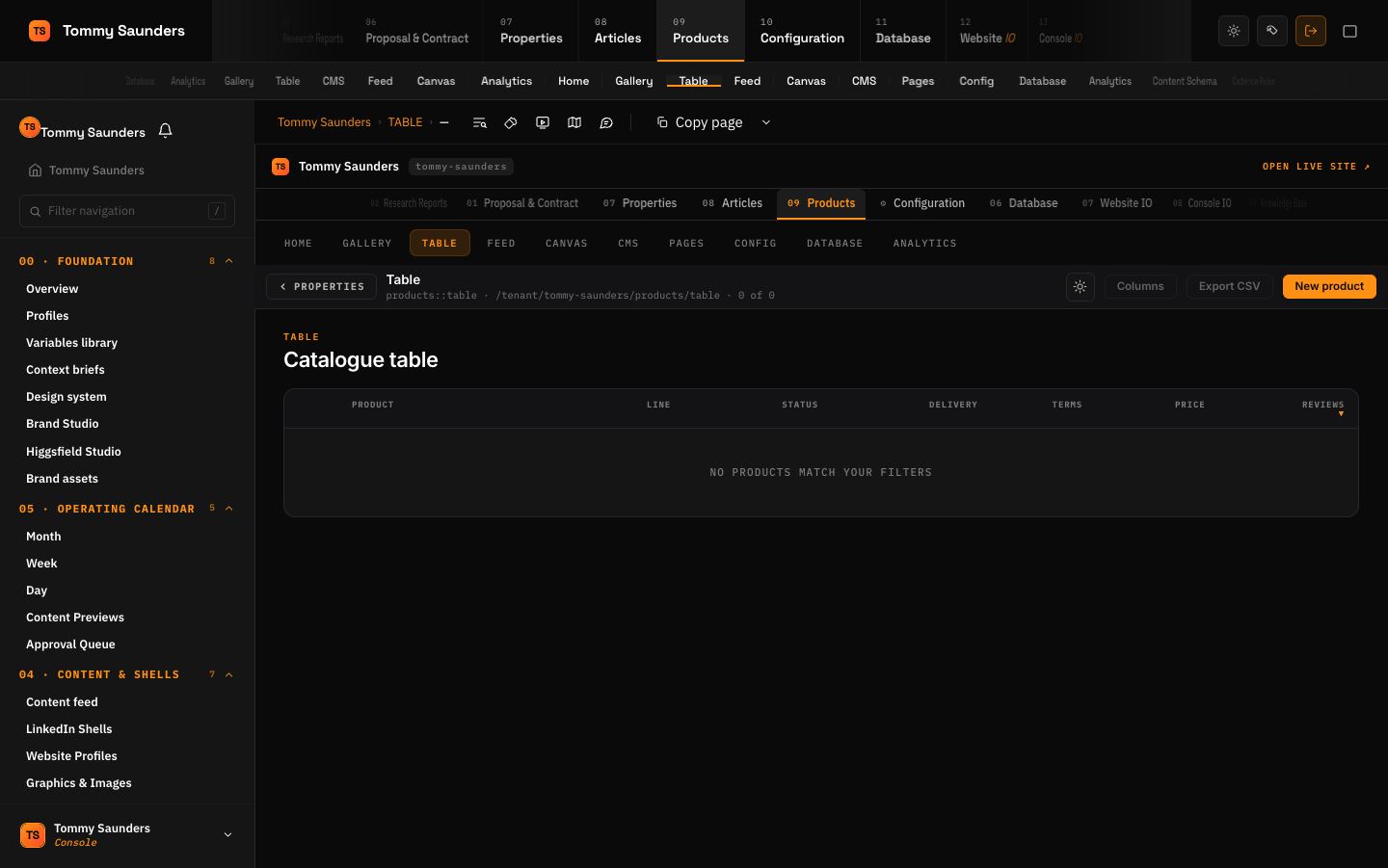
/tenant/tommy-saunders/products/table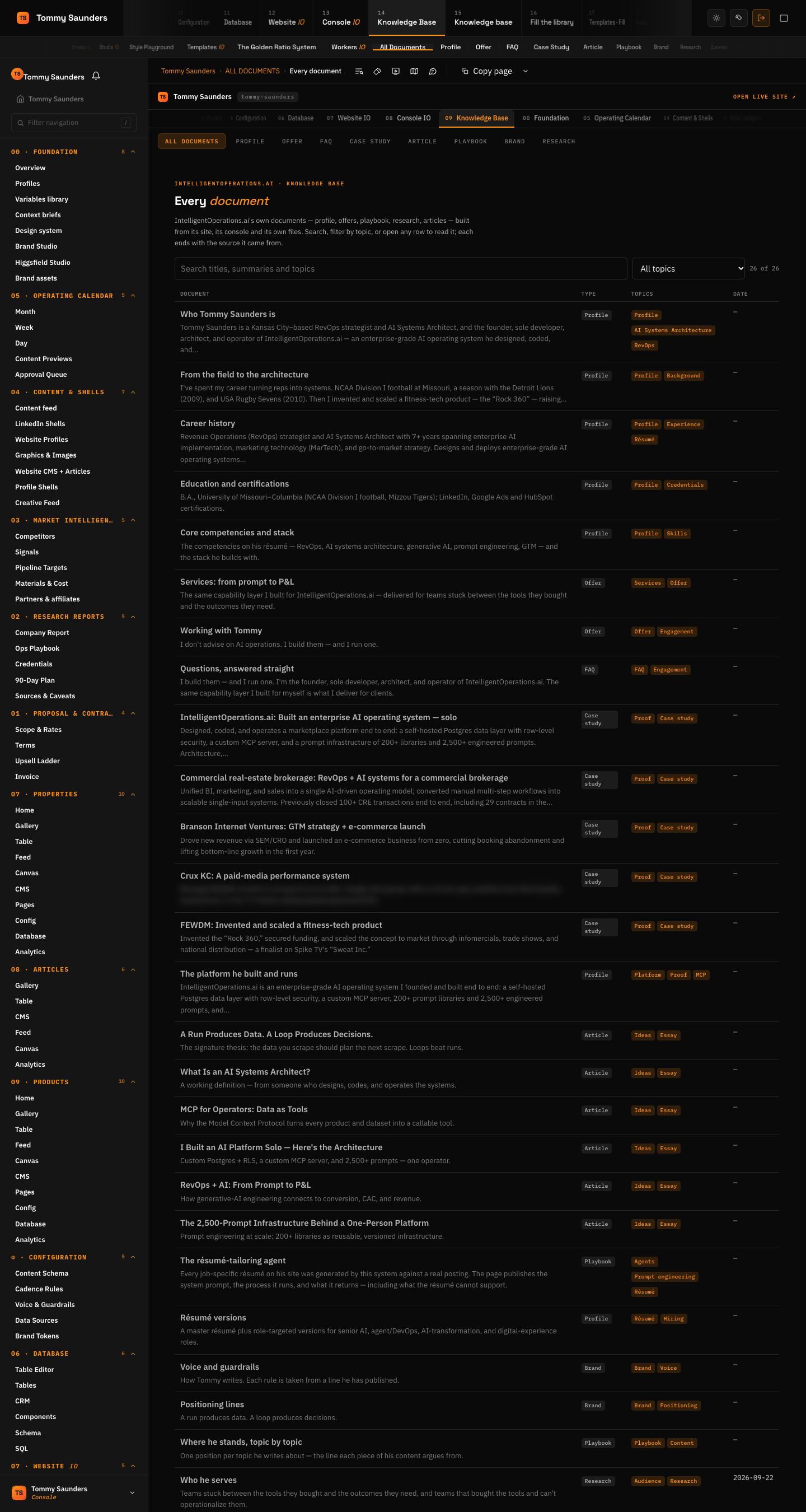
/tenant/tommy-saunders/knowledge/all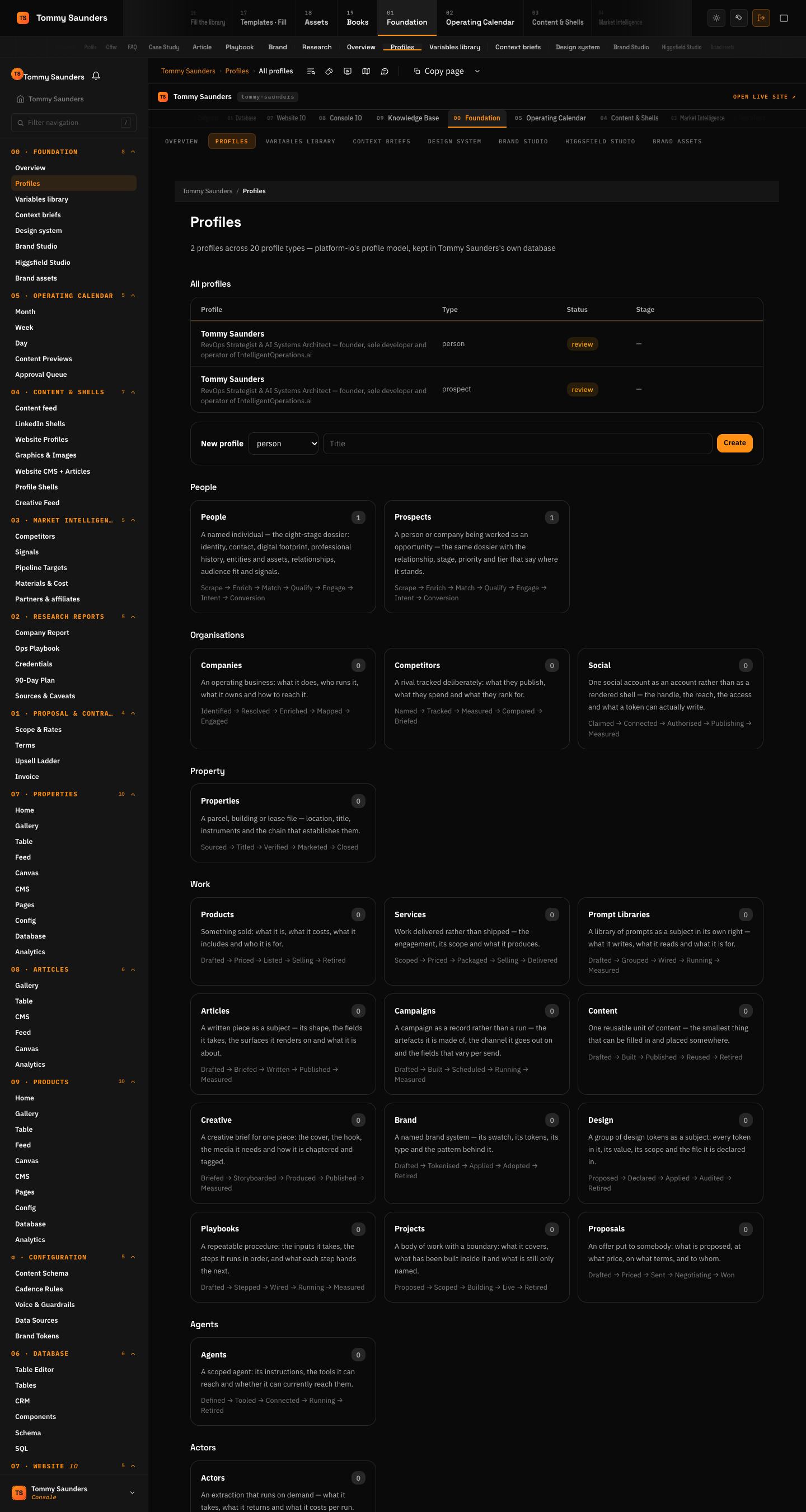
/tenant/tommy-saunders/foundation/profiles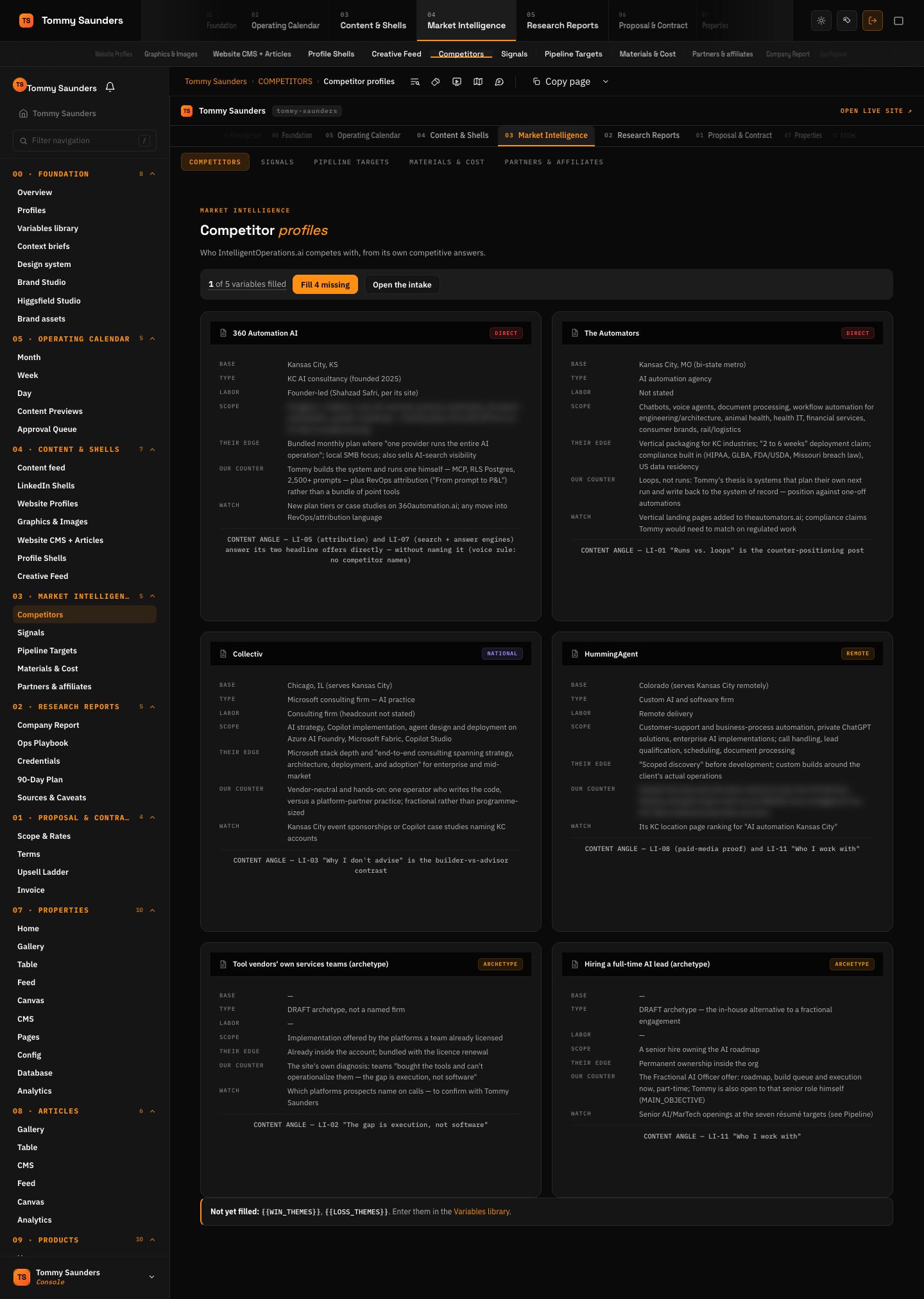
/tenant/tommy-saunders/intel/competitors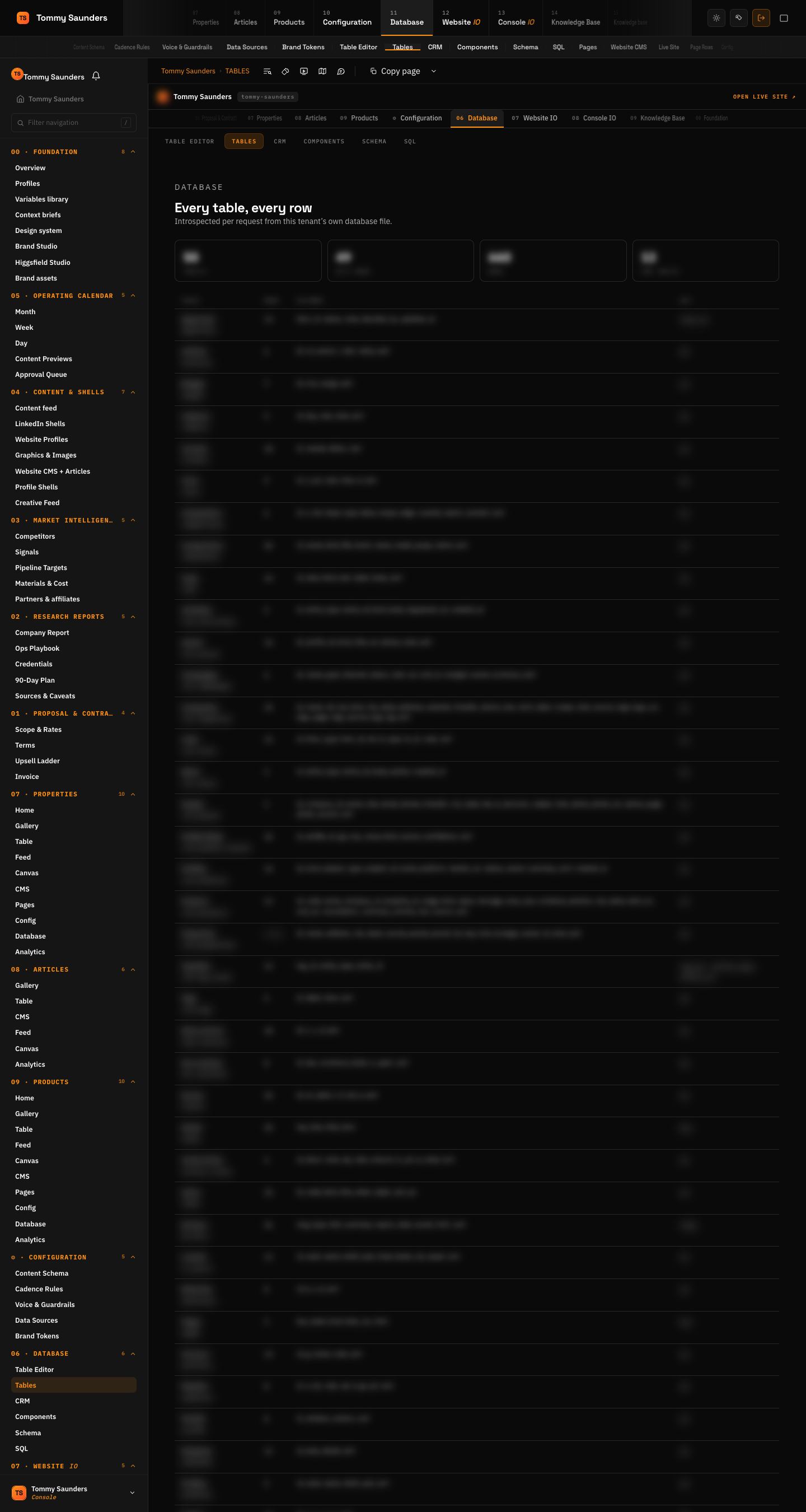
/tenant/tommy-saunders/database/tables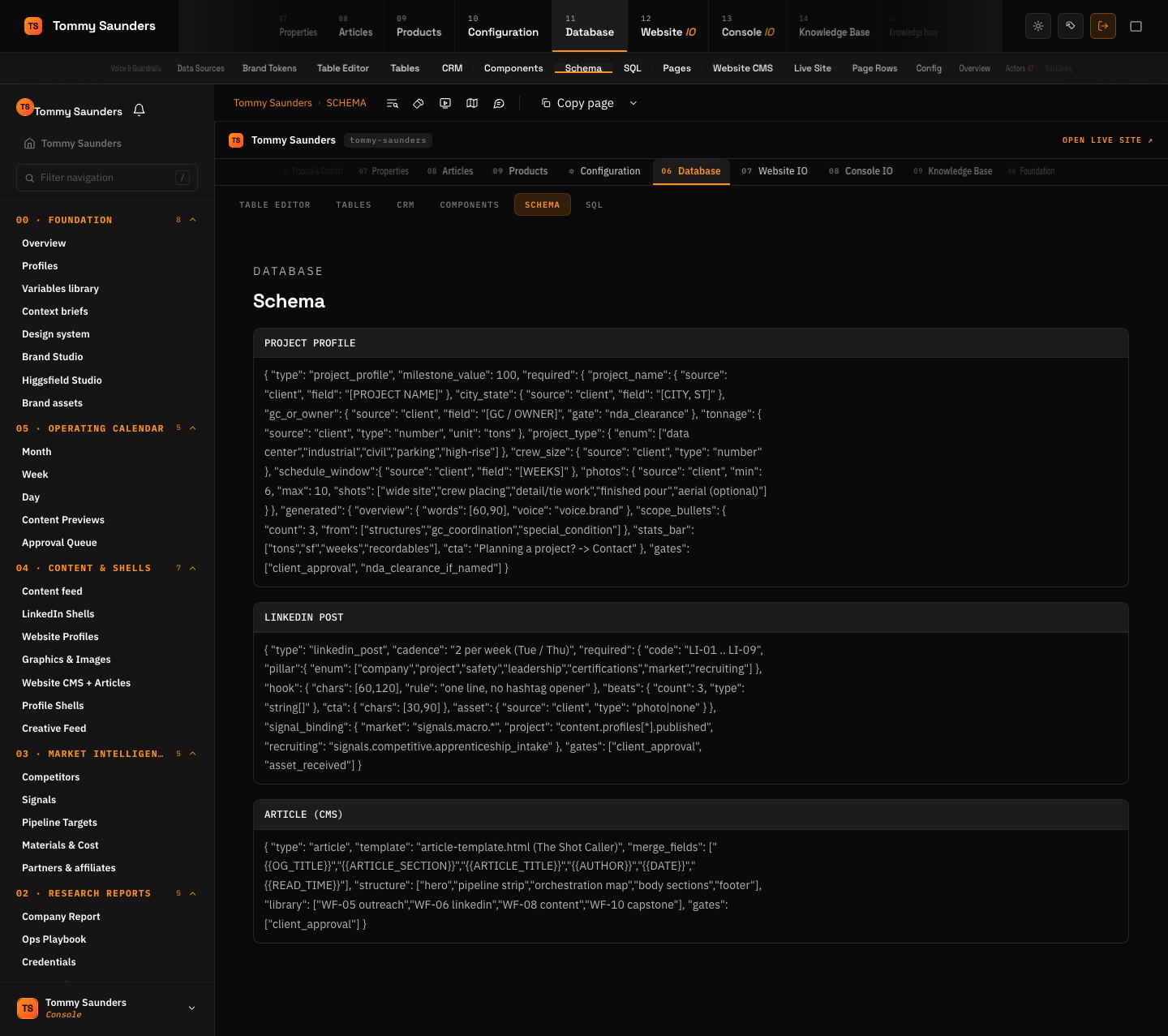
/tenant/tommy-saunders/database/schema
/tenant/tommy-saunders/database/crm
/tenant/tommy-saunders/intel/pipeline
/tenant/tommy-saunders/config/voice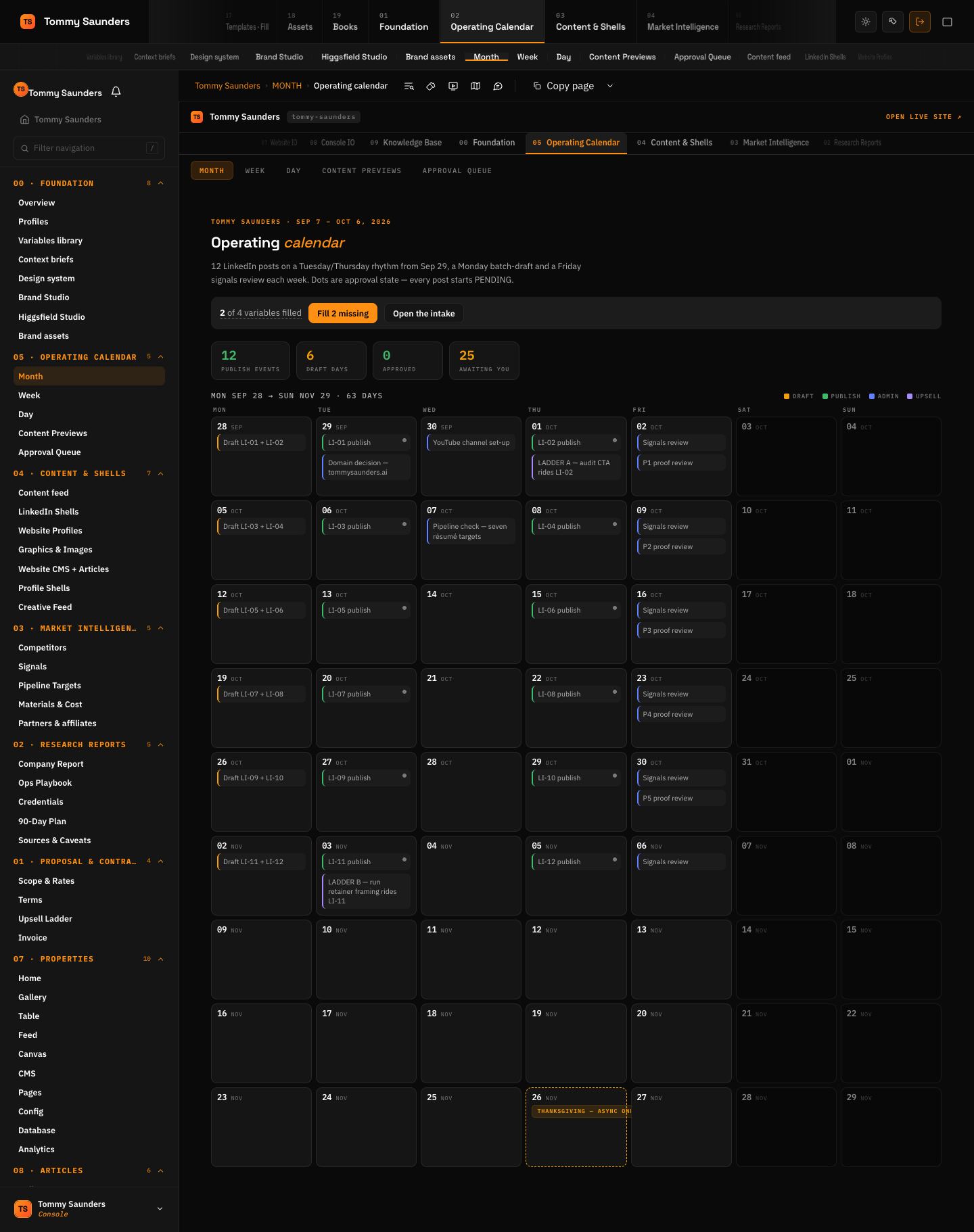
/tenant/tommy-saunders/calendar/month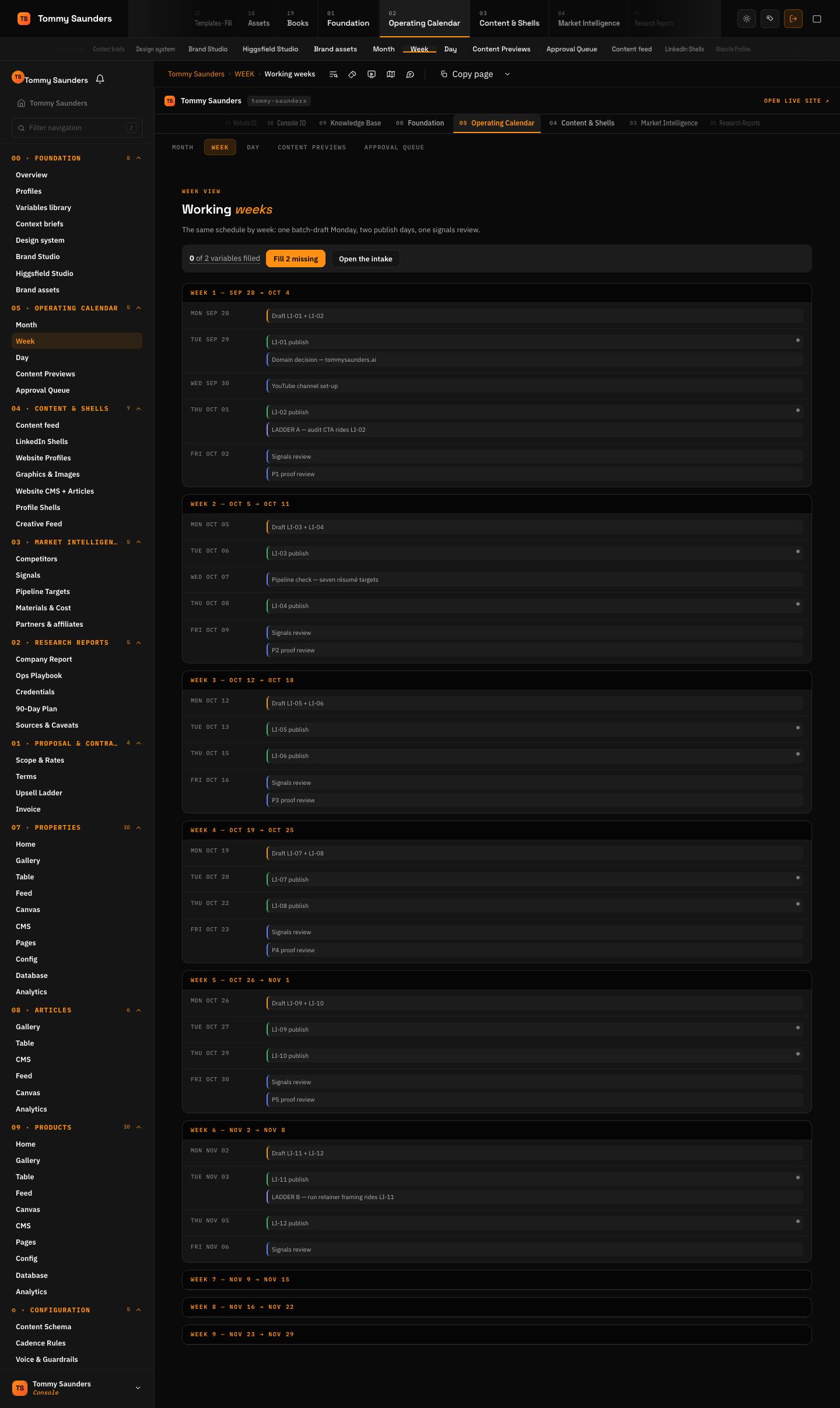
/tenant/tommy-saunders/calendar/week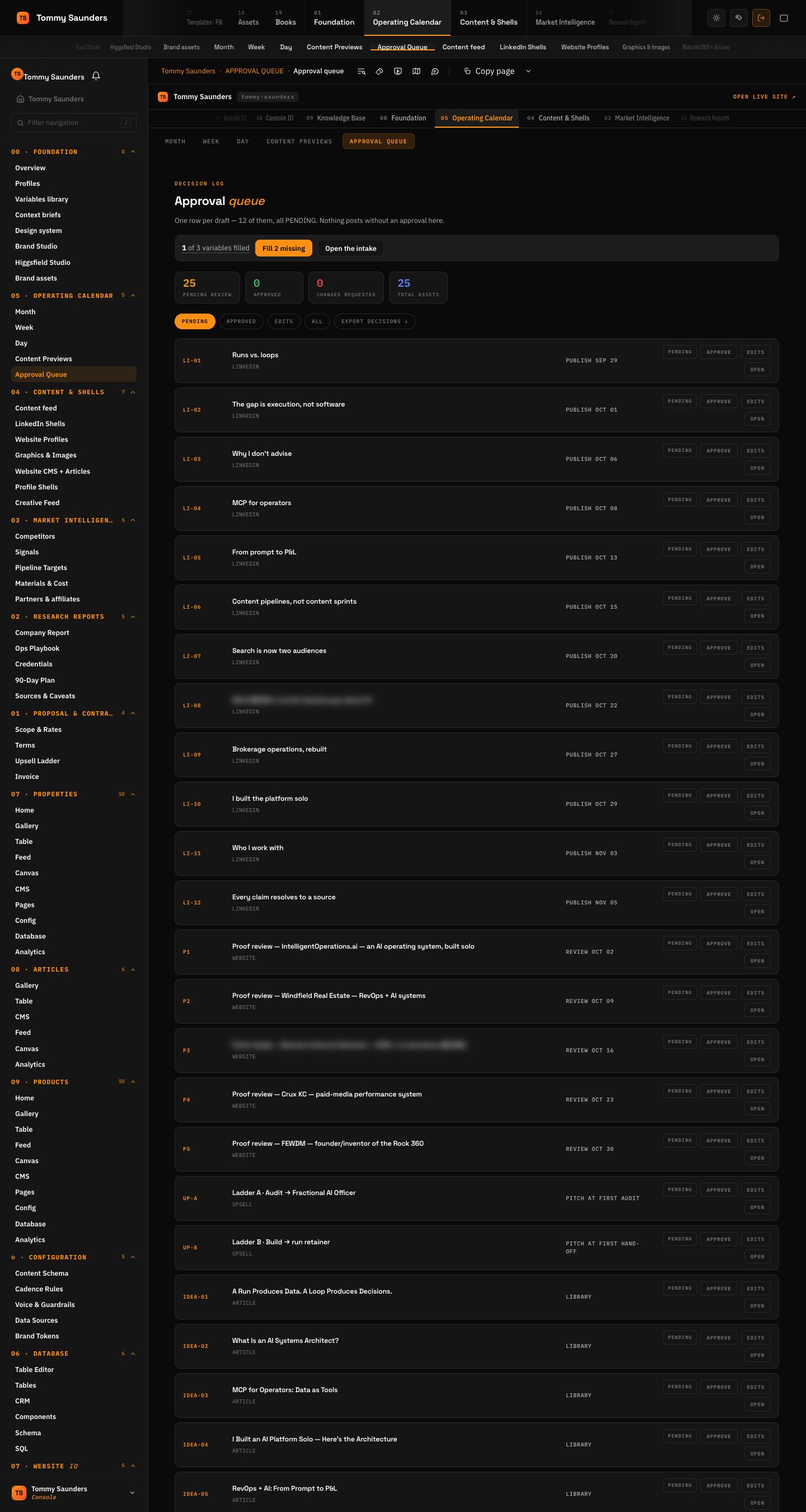
/tenant/tommy-saunders/calendar/approvals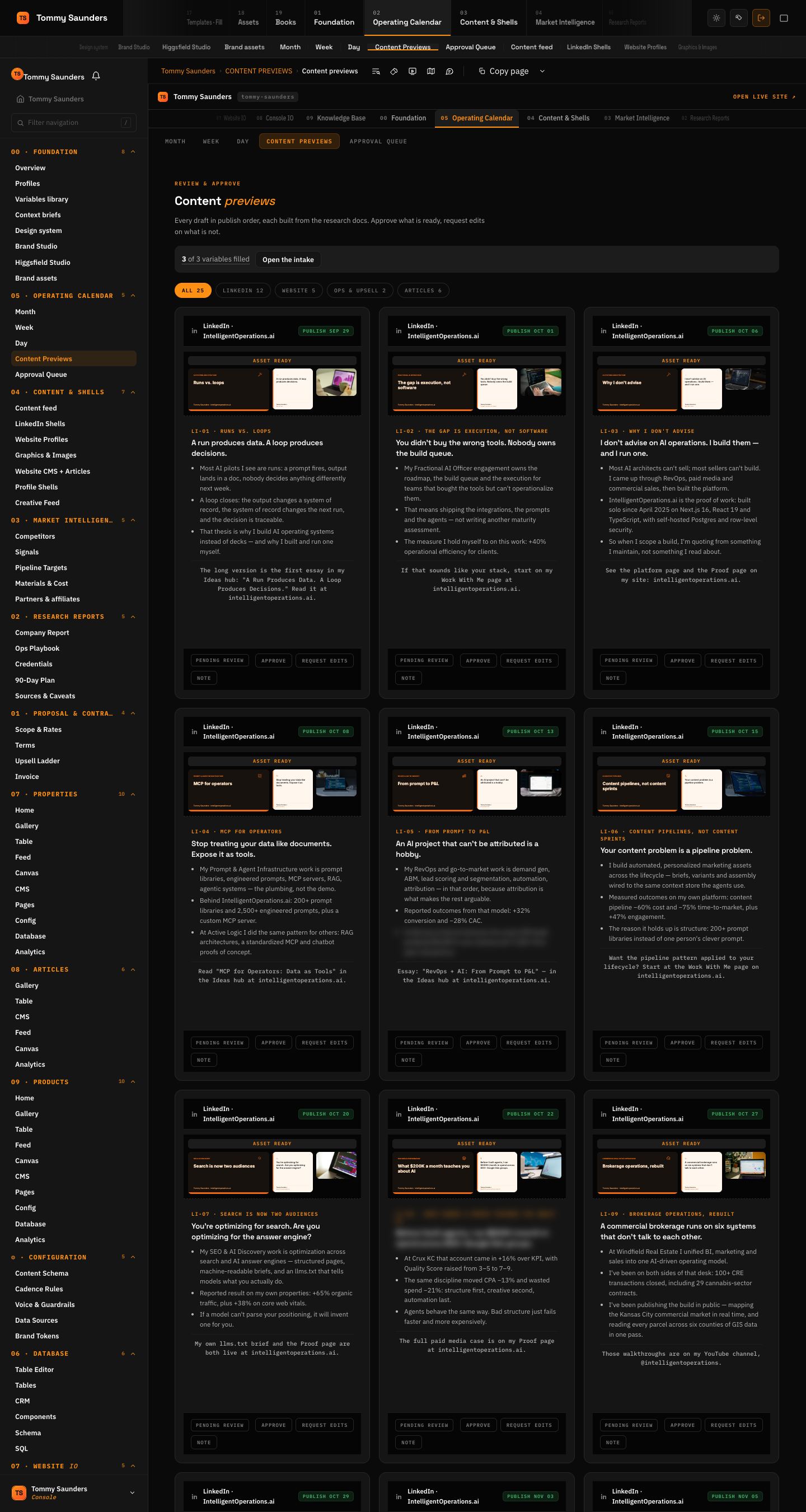
/tenant/tommy-saunders/calendar/previews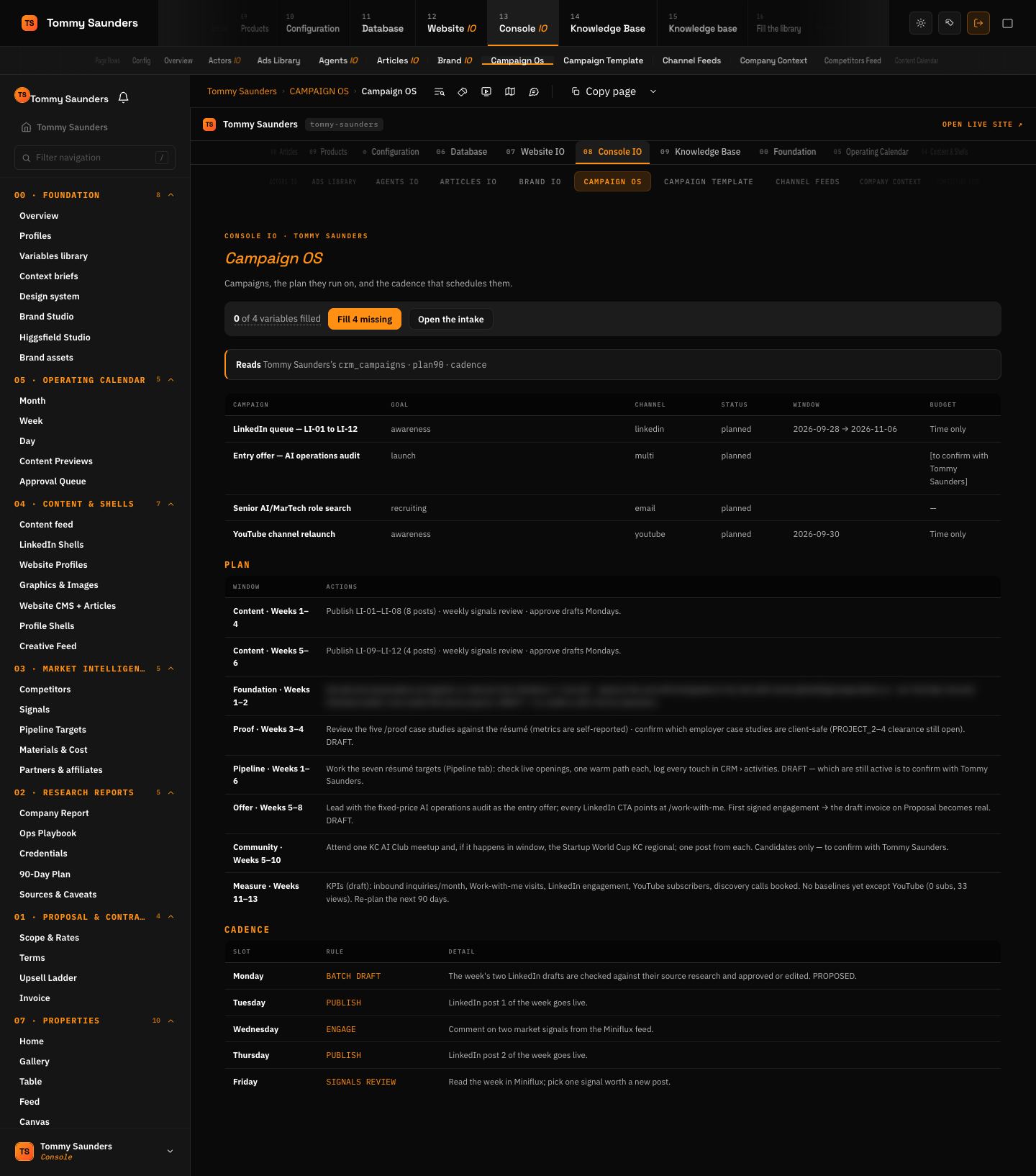
/tenant/tommy-saunders/consoles/campaign-os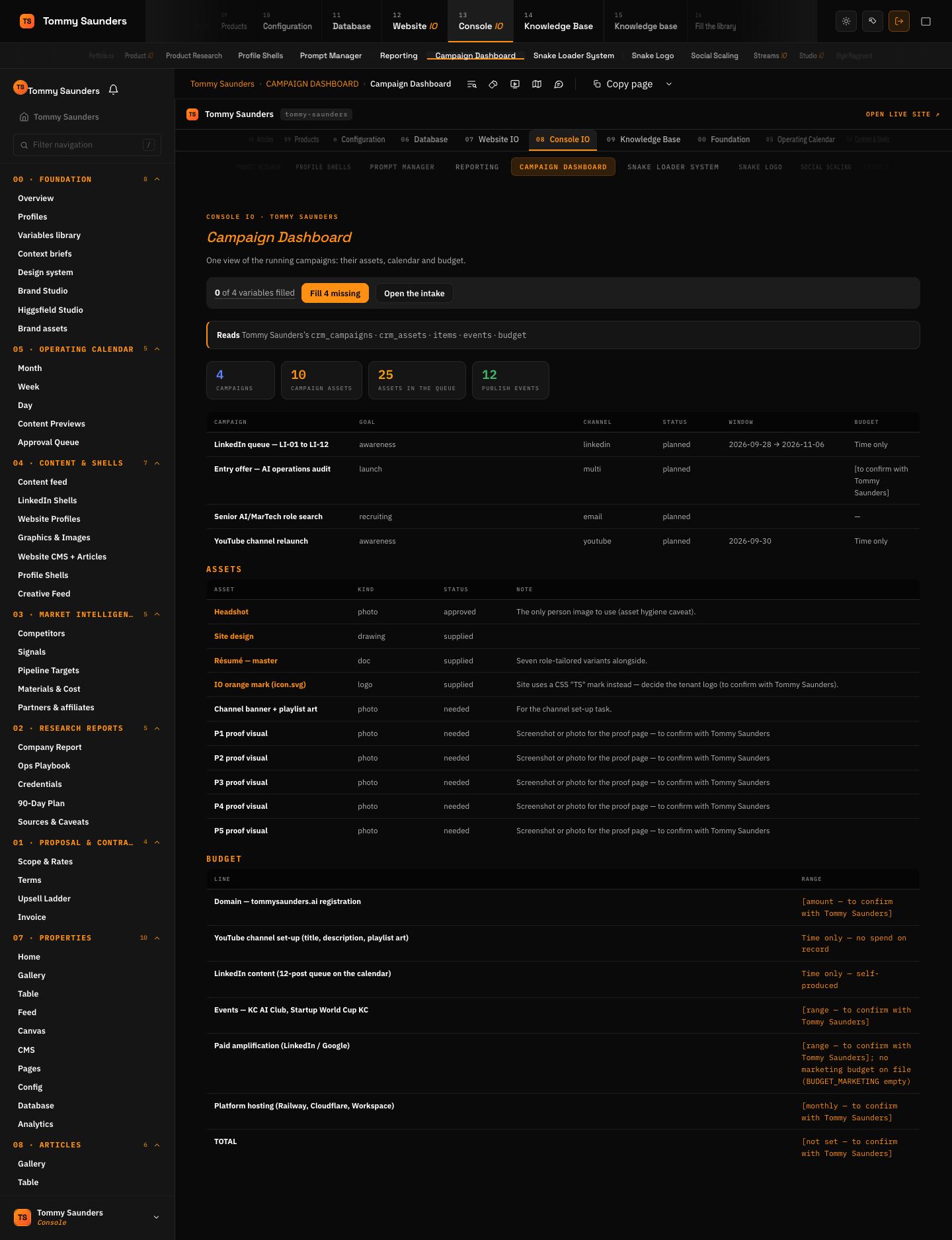
/tenant/tommy-saunders/consoles/campaign-dashboard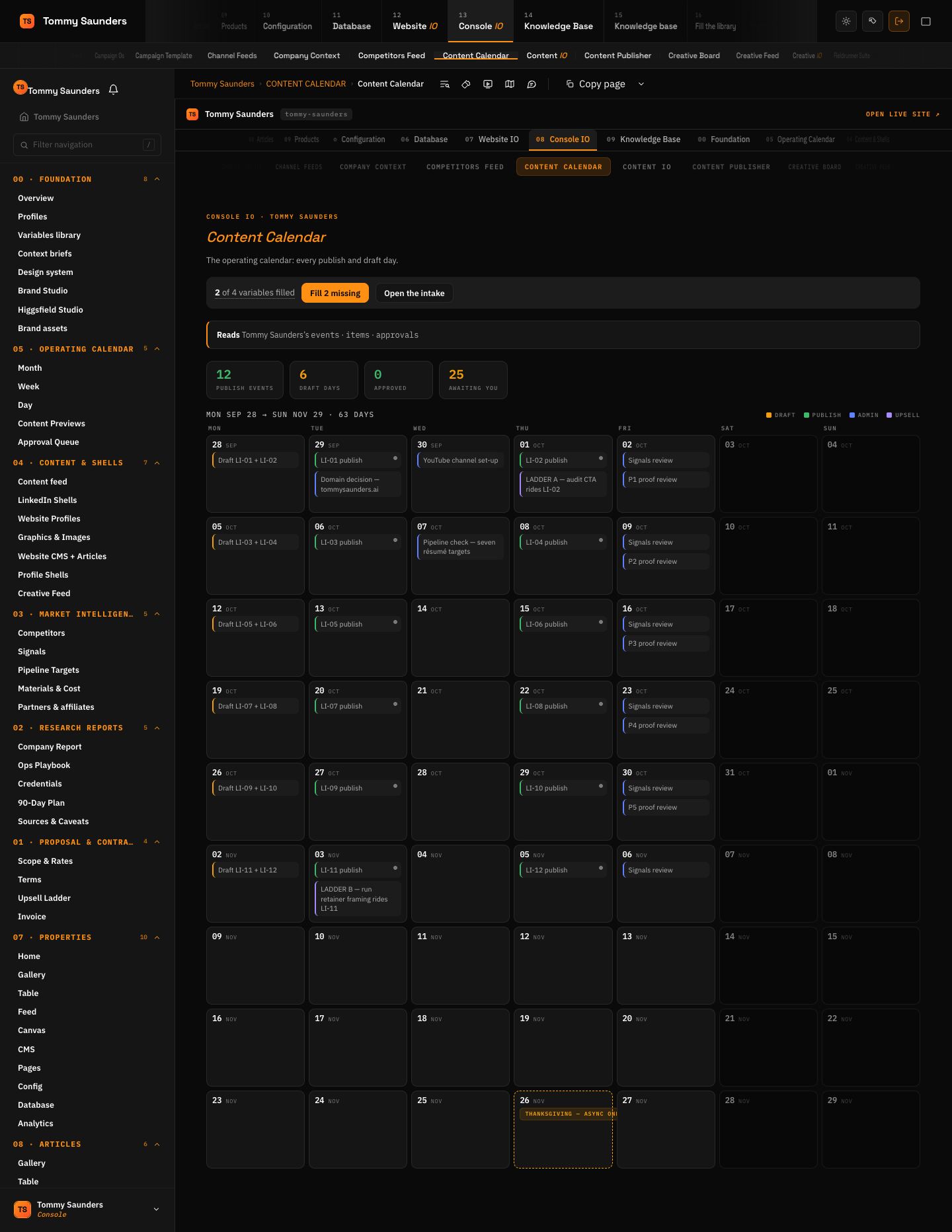
/tenant/tommy-saunders/consoles/content-calendar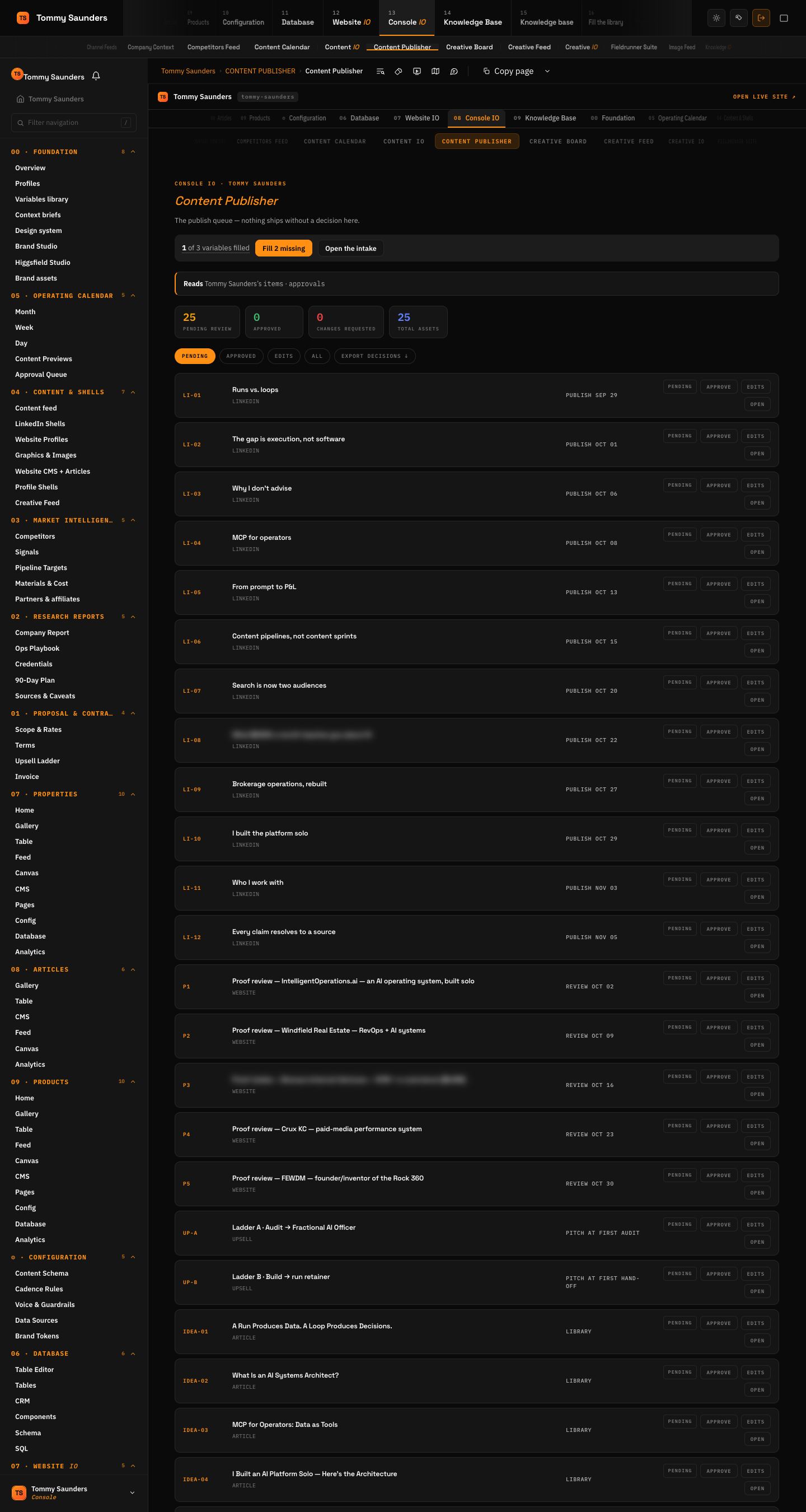
/tenant/tommy-saunders/consoles/content-publisher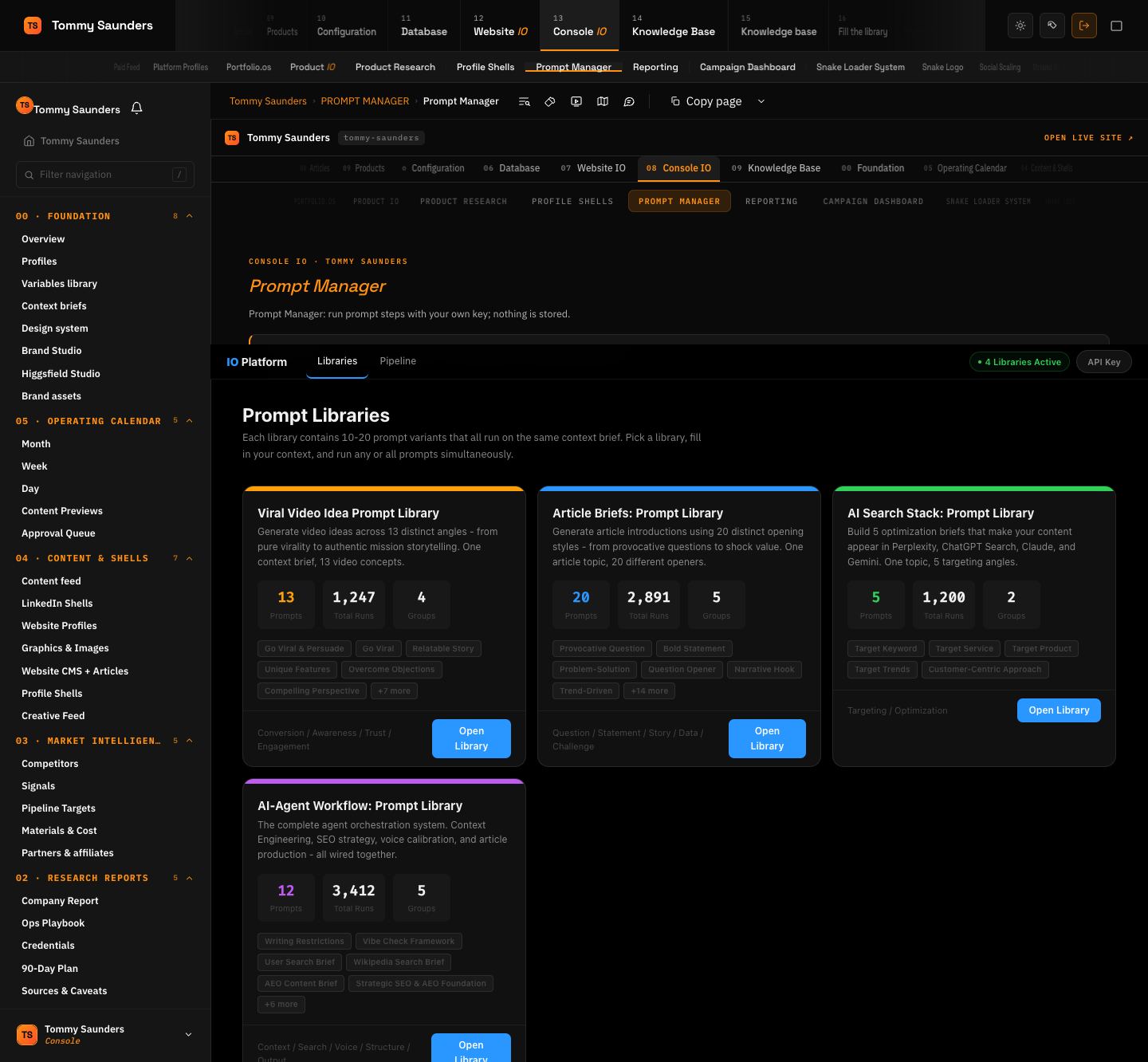
/tenant/tommy-saunders/consoles/prompt-library-workflows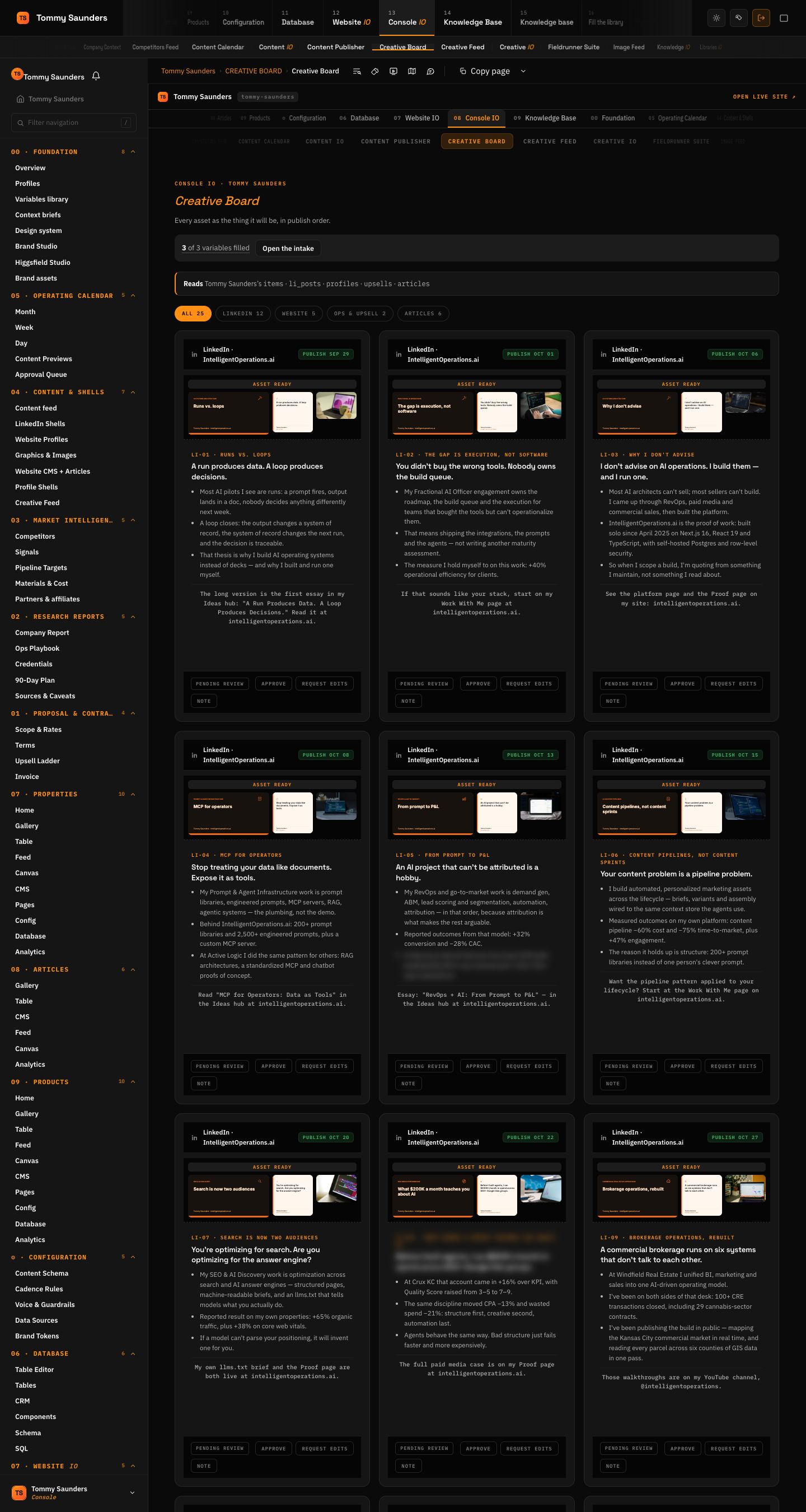
/tenant/tommy-saunders/consoles/creative-board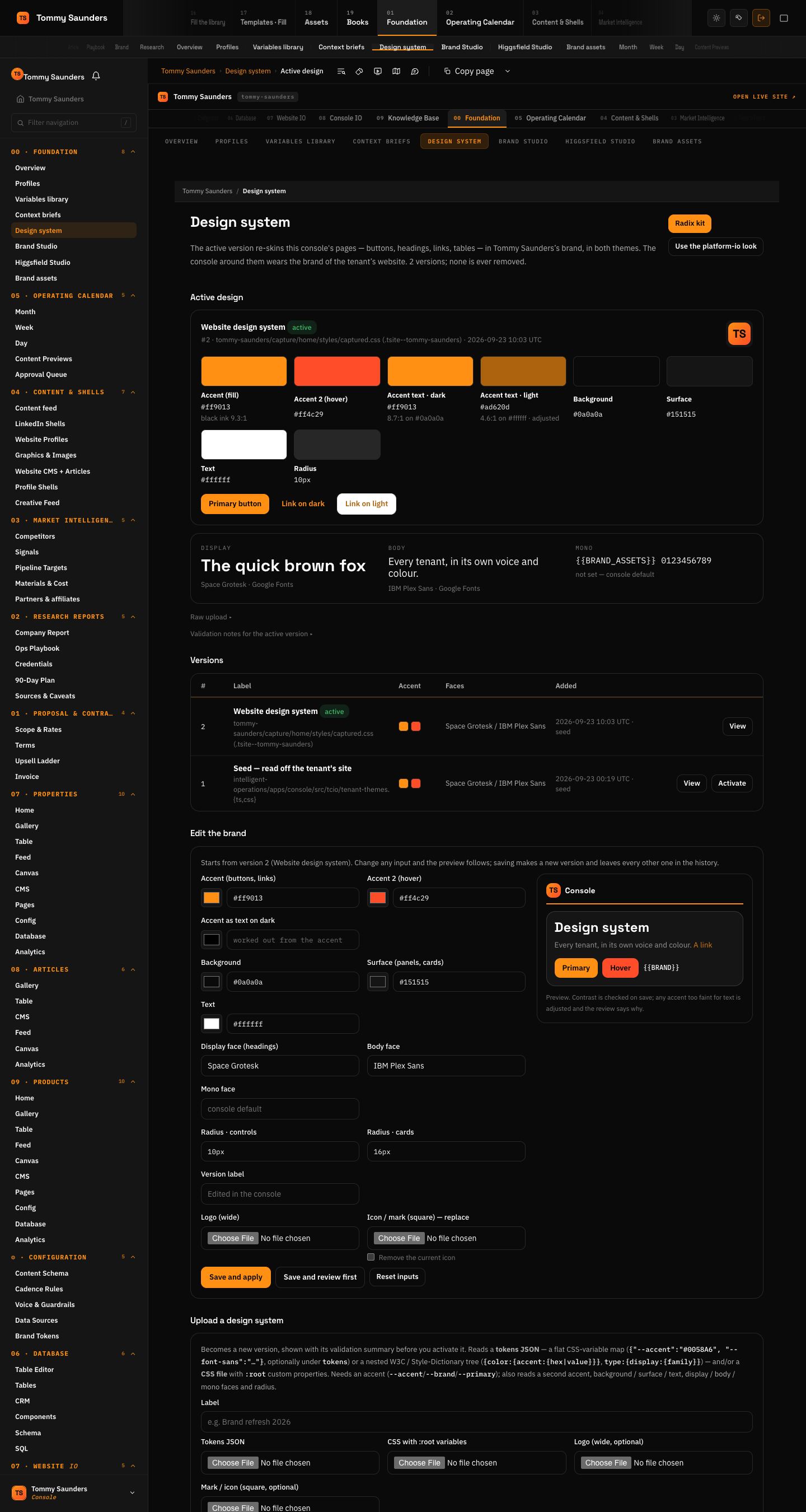
/tenant/tommy-saunders/foundation/design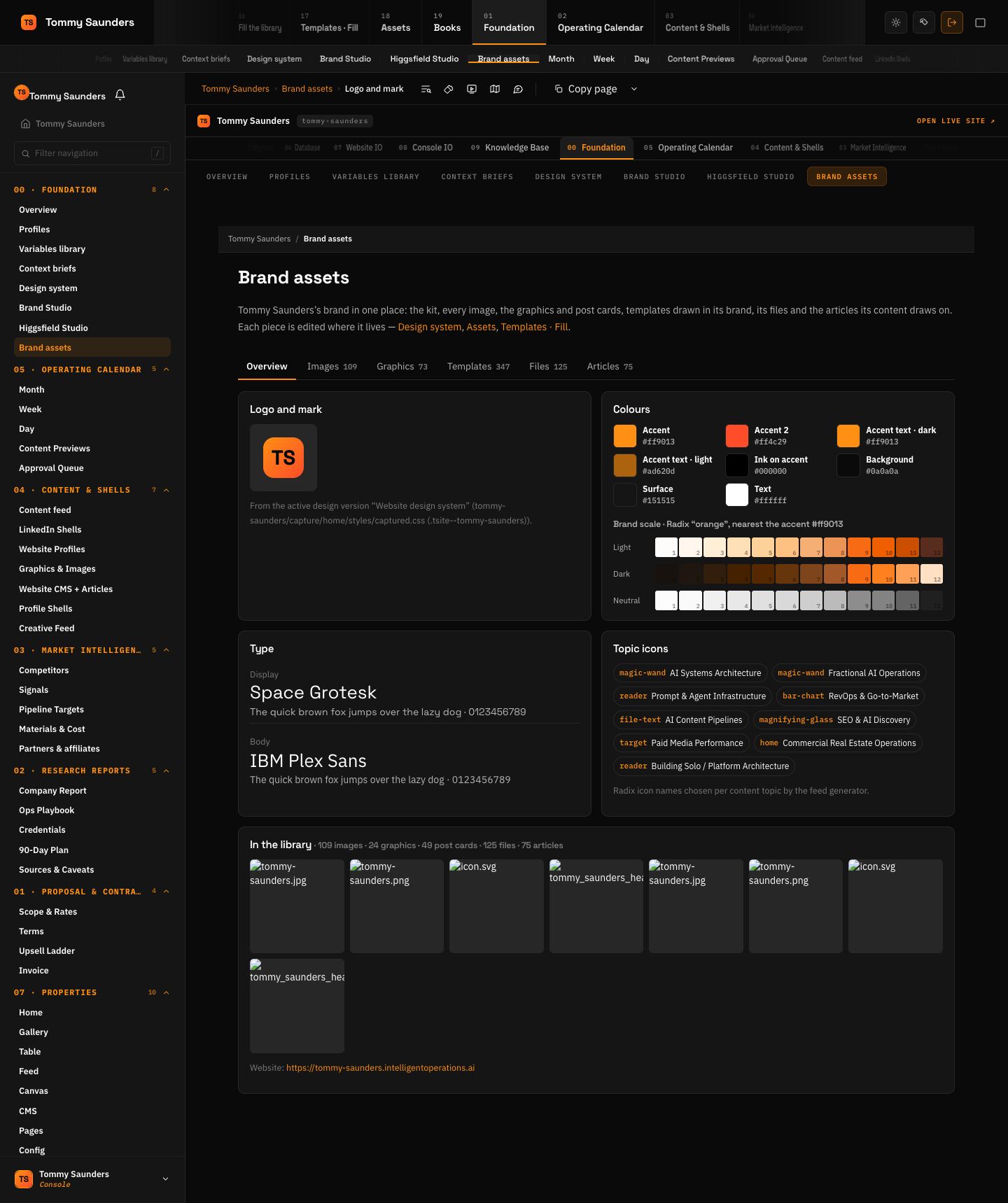
/tenant/tommy-saunders/foundation/brand-assets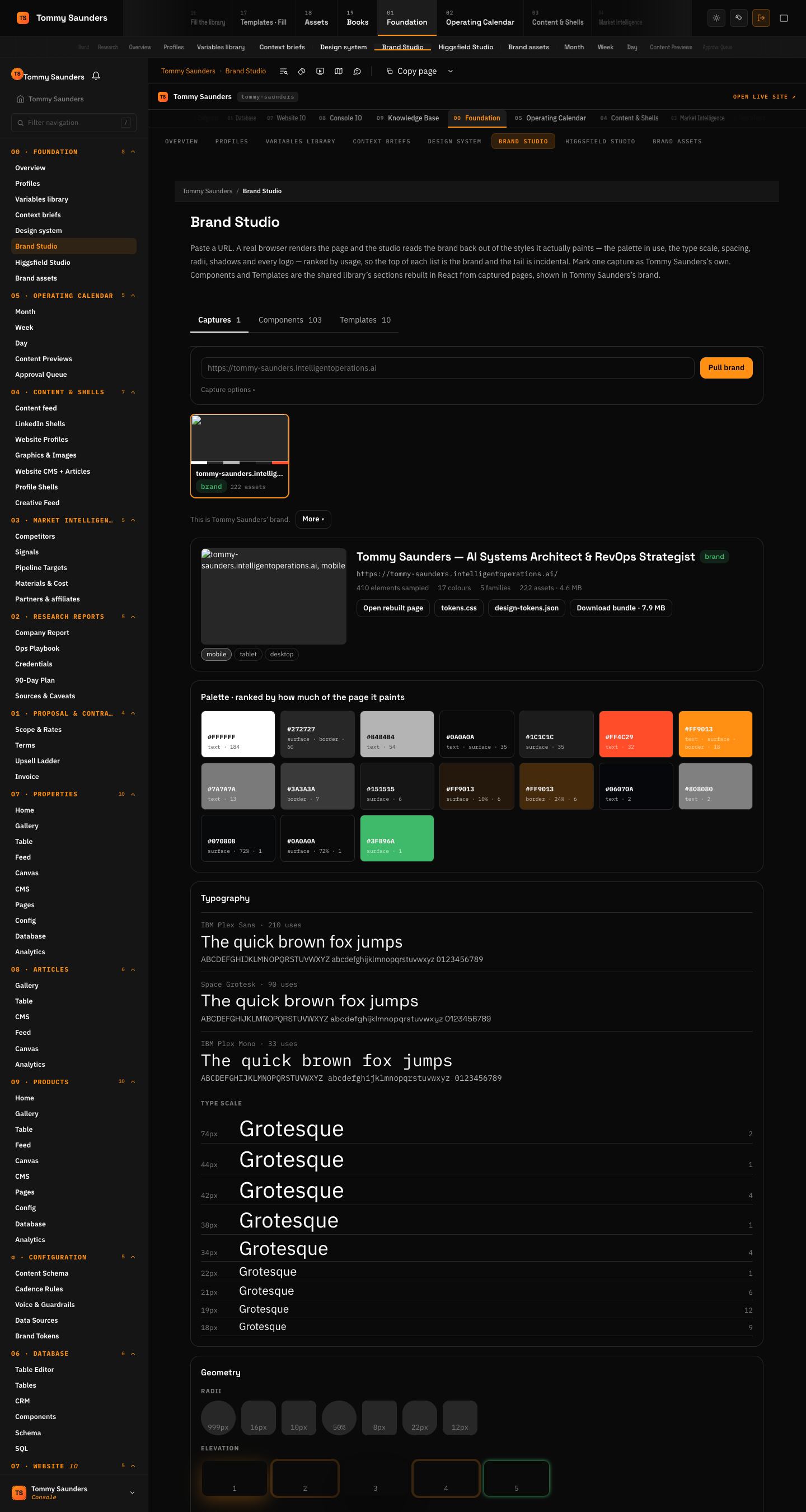
/tenant/tommy-saunders/foundation/brand-studio
/tenant/tommy-saunders/config/tokens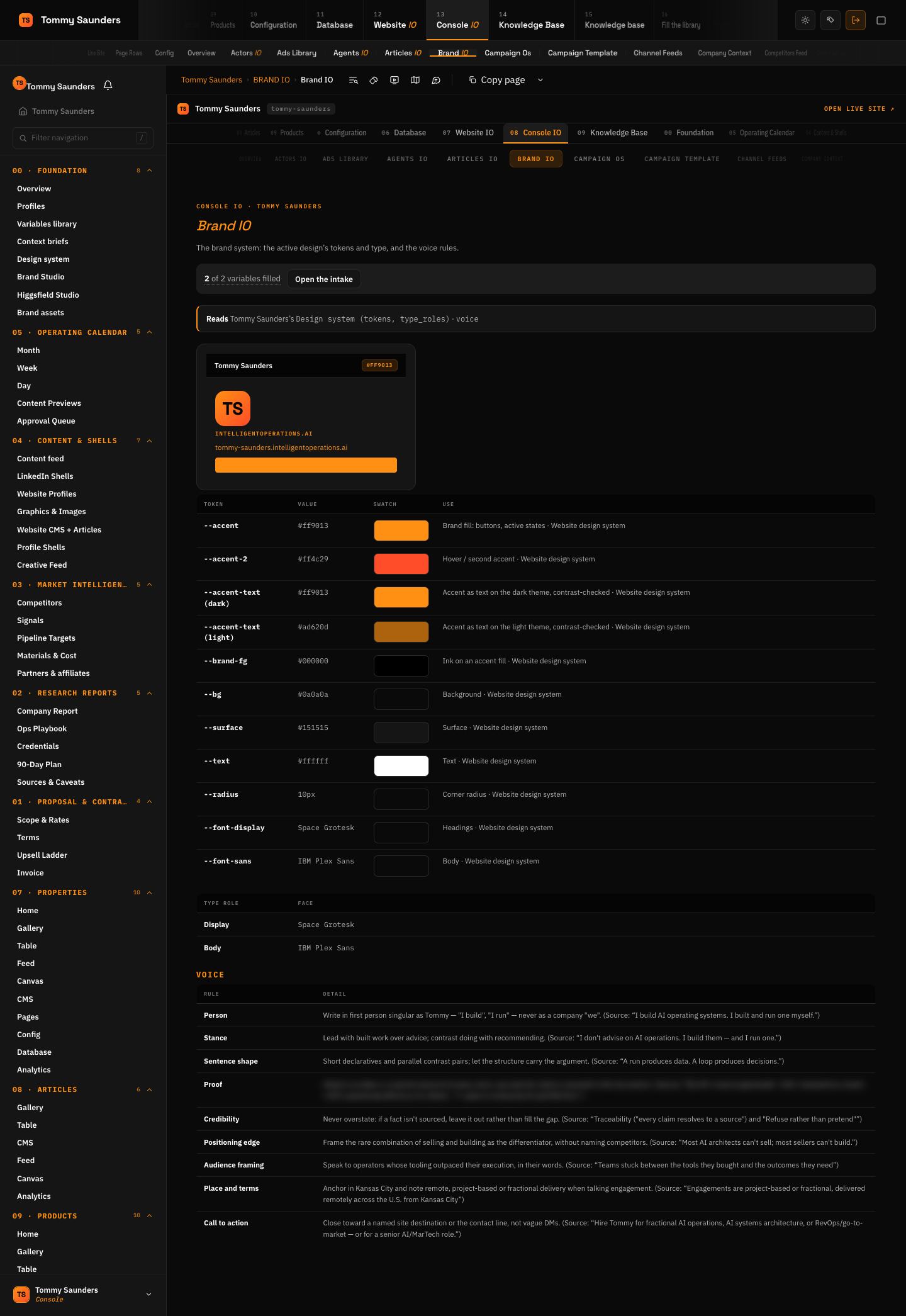
/tenant/tommy-saunders/consoles/brand-io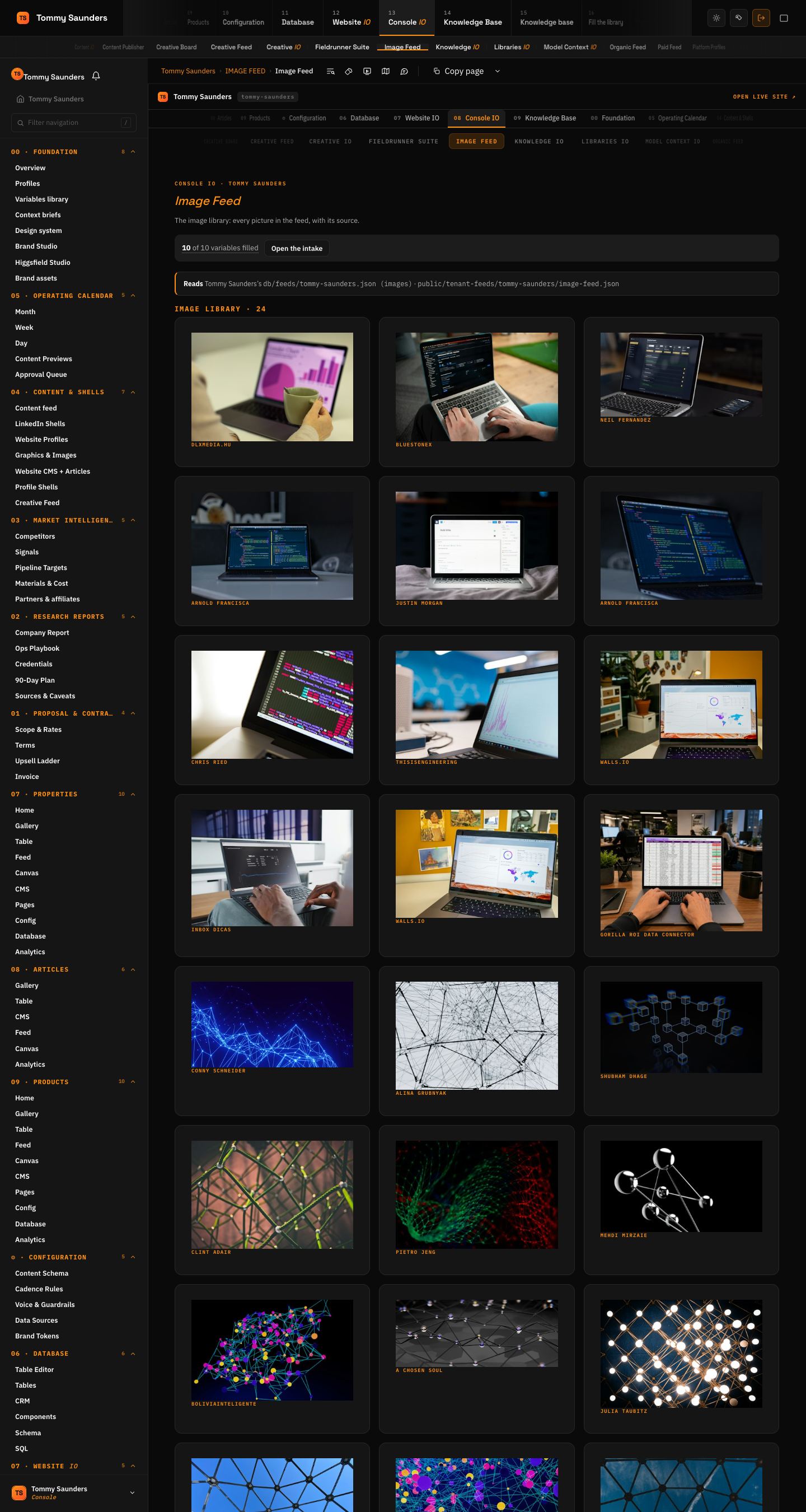
/tenant/tommy-saunders/consoles/image-feed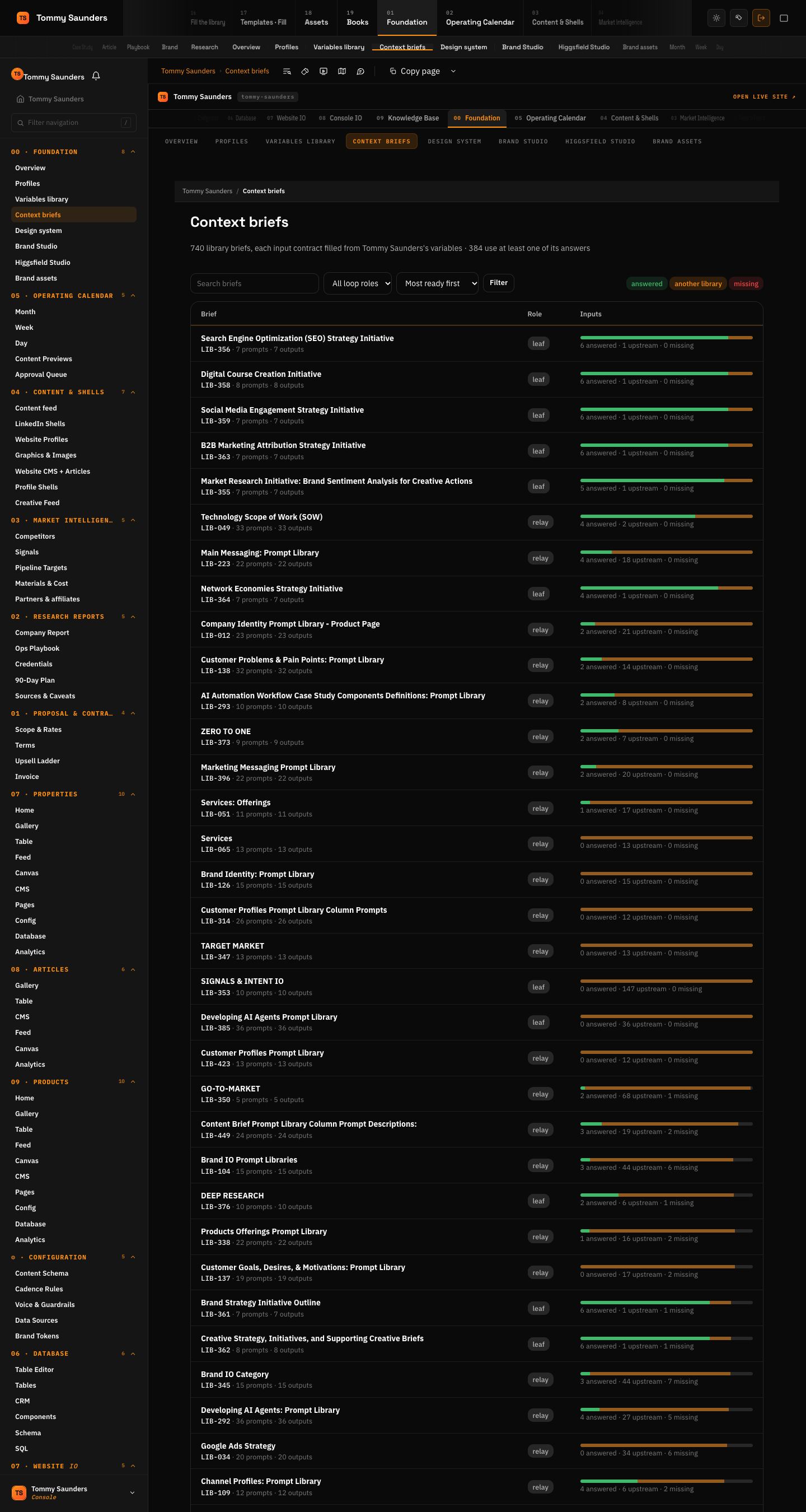
/tenant/tommy-saunders/foundation/briefs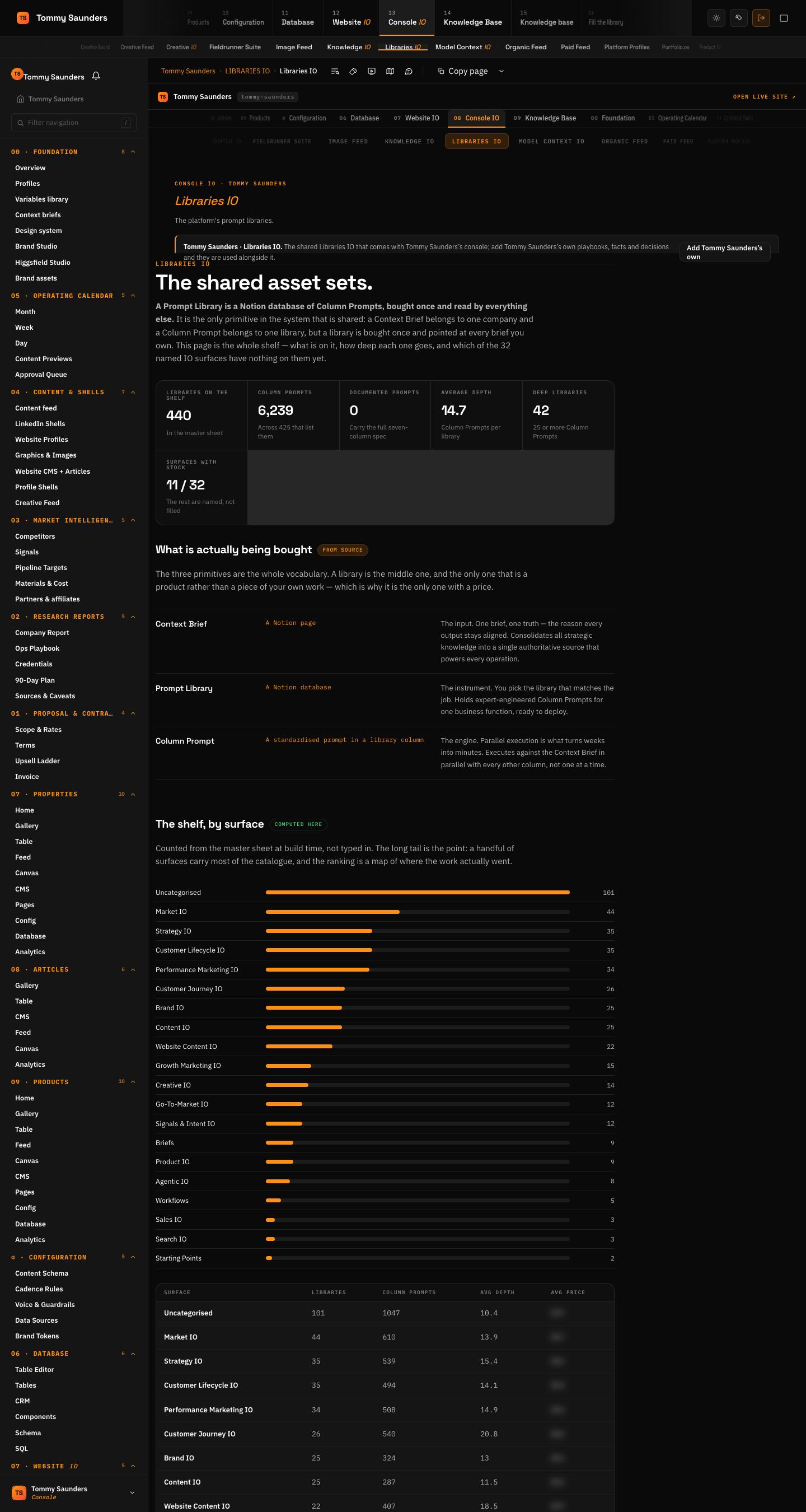
/tenant/tommy-saunders/consoles/libraries-io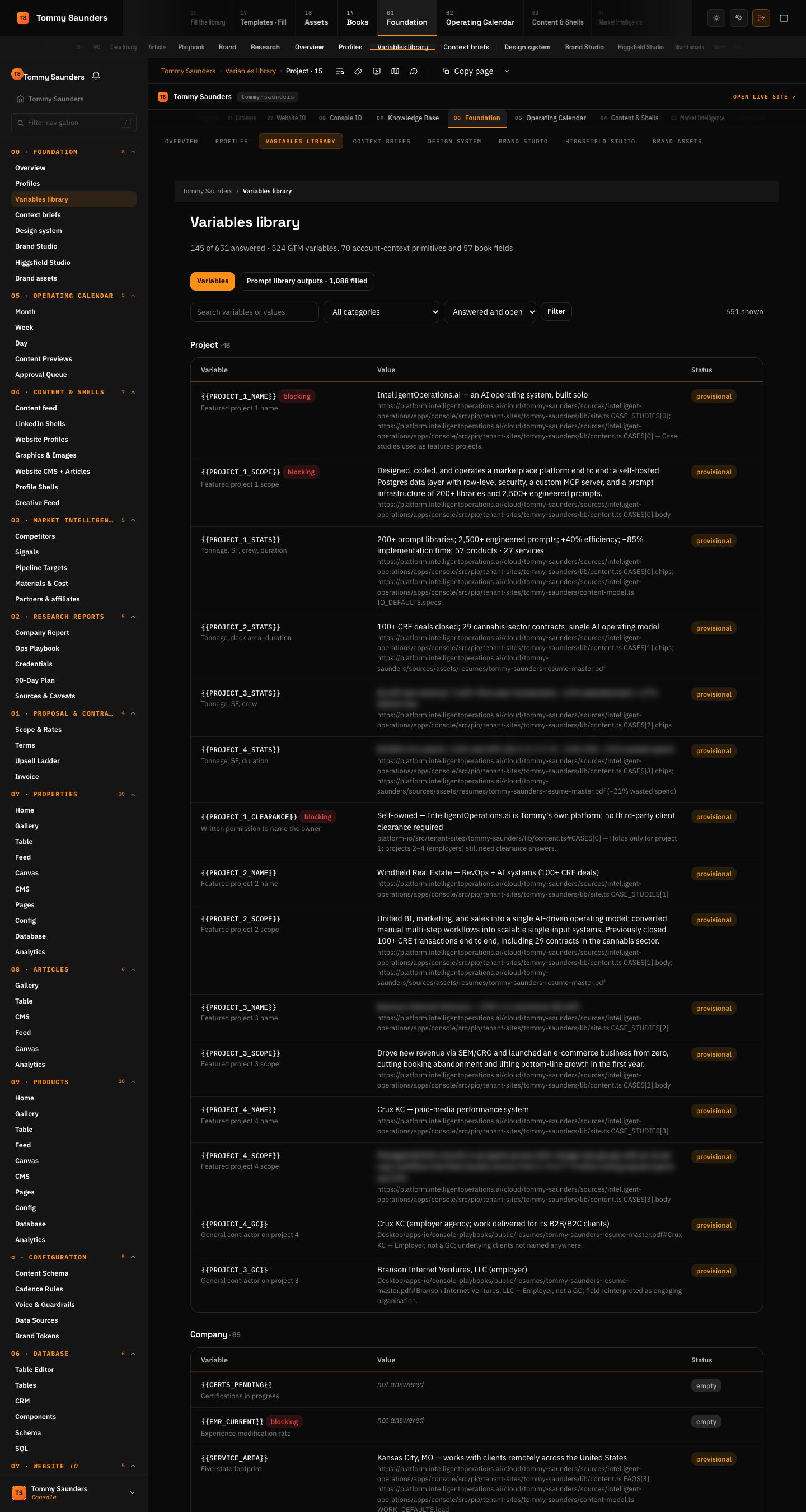
/tenant/tommy-saunders/foundation/variables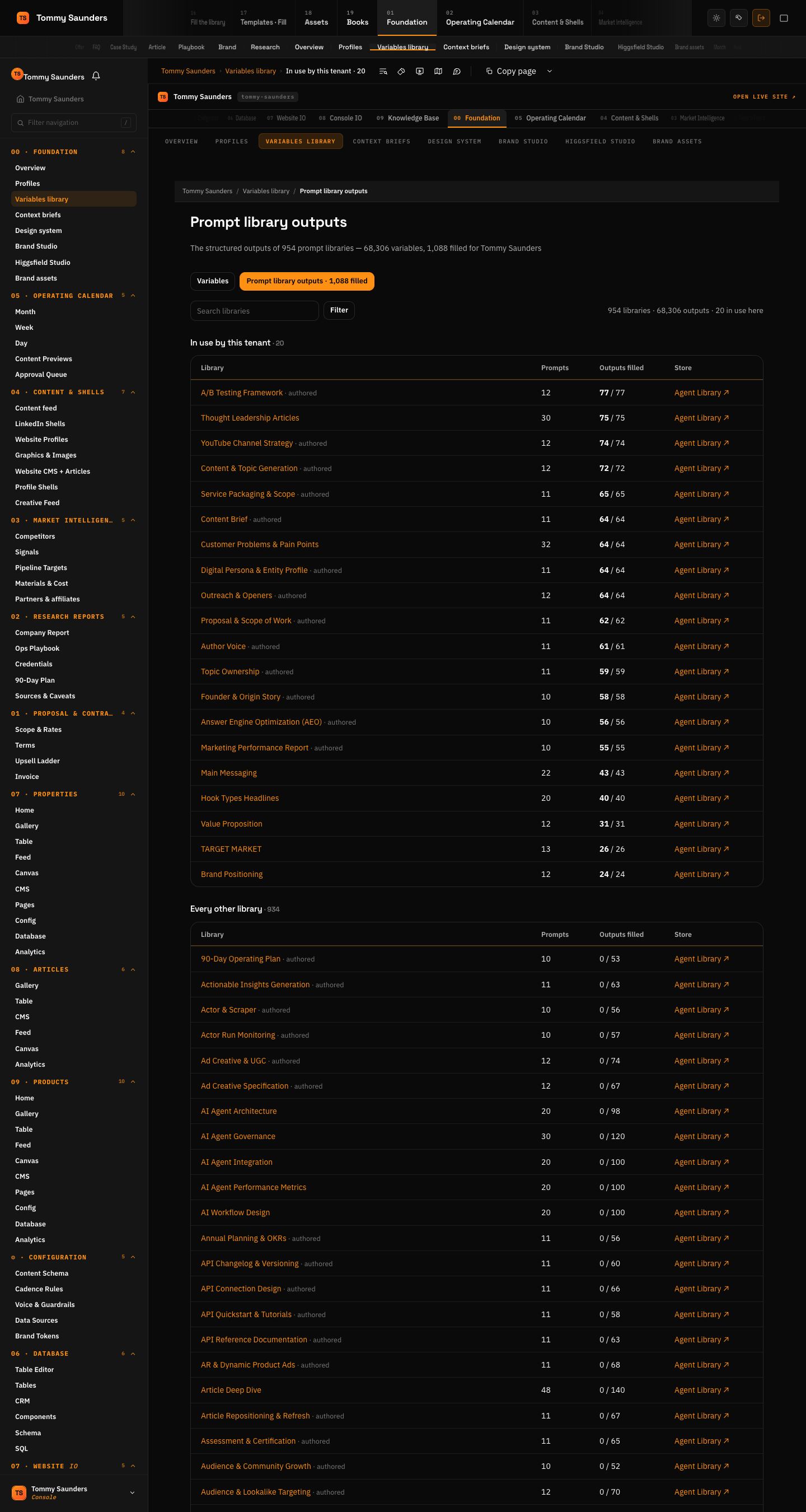
/tenant/tommy-saunders/foundation/variables?tab=outputs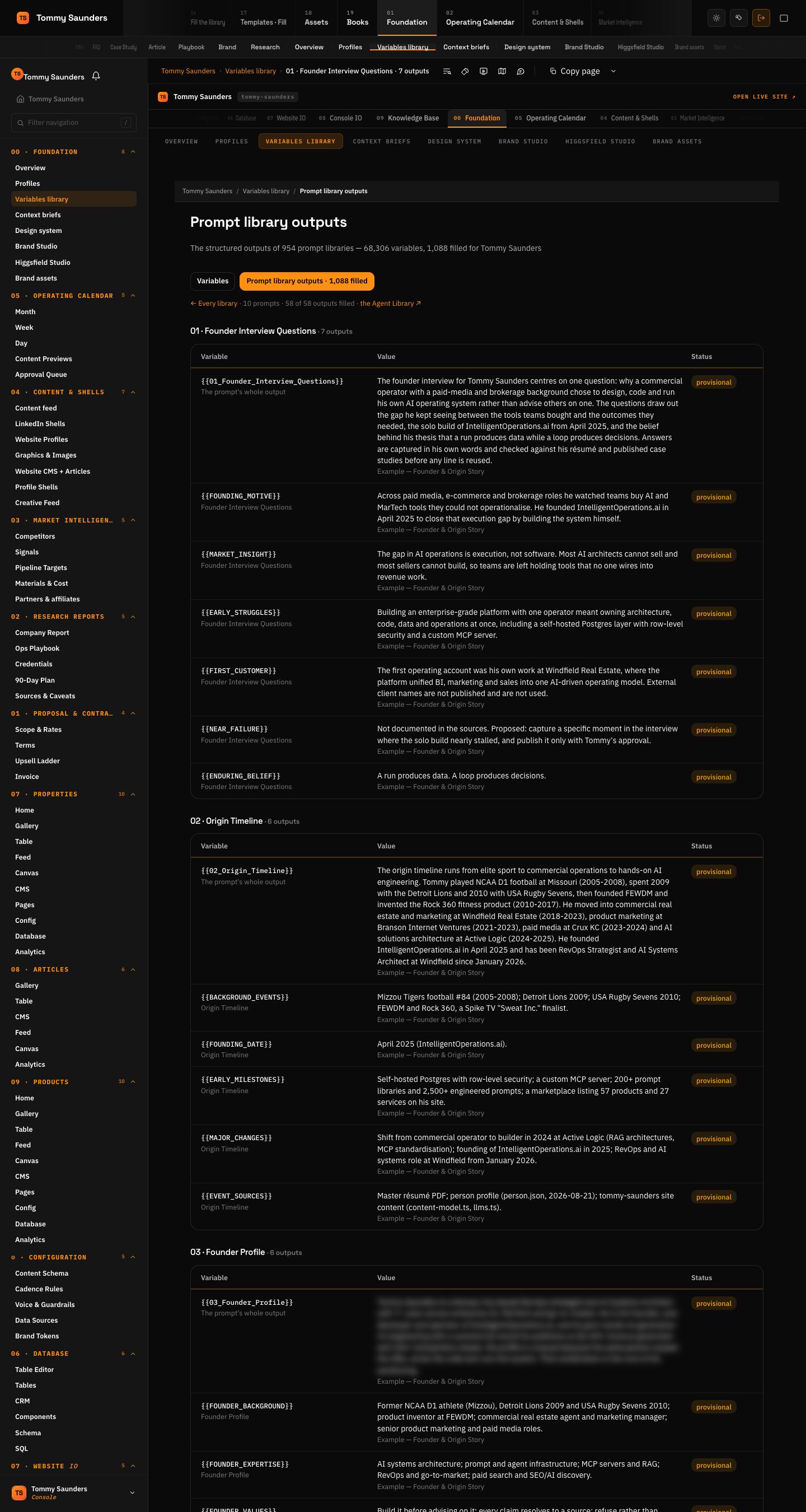
/tenant/tommy-saunders/foundation/variables?tab=outputs&lib=founder-and-origin-story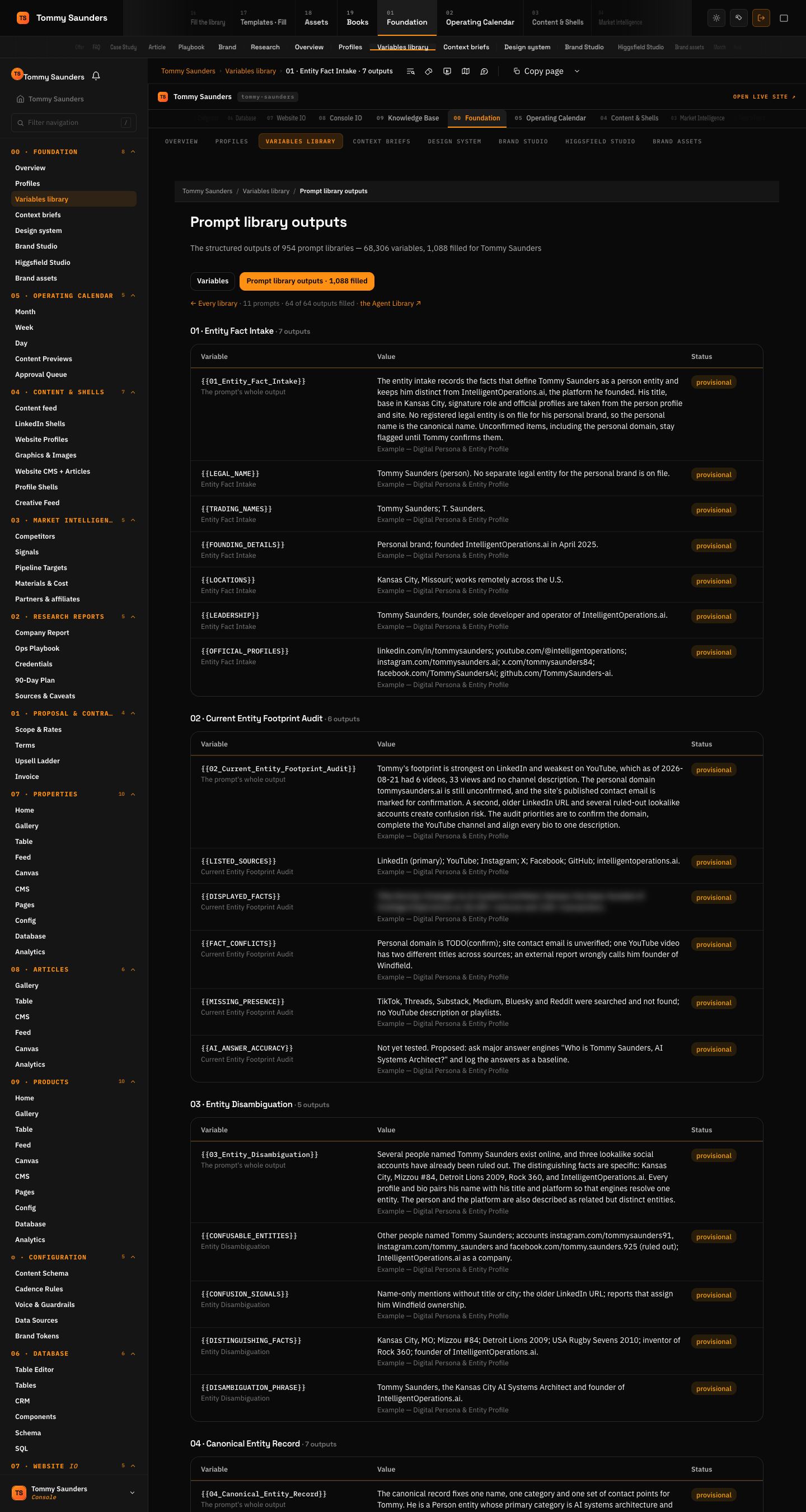
/tenant/tommy-saunders/foundation/variables?tab=outputs&lib=digital-persona-and-entity-profile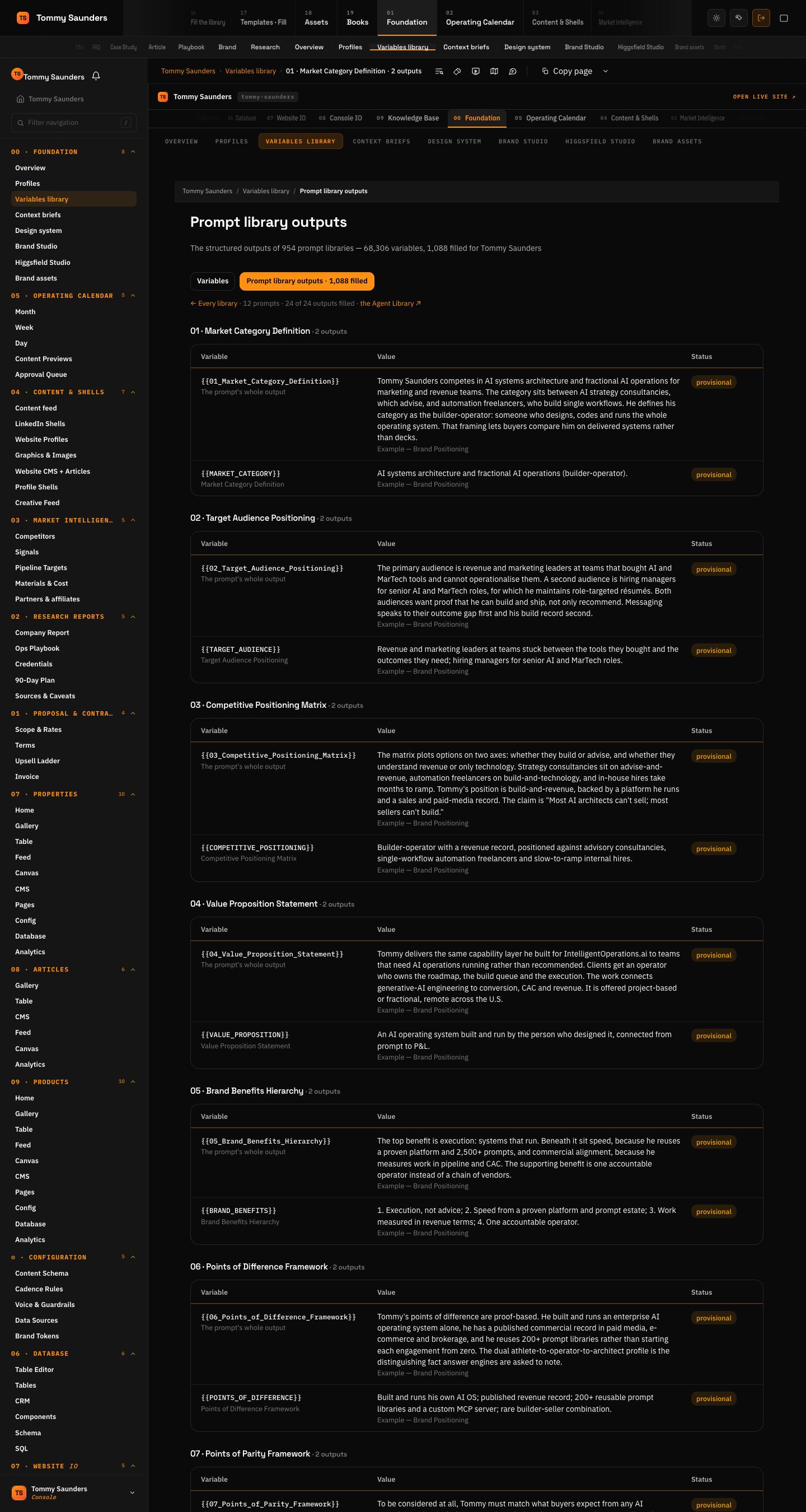
/tenant/tommy-saunders/foundation/variables?tab=outputs&lib=brand-positioning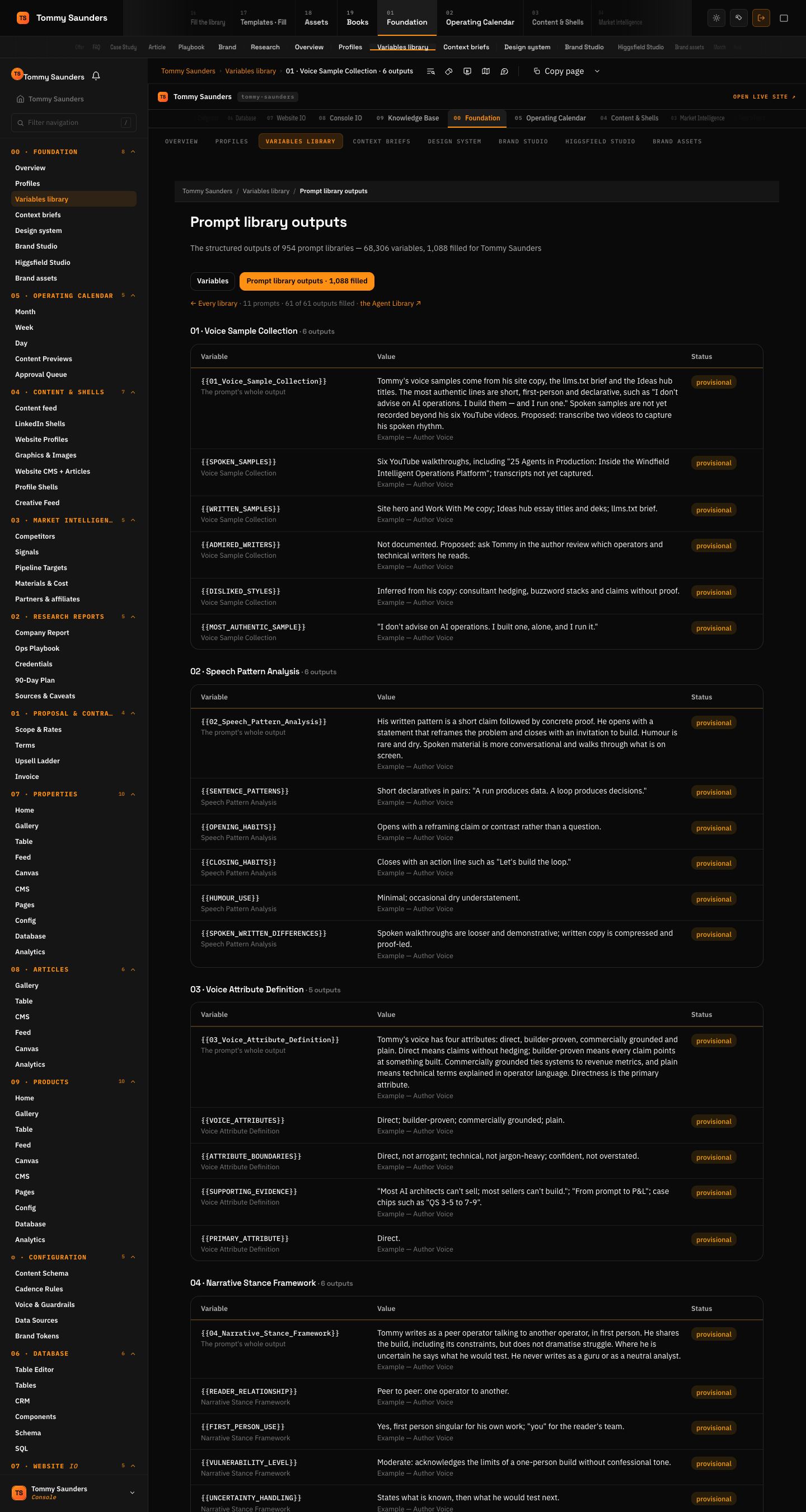
/tenant/tommy-saunders/foundation/variables?tab=outputs&lib=author-voice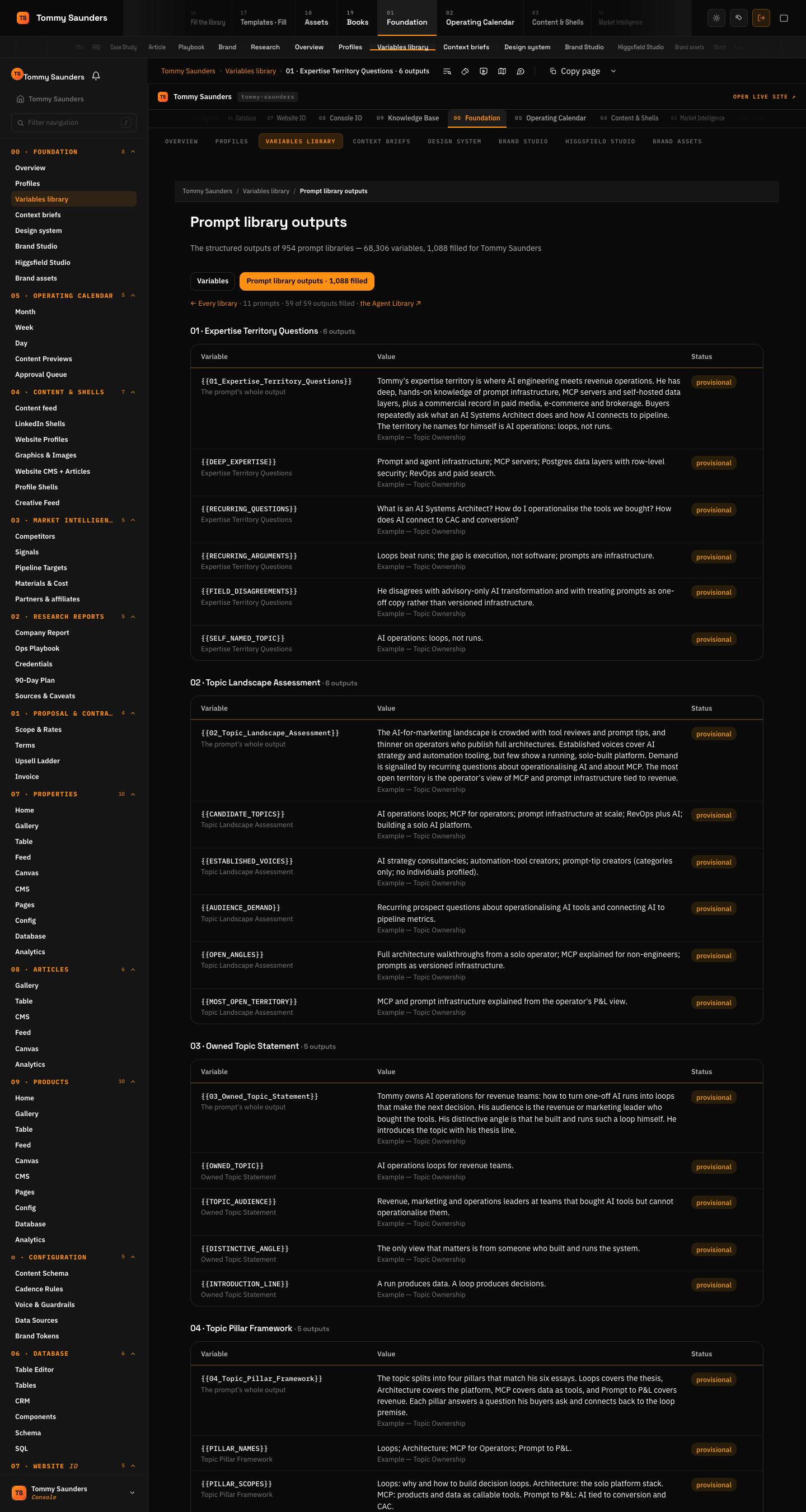
/tenant/tommy-saunders/foundation/variables?tab=outputs&lib=topic-ownership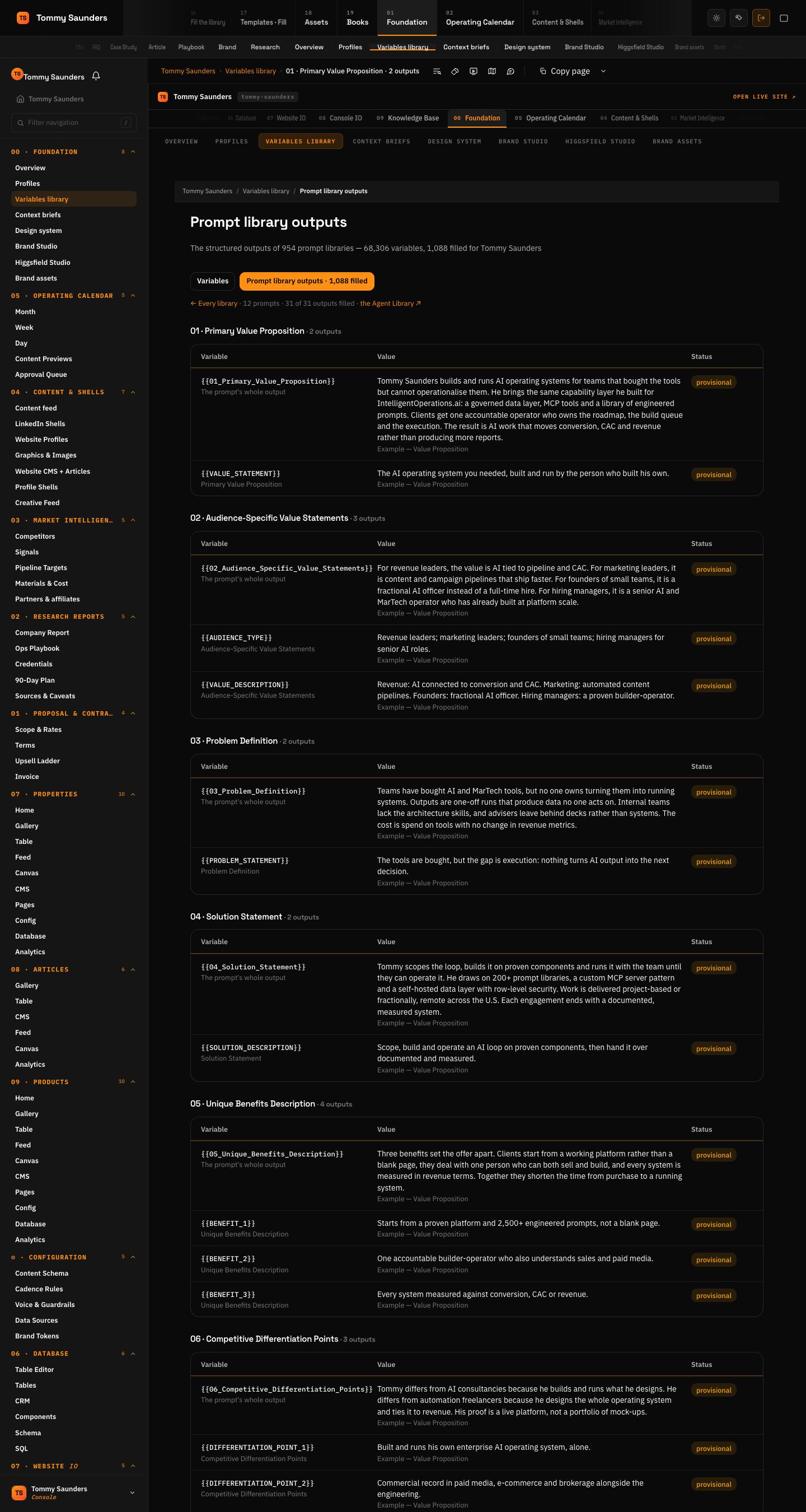
/tenant/tommy-saunders/foundation/variables?tab=outputs&lib=value-proposition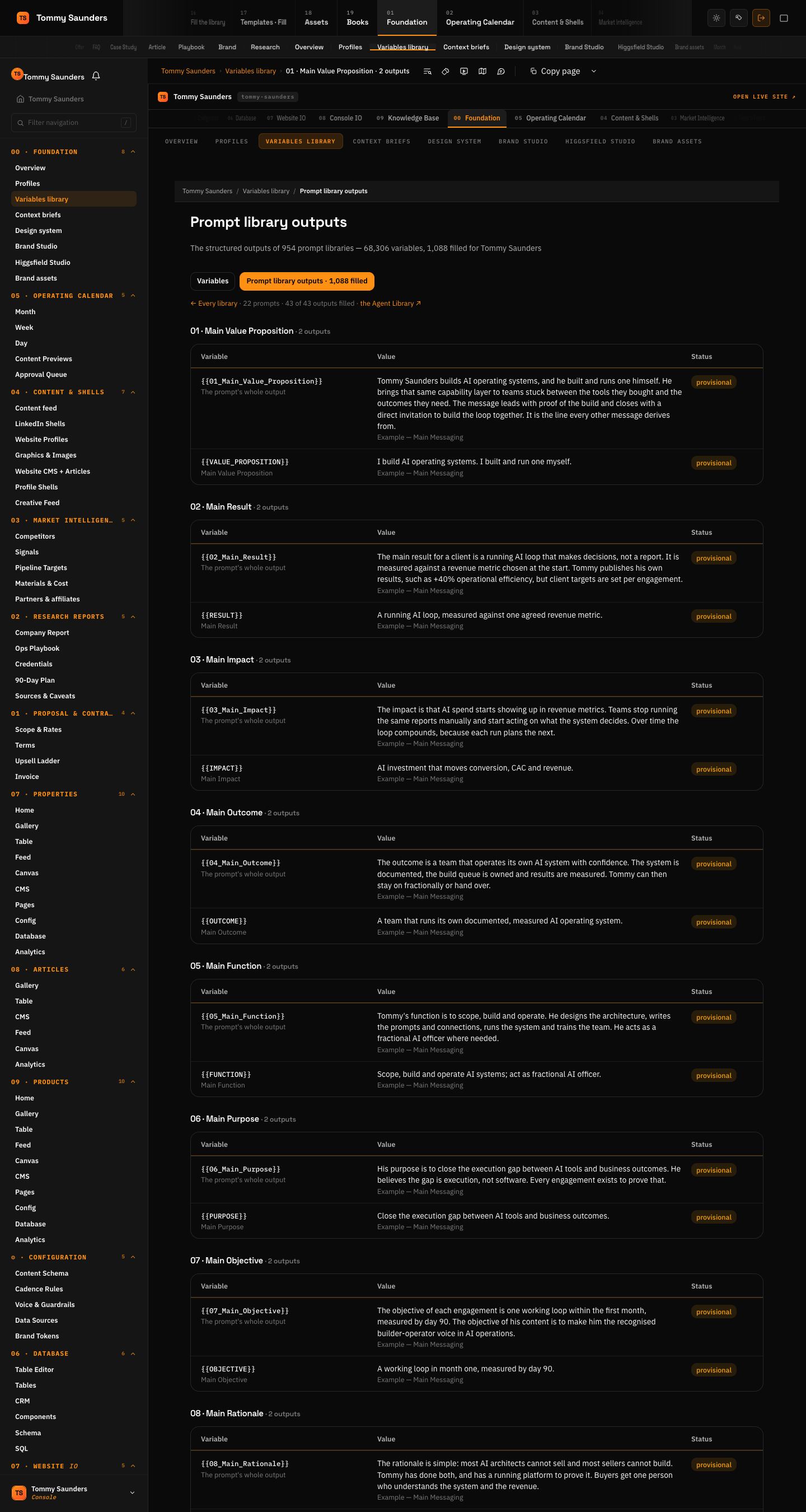
/tenant/tommy-saunders/foundation/variables?tab=outputs&lib=main-messaging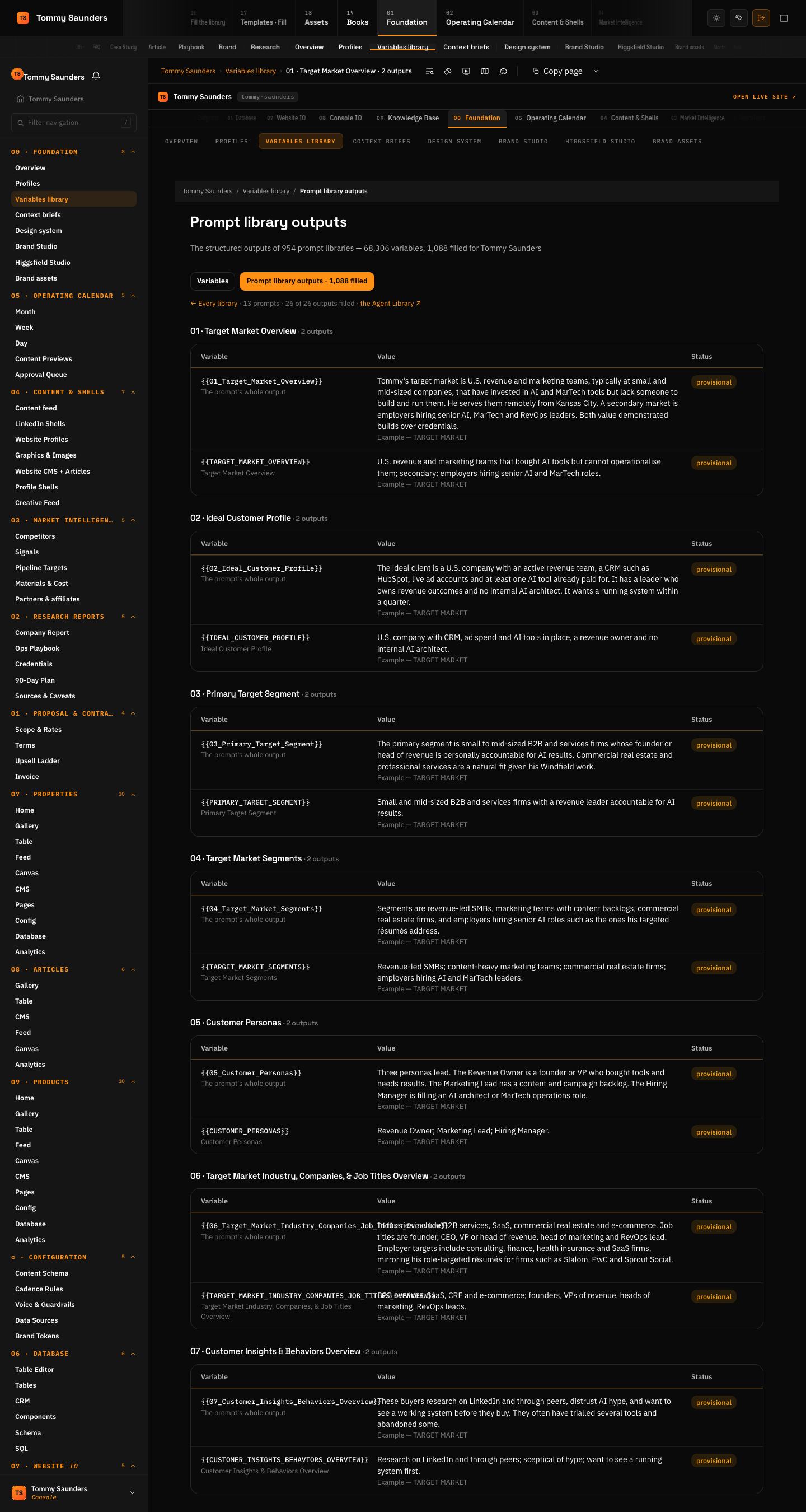
/tenant/tommy-saunders/foundation/variables?tab=outputs&lib=target-market-2#ff9013


His positioning rests on the athlete-to-operator-to-builder story and the solo build of IntelligentOperations.ai.
- Founder Interview Questions
- Origin Timeline
- Founder Profile
- Story Arc
- Story Truth Standards
- Signature Origin Story
- Short-Form Versions
- Founder Bio Set
- Story Resonance Review
- Story Deployment Map
He must be resolved as one entity, distinct from namesakes and from the IO platform, with an unconfirmed domain to fix.
- Entity Fact Intake
- Current Entity Footprint Audit
- Entity Disambiguation
- Canonical Entity Record
- Entity Description Set
- Identifier and Profile Register
- Entity Relationship Map
- Structured Data Specification
- Answer-Ready Fact Pages
- Consistency Validation
- Entity Maintenance Process
He needs a clear builder-operator position against advisory consultancies and automation freelancers.
- Market Category Definition
- Target Audience Positioning
- Competitive Positioning Matrix
- Value Proposition Statement
- Brand Benefits Hierarchy
- Points of Difference Framework
- Points of Parity Framework
- Brand Promise Statement
- Positioning Statement Structure
- Positioning Testing Framework
- Positioning Evolution Timeline
- Category Disruption Strategy
His essays, posts and site copy all depend on a consistent, direct first-person voice.
- Voice Sample Collection
- Speech Pattern Analysis
- Voice Attribute Definition
- Narrative Stance Framework
- Signature Vocabulary List
- Sentence Rhythm Rules
- Voice Do And Avoid Guide
- Sample Passage Rewrite
- Author Review Questions
- Voice Match Scoring
- Voice Guide Summary
He is building authority on AI operations loops through the Ideas hub and YouTube.
- Expertise Territory Questions
- Topic Landscape Assessment
- Owned Topic Statement
- Topic Pillar Framework
- Point Of View Positions
- Subtopic Question Map
- Signature Framework Concept
- Content Anchor Plan
- Topic Boundary Rules
- Authority Signal Measures
- Topic Ownership Summary
Work With Me and outreach need one sharp statement of what hiring him delivers.
- Primary Value Proposition
- Audience-Specific Value Statements
- Problem Definition
- Solution Statement
- Unique Benefits Description
- Competitive Differentiation Points
- Evidence and Proof Points
- Value Quantification Framework
- Emotional Value Components
- Rational Value Components
- Value Delivery Timeline
- Value Proposition Testing Framework
Every bio, headline and page derives from the same core messages.
- Main Value Proposition
- Main Result
- Main Impact
- Main Outcome
- Main Function
- Main Purpose
- Main Objective
- Main Rationale
- Main Use Case
- Main Hook
- Main Jobs to Be Done
- Main User Story
- Main Benefit
- Main Feature
- One-liner
- Summary
- Description
- Overview
- Synopsis
- Excerpt
- Definition
- Explanation
He serves two audiences, clients and employers, and needs them defined.
- Target Market Overview
- Ideal Customer Profile
- Primary Target Segment
- Target Market Segments
- Customer Personas
- Target Market Industry, Companies, & Job Titles Overview
- Customer Insights & Behaviors Overview
- Customer Goals, Desires, & Motivations Overview
- Customer Communication & Engagement Overview
- Customer Problems & Pain Points Overview
- Customer Personalities & Archetypes Overview
- Customer Transformation Overview
- Storybrand Script
His offer is built around the execution gap, so the pains and objections must be explicit.
- Customer Objections
- Customer Objections
- Customer Problems
- Customer Problems
- Customer External Problems
- Customer External Problems
- Customer Internal Problems
- Customer Internal Problems
- Customer Philosophical Problems
- Customer Philosophical Problems
- Customer Pain Points
- Customer Pain Points
- Customer Internal Pain Points
- Customer Internal Pain Points
- Customer External Pain Points
- Customer External Pain Points
- Customer Philosophical Pain Points
- Customer Philosophical Pain Points
- Customer Dilemmas
- Customer Dilemmas
- Customer Barriers to Purchase
- Customer Barriers to Purchase
- Customer Roadblocks
- Customer Roadblocks
- Customer Sales Objections
- Customer Sales Objections
- Customer Buying Resistance
- Customer Buying Resistance
- Customer Hesitations
- Customer Hesitations
- Customer Concerns
- Customer Concerns
His six services need a package ladder anchored to the published audit and fractional prices.
- Service Demand Review
- Buyer Segment Needs
- Package Architecture
- Package Definitions
- Tier Differentiation
- Scope Boundary Rules
- Pricing Logic
- Package Page Copy
- Delivery Playbook Link
- Package Launch Test
- Package Performance Measures
As a solo consultant he needs a reusable proposal for audit, build and fractional work.
- Discovery Findings Summary
- Client Situation Framing
- Proposed Approach
- Deliverables Schedule
- Scope Boundaries
- Timeline and Milestones
- Team and Governance
- Investment and Payment Terms
- Proof and Credentials
- Proposal Review Check
- Acceptance and Next Steps
LinkedIn outreach to revenue leaders is his main route to discovery calls.
- Outreach Goal Questions
- Prospect Persona Cards
- Trigger Event Catalogue
- Account Research Checklist
- Outreach Angle Framework
- Opening Lines
- First Touch Messages
- Cold Call Opener
- Multi-Touch Sequence
- Outreach Compliance Rules
- Outreach Performance Measures
- Meeting Handoff Note
Long-form essays are his second-strongest channel and carry the loop thesis.
- Exploring Emerging Trends in Industry
- H1 Heading: Title as a Problem-Solution Hook
- The Impact of Technology on Social Change
- H1 Subheading: Preparing for Future Success and Transformation
- Strategies for Effective Leadership in a Digital Age
- H1 Body Text Introduction: Problem, Solution, and Context
- The Role of Innovation in Business Growth
- H2 Heading Section 01: Framing Past Struggles
- Building a Sustainable Future: Challenges and Opportunities
- H2 Body Text Section 01: Historical Problems and Market Shifts
- Navigating the Complexities of Global Markets
- H3 Heading Section 01: Early Struggles to Innovate
- The Importance of Diversity and Inclusion in the Workplace
- H3 Heading Section 01: Why Traditional Solutions Failed
- Harnessing Data for Strategic Decision Making
- H3 Heading Section 01: Market Demand Driving New Solutions
- The Future of Work: Adapting to New Realities
- H2 Heading Section 02: Showcasing Current Innovation and Impact
- Engaging Communities Through Corporate Social Responsibility
- H2 Body Text Section 02: Trends, Innovations, and Value
- H3 Heading Section 02: Emerging Trends
- H3 Heading Section 02: Technological Disruption
- H3 Heading Section 02: Urgency of Adoption
- H2 Heading Section 03: Opportunities and Challenges
- H2 Body Text Section 03: Opportunities, Obstacles, and Solutions
- H3 Heading Section 03: Competitive Advantage Through Early Adoption
- H3 Heading Section 03: Overcoming Cost Barriers
- H3 Heading Section 03: Preparing Teams for Innovation
- H2 Heading Section 04: Conclusion and Action Steps
- H2 Body Text Section 04: Summary, Call to Action, and Final Thoughts
Posts, videos and essays all need openers in his voice built from real proof.
- Anecdotal Hook
- Four Us Hooks
- PAS Hooks
- AIDA Hooks
- 5 Ws Hook
- Story Hook
- Bridge Hook
- Value Proposition Hooks
- Cliffhanger Hook
- Testimonial Hooks
- How-to" Hooks
- Shock Factor Hook
- Statistical Hook
- Question Hook
- Comparison Hook
- FOMO Hook
- The Guarantee Hook
- The Scarcity Hook
- The Authority Hook
- The Social Proof Hook
The next Ideas essay needs a brief that ties the proposed Loop framework to a Work With Me call.
- Brief Intake Questions
- Audience Reader Profile
- Objective And Success Measure
- Core Message And Angle
- Search Intent And Keyword Plan
- Content Outline
- Tone And Style Direction
- Sources And Evidence Plan
- Call To Action Design
- Brief Quality Checklist
- Distribution And Repurposing Notes
His YouTube channel has six videos and no description or playlists, so it needs a positioning, pillar and cadence plan.
- Channel Purpose and Positioning
- Viewer Search and Watch Questions
- Competing Channel Review
- Content Pillars and Series
- Shorts and Long-Form Balance
- Playlist and Channel Architecture
- Title and Thumbnail Packaging Rules
- Video Structure and Retention Outline
- Description and Metadata Standards
- Channel Health Scorecard
- Publishing Cadence Plan
- Quarterly Channel Review
He already publishes an llms.txt brief and wants answer engines to describe him correctly.
- Question Universe Discovery
- Answer Opportunity Assessment
- Answer Architecture
- Answer Writing Rules
- Direct Answer Drafts
- Structured Data Plan
- Voice and Conversational Fit
- Answer Readiness Audit
- Answer Visibility Measures
- Answer Refresh Cycle
Positioning headlines and outreach openers need a disciplined test programme sized to a low-traffic personal site.
- Testing Readiness Questions
- Conversion Baseline Assessment
- Hypothesis Backlog
- Test Prioritisation Framework
- Experiment Design Brief
- Sample Size And Duration Plan
- Variant Copy And Layout Spec
- Test Launch Checklist
- Mid-Test Monitoring Rules
- Result Analysis Report
- Rollout And Learning Log
- Testing Programme Cadence
A steady essay and video cadence needs a repeatable, scored topic pipeline built on his four pillars.
- Content Discovery Questions
- Audience Question Mining
- Search Demand Review
- Competitor Content Gap Scan
- Topic Pillar Framework
- Topic Idea Generation
- Topic Scoring Model
- Topic Brief Template
- Angle and Hook Development
- Format and Channel Mapping
- Topic Pipeline Schedule
- Topic Performance Review
He needs a monthly report that starts from recorded baselines and decides next month's effort.
- Reporting Scope and Goals
- Metric Hierarchy
- Attribution and Data Notes
- Funnel Performance Summary
- Channel Performance Breakdown
- Campaign Results Review
- Content and Engagement Signals
- Performance Diagnosis
- Next Period Allocation
- Marketing Report Summary
{{01_Founder_Interview_Questions}}- The founder interview for Tommy Saunders centres on one question: why a commercial operator with a paid-media and brokerage background chose to design, code and run his own AI operating system rather than advise others on one. The questions draw out the gap he kept seeing between the tools teams bought and the outcomes they needed, the solo build of IntelligentOperations.ai from April 2025, and the belief behind his thesis that a run produces data while a loop produces decisions. Answers are captured in his own words and checked against his résumé and published case studies before any line is reused.
{{FOUNDING_MOTIVE}}- Across paid media, e-commerce and brokerage roles he watched teams buy AI and MarTech tools they could not operationalise. He founded IntelligentOperations.ai in April 2025 to close that execution gap by building the system himself.
{{MARKET_INSIGHT}}- The gap in AI operations is execution, not software. Most AI architects cannot sell and most sellers cannot build, so teams are left holding tools that no one wires into revenue work.
{{EARLY_STRUGGLES}}- Building an enterprise-grade platform with one operator meant owning architecture, code, data and operations at once, including a self-hosted Postgres layer with row-level security and a custom MCP server.
{{FIRST_CUSTOMER}}- The first operating account was his own work at Windfield Real Estate, where the platform unified BI, marketing and sales into one AI-driven operating model. External client names are not published and are not used.
{{NEAR_FAILURE}}- Not documented in the sources. Proposed: capture a specific moment in the interview where the solo build nearly stalled, and publish it only with Tommy's approval.
{{ENDURING_BELIEF}}- A run produces data. A loop produces decisions.
{{02_Origin_Timeline}}- The origin timeline runs from elite sport to commercial operations to hands-on AI engineering. Tommy played NCAA D1 football at Missouri (2005-2008), spent 2009 with the Detroit Lions and 2010 with USA Rugby Sevens, then founded FEWDM and invented the Rock 360 fitness product (2010-2017). He moved into commercial real estate and marketing at Windfield Real Estate (2018-2023), product marketing at Branson Internet Ventures (2021-2023), paid media at Crux KC (2023-2024) and AI solutions architecture at Active Logic (2024-2025). He founded IntelligentOperations.ai in April 2025 and has been RevOps Strategist and AI Systems Architect at Windfield since January 2026.
{{BACKGROUND_EVENTS}}- Mizzou Tigers football #84 (2005-2008); Detroit Lions 2009; USA Rugby Sevens 2010; FEWDM and Rock 360, a Spike TV "Sweat Inc." finalist.
{{FOUNDING_DATE}}- April 2025 (IntelligentOperations.ai).
{{EARLY_MILESTONES}}- Self-hosted Postgres with row-level security; a custom MCP server; 200+ prompt libraries and 2,500+ engineered prompts; a marketplace listing 57 products and 27 services on his site.
{{MAJOR_CHANGES}}- Shift from commercial operator to builder in 2024 at Active Logic (RAG architectures, MCP standardisation); founding of IntelligentOperations.ai in 2025; RevOps and AI systems role at Windfield from January 2026.
{{EVENT_SOURCES}}- Master résumé PDF; person profile (person.json, 2026-08-21); tommy-saunders site content (content-model.ts, llms.ts).
{{03_Founder_Profile}}- Tommy Saunders is a Kansas City-based RevOps strategist and AI Systems Architect with 7+ years across enterprise AI, MarTech and go-to-market. He is the founder, sole developer and operator of IntelligentOperations.ai, and he pairs hands-on generative-AI engineering with a commercial record he publishes as $2.6M+ revenue generated and 100+ transactions closed. His profile is unusual because the same person scoped the offer, wrote the code and runs the system. That combination is the core of his positioning.
{{FOUNDER_BACKGROUND}}- Former NCAA D1 athlete (Mizzou), Detroit Lions 2009 and USA Rugby Sevens 2010; product inventor at FEWDM; commercial real estate agent and marketing manager; senior product marketing and paid media roles.
{{FOUNDER_EXPERTISE}}- AI systems architecture; prompt and agent infrastructure; MCP servers and RAG; RevOps and go-to-market; paid search and SEO/AI discovery.
{{FOUNDER_VALUES}}- Build it before advising on it; every claim resolves to a source; refuse rather than pretend.
{{FOUNDER_VOICE}}- Direct, first-person and builder-led. Short declarative lines such as "I don't advise on AI operations. I build them — and I run one."
{{CUSTOMER_CONNECTION}}- He has sat in the seats his clients sit in: running ad budgets, closing deals and launching e-commerce, so he speaks to revenue owners in revenue terms.
{{04_Story_Arc}}- The story arc moves from a world where teams buy tools and wait for results, to a founder who noticed the waiting was the problem. Tommy decided to stop recommending systems and build one, alone, with the data layer, MCP server and prompt infrastructure to prove it. The struggle is the solo scope; the turning point is a platform that runs his own operations and Windfield's. The present purpose is to deliver the same capability layer to teams stuck between the tools they bought and the outcomes they need.
{{WORLD_BEFORE}}- Marketing and revenue teams hold stacks of AI and MarTech tools, but runs produce reports rather than decisions and no one owns the build queue.
{{PROBLEM_NOTICED}}- The gap was execution: tools were bought, but no one connected them into loops that plan the next action.
{{DECISION_TO_ACT}}- In April 2025 he founded IntelligentOperations.ai to build and operate an AI operating system himself instead of advising on one.
{{STRUGGLE}}- One operator carrying architecture, code and operations for a platform with 200+ prompt libraries and a custom MCP server.
{{TURNING_POINT}}- The platform began running real operations, unifying BI, marketing and sales for a commercial brokerage.
{{PRESENT_PURPOSE}}- Deliver that same capability layer to other teams as fractional AI operations, systems architecture or RevOps work.
{{05_Story_Truth_Standards}}- Every line of Tommy's origin story must resolve to the résumé, the person profile or his published case studies. Metrics are quoted exactly as he publishes them and attributed to the engagement they came from. No dialogue is invented, no client is named without permission, and claims from the low-trust Windfield report (such as "Founder, Windfield Real Estate") are excluded. Tommy approves the final text before it ships.
{{VERIFIABILITY_RULE}}- Each fact must trace to the résumé, person.json or the site's case studies; anything else is marked TODO(confirm) and left out.
{{DIALOGUE_RULE}}- No reconstructed quotes. Only lines Tommy has published or approved in writing, such as his signature thesis.
{{CREDIT_RULE}}- Windfield is credited to its founder and broker; Tommy's role there is stated as RevOps Strategist and AI Systems Architect, and earlier CRE agent.
{{EXAGGERATION_RULE}}- Use his published figures verbatim (for example $2.6M+ and 100+ transactions) and never round up, combine or extrapolate them.
{{APPROVAL_OWNER}}- Tommy Saunders.
{{06_Signature_Origin_Story}}- Tommy Saunders spent fifteen years in rooms where results were the only score: a D1 football field, an NFL camp, a pitch for a product he invented, and ad accounts spending $200K+ a month. In each commercial role he saw the same thing: teams bought the tools and could not make them run. In April 2025 he stopped recommending systems and built one, IntelligentOperations.ai, alone, from the Postgres data layer to the MCP server to 2,500+ engineered prompts. Today he runs that platform and brings the same capability layer to teams who need the loop built, not described.
{{OPENING_SCENE}}- A paid-media account with 600+ ad groups, Quality Scores stuck at 3-5, and a team with every tool but no system.
{{PROBLEM_SECTION}}- Tools were bought, dashboards were built, and runs produced data. Nothing produced the next decision.
{{STRUGGLE_SECTION}}- Building an enterprise AI operating system with one operator: data layer, security, MCP server, prompt infrastructure and the marketplace on top.
{{TURNING_POINT_SECTION}}- The platform started running real work, first for his own operations and then for a Kansas City commercial brokerage.
{{PRESENT_DAY_SECTION}}- Tommy offers the same layer as fractional AI operations, systems architecture and RevOps, remote across the U.S. from Kansas City.
{{07_Short_Form_Versions}}- The short forms compress the story to its proof: an operator who built and runs his own AI operating system. The one-sentence version leads with the solo build, the bio paragraph adds the commercial record, and the spoken version is written for a podcast or panel introduction. Each version keeps the thesis line intact.
{{ONE_SENTENCE_VERSION}}- Tommy Saunders is a Kansas City RevOps strategist and AI Systems Architect who built, and runs, the IntelligentOperations.ai platform himself.
{{BIO_PARAGRAPH}}- Tommy Saunders is a RevOps strategist and AI Systems Architect based in Kansas City. He founded IntelligentOperations.ai in 2025 and is its sole developer and operator, and he brings a published commercial record of $2.6M+ revenue generated and 100+ transactions closed.
{{SPOKEN_VERSION}}- Tommy played D1 football at Mizzou, went to camp with the Lions, invented a fitness product, closed over a hundred real estate deals, and then built an AI operating system by himself. He's here to talk about why a loop beats a run.
{{08_Founder_Bio_Set}}- The founder bio set gives Tommy a consistent description at three lengths plus a first-person profile. Third-person versions are used by event hosts, directories and press; the first-person profile is for LinkedIn and his About page. All versions state the same title, location and signature role so that search and answer engines resolve one entity.
{{THIRD_PERSON_SHORT}}- Tommy Saunders is a Kansas City-based RevOps strategist and AI Systems Architect, and the founder and sole operator of IntelligentOperations.ai.
{{THIRD_PERSON_LONG}}- Tommy Saunders is a RevOps strategist and AI Systems Architect with 7+ years across enterprise AI, MarTech and go-to-market. He founded IntelligentOperations.ai in 2025 and designed, coded and operates it himself, including a self-hosted Postgres layer with row-level security, a custom MCP server and 200+ prompt libraries. Earlier he played NCAA D1 football at Missouri and closed 100+ commercial real estate transactions.
{{FIRST_PERSON_PROFILE}}- I build AI operating systems, and I built and run one myself. I work with teams that bought the tools and can't operationalise them, as a fractional AI operator, systems architect or RevOps lead.
{{HEADSHOT_CAPTION}}- Tommy Saunders, founder of IntelligentOperations.ai, Kansas City.
{{09_Story_Resonance_Review}}- The resonance review tests whether readers remember the solo build and the thesis, and whether the athlete background helps or distracts. Proposed method: share the signature story with five people from the target audience and ask what they recall after a day. The review keeps what is recalled and credible and cuts whatever reads as résumé listing. No review has been run yet; the fields below are the plan.
{{RECALLED_ELEMENTS}}- Target: readers recall "built and runs it himself" and "a run produces data, a loop produces decisions" unprompted.
{{CREDIBILITY_FEEDBACK}}- Proposed check: ask whether the figures feel verifiable, and link each to its case study on the Proof page.
{{VALUE_CLARITY}}- Proposed check: readers can say in one sentence what hiring Tommy gets them.
{{REVISIONS}}- Proposed: trim sport detail to one line in business contexts; keep it fuller for podcasts and speaking.
{{10_Story_Deployment_Map}}- The story is deployed wherever a buyer or hiring manager first meets Tommy. The long version anchors the About page and the platform page; short forms go to LinkedIn, speaker bios and outreach. Tommy owns every placement, since he is the only operator.
{{WEBSITE_PLACEMENT}}- About page (full story); Home hero (one-sentence version); IntelligentOperations.ai page (platform build section).
{{PRESS_PLACEMENT}}- Proposed: podcast and event bio kit using the spoken version and third-person long bio.
{{SALES_PLACEMENT}}- Opening slide of proposals and the Work With Me page, followed by the Proof page.
{{PROFILE_PLACEMENT}}- LinkedIn About and headline, YouTube channel description, Instagram and X bios.
{{PLACEMENT_OWNERS}}- Tommy Saunders owns all placements.
{{01_Entity_Fact_Intake}}- The entity intake records the facts that define Tommy Saunders as a person entity and keeps him distinct from IntelligentOperations.ai, the platform he founded. His title, base in Kansas City, signature role and official profiles are taken from the person profile and site. No registered legal entity is on file for his personal brand, so the personal name is the canonical name. Unconfirmed items, including the personal domain, stay flagged until Tommy confirms them.
{{LEGAL_NAME}}- Tommy Saunders (person). No separate legal entity for the personal brand is on file.
{{TRADING_NAMES}}- Tommy Saunders; T. Saunders.
{{FOUNDING_DETAILS}}- Personal brand; founded IntelligentOperations.ai in April 2025.
{{LOCATIONS}}- Kansas City, Missouri; works remotely across the U.S.
{{LEADERSHIP}}- Tommy Saunders, founder, sole developer and operator of IntelligentOperations.ai.
{{OFFICIAL_PROFILES}}- linkedin.com/in/tommysaunders; youtube.com/@intelligentoperations; instagram.com/tommysaunders.ai; x.com/tommysaunders84; facebook.com/TommySaundersAi; github.com/TommySaunders-ai.
{{02_Current_Entity_Footprint_Audit}}- Tommy's footprint is strongest on LinkedIn and weakest on YouTube, which as of 2026-08-21 had 6 videos, 33 views and no channel description. The personal domain tommysaunders.ai is still unconfirmed, and the site's published contact email is marked for confirmation. A second, older LinkedIn URL and several ruled-out lookalike accounts create confusion risk. The audit priorities are to confirm the domain, complete the YouTube channel and align every bio to one description.
{{LISTED_SOURCES}}- LinkedIn (primary); YouTube; Instagram; X; Facebook; GitHub; intelligentoperations.ai.
{{DISPLAYED_FACTS}}- Title RevOps Strategist & AI Systems Architect; Kansas City base; founder of IntelligentOperations.ai; $2.6M+ revenue and 100+ transactions.
{{FACT_CONFLICTS}}- Personal domain is TODO(confirm); site contact email is unverified; one YouTube video has two different titles across sources; an external report wrongly calls him founder of Windfield.
{{MISSING_PRESENCE}}- TikTok, Threads, Substack, Medium, Bluesky and Reddit were searched and not found; no YouTube description or playlists.
{{AI_ANSWER_ACCURACY}}- Not yet tested. Proposed: ask major answer engines "Who is Tommy Saunders, AI Systems Architect?" and log the answers as a baseline.
{{03_Entity_Disambiguation}}- Several people named Tommy Saunders exist online, and three lookalike social accounts have already been ruled out. The distinguishing facts are specific: Kansas City, Mizzou #84, Detroit Lions 2009, Rock 360, and IntelligentOperations.ai. Every profile and bio pairs his name with his title and platform so that engines resolve one entity. The person and the platform are also described as related but distinct entities.
{{CONFUSABLE_ENTITIES}}- Other people named Tommy Saunders; accounts instagram.com/tommysaunders91, instagram.com/tommy_saunders and facebook.com/tommy.saunders.925 (ruled out); IntelligentOperations.ai as a company.
{{CONFUSION_SIGNALS}}- Name-only mentions without title or city; the older LinkedIn URL; reports that assign him Windfield ownership.
{{DISTINGUISHING_FACTS}}- Kansas City, MO; Mizzou #84; Detroit Lions 2009; USA Rugby Sevens 2010; inventor of Rock 360; founder of IntelligentOperations.ai.
{{DISAMBIGUATION_PHRASE}}- Tommy Saunders, the Kansas City AI Systems Architect and founder of IntelligentOperations.ai.
{{04_Canonical_Entity_Record}}- The canonical record fixes one name, one category and one set of contact points for Tommy. He is a Person entity whose primary category is AI systems architecture and RevOps consulting, based in Kansas City and serving the U.S. remotely. Contact runs through LinkedIn and the site's contact page. No street address is published, and none is added.
{{CANONICAL_NAME}}- Tommy Saunders
{{ALTERNATE_NAMES}}- T. Saunders
{{PRIMARY_CATEGORY}}- AI Systems Architect and RevOps strategist (fractional AI operations consultant).
{{CANONICAL_ADDRESS}}- Kansas City, Missouri (city only; no street address published).
{{CONTACT_POINTS}}- LinkedIn (linkedin.com/in/tommysaunders) and the Contact page on his site.
{{SERVICE_AREA}}- United States, delivered remotely from Kansas City.
{{05_Entity_Description_Set}}- The description set gives every platform the same facts at the right length. Each version names Tommy, his title, Kansas City and IntelligentOperations.ai, and the longer ones add his commercial record. They are written in third person for directories and answer engines.
{{ONE_LINE_DESCRIPTION}}- Kansas City RevOps strategist and AI Systems Architect; founder and sole operator of IntelligentOperations.ai.
{{SHORT_DESCRIPTION}}- Tommy Saunders designs and runs AI operating systems that unify BI, RevOps and workflow orchestration, and he built and operates IntelligentOperations.ai himself.
{{PARAGRAPH_DESCRIPTION}}- Tommy Saunders is a Kansas City-based RevOps strategist and AI Systems Architect with 7+ years across enterprise AI, MarTech and go-to-market. He founded IntelligentOperations.ai in 2025 and is its sole developer and operator. He publishes a commercial record of $2.6M+ revenue generated and 100+ transactions closed, and he played NCAA D1 football at Missouri.
{{CATEGORY_STATEMENT}}- AI systems architecture and fractional AI operations for marketing and revenue teams.
{{06_Identifier_and_Profile_Register}}- The register lists every identifier and profile that represents Tommy and whether it is claimed. Social profiles are claimed and owned; business listings and knowledge-base entries do not yet exist. The YouTube channel ID is confirmed through the API. Proposed next steps are a Wikidata-style entry only once independent coverage exists, and no business listing, since he has no storefront.
{{REGISTRY_IDENTIFIERS}}- YouTube channel UCE25DoV2GjSjIWikFQEJ0dA; no business registry identifier on file for the personal brand.
{{KNOWLEDGE_BASE_ENTRIES}}- None on record. Proposed: consider one only after independent press coverage exists.
{{BUSINESS_LISTINGS}}- None; a personal consulting brand without a public office does not need a map listing.
{{SOCIAL_PROFILES}}- LinkedIn, YouTube, Instagram, X, Facebook and GitHub, as listed in the official profiles.
{{CLAIM_STATUS}}- All six social profiles claimed; LinkedIn and YouTube verified; X and Facebook ownership still unverified in the profile record.
{{07_Entity_Relationship_Map}}- The relationship map ties Tommy to the organisations, places and offers that confirm who he is. His strongest relationships are founder of IntelligentOperations.ai and RevOps Strategist at Windfield Real Estate. Alumni and team relationships (Mizzou, Detroit Lions) add distinguishing facts. Each relationship links to a source page.
{{PEOPLE_RELATIONSHIPS}}- Works with Andrew Danner, founder and broker of Windfield Real Estate, in a RevOps and AI systems role.
{{ORGANISATION_RELATIONSHIPS}}- Founder of IntelligentOperations.ai; RevOps Strategist & AI Systems Architect at Windfield Real Estate; former roles at Active Logic, Crux KC, Branson Internet Ventures and FEWDM.
{{LOCATION_RELATIONSHIPS}}- Based in Kansas City, Missouri (Jackson County); alumnus of the University of Missouri-Columbia.
{{OFFERING_RELATIONSHIPS}}- AI Systems Architecture; Prompt & Agent Infrastructure; RevOps & Go-to-Market; AI Content Pipelines; SEO & AI Discovery; Fractional AI Officer.
{{SUPPORTING_SOURCES}}- Proof page case studies; résumé; LinkedIn experience section; intelligentoperations.ai.
{{08_Structured_Data_Specification}}- Tommy's site publishes a Person schema as its primary entity, with founder and worksFor relationships and sameAs links to every claimed profile. The About and Home pages carry the full Person markup, and the platform page references the Organization. Properties use only confirmed facts, so the personal domain waits for confirmation before it becomes the url property.
{{ENTITY_TYPE}}- Person
{{CORE_PROPERTIES}}- name; jobTitle "RevOps Strategist & AI Systems Architect"; address (Kansas City, MO); alumniOf University of Missouri-Columbia; knowsAbout AI systems architecture, RevOps, MCP, prompt engineering.
{{SAME_AS_LINKS}}- LinkedIn, YouTube, Instagram, X, Facebook and GitHub profile URLs.
{{FOUNDER_PROPERTIES}}- founder of Organization IntelligentOperations.ai (https://intelligentoperations.ai); worksFor Windfield Real Estate.
{{PUBLISHING_PAGES}}- Home, About and IntelligentOperations.ai pages.
{{09_Answer_Ready_Fact_Pages}}- Answer-ready pages state Tommy's key facts in plain sentences that an engine can quote. The About page leads with the one-line description, the platform page states the build facts, and an FAQ answers the questions people ask before hiring him. Every quotable fact is one of his published figures.
{{ABOUT_PAGE_STANDARD}}- Open with the one-line description, then role, location, signature platform and a dated career summary.
{{LEADERSHIP_PAGE_STANDARD}}- Not applicable as a team page; the IntelligentOperations.ai page states he is sole developer and operator.
{{LOCATION_PAGE_STANDARD}}- One line on the Contact page: based in Kansas City, working remotely across the U.S.
{{FAQ_STANDARD}}- Question as heading, one-sentence direct answer, then detail; covers engagement types, location, and what a fractional AI officer does.
{{QUOTABLE_FACTS}}- Founder and sole operator of IntelligentOperations.ai; 200+ prompt libraries and 2,500+ engineered prompts; $2.6M+ revenue generated; 100+ transactions closed.
{{10_Consistency_Validation}}- Validation checks that every profile and answer engine shows the same name, title and platform. The baseline has not been measured, so the fields below are targets. Checks run through a profile-by-profile comparison, answer-engine prompts and a schema validator.
{{LISTING_MATCH_RATE}}- Target: 100% of the six claimed profiles show the same title and one-line description.
{{PANEL_ACCURACY}}- No knowledge panel exists yet; target is none showing incorrect facts.
{{AI_ANSWER_TESTS}}- Proposed: monthly prompts to major answer engines asking who Tommy Saunders is and what IntelligentOperations.ai is, logged against the canonical record.
{{MARKUP_VALIDATION}}- Validate Person schema on Home and About with a rich-results tester after each deploy.
{{11_Entity_Maintenance_Process}}- Tommy's entity record is updated whenever his role, platform facts or profiles change. The canonical record is edited first, then the site, then LinkedIn, then the other profiles. A quarterly audit repeats the answer-engine tests.
{{CHANGE_TRIGGERS}}- New role or title; changes to platform counts; confirmation of the personal domain; a new social profile.
{{UPDATE_ORDER}}- Canonical record, then site schema and About page, then LinkedIn, then YouTube, Instagram, X and Facebook.
{{AUDIT_CADENCE}}- Quarterly.
{{RECORD_OWNER}}- Tommy Saunders.
{{01_Market_Category_Definition}}- Tommy Saunders competes in AI systems architecture and fractional AI operations for marketing and revenue teams. The category sits between AI strategy consultancies, which advise, and automation freelancers, who build single workflows. He defines his category as the builder-operator: someone who designs, codes and runs the whole operating system. That framing lets buyers compare him on delivered systems rather than decks.
{{MARKET_CATEGORY}}- AI systems architecture and fractional AI operations (builder-operator).
{{02_Target_Audience_Positioning}}- The primary audience is revenue and marketing leaders at teams that bought AI and MarTech tools and cannot operationalise them. A second audience is hiring managers for senior AI and MarTech roles, for which he maintains role-targeted résumés. Both audiences want proof that he can build and ship, not only recommend. Messaging speaks to their outcome gap first and his build record second.
{{TARGET_AUDIENCE}}- Revenue and marketing leaders at teams stuck between the tools they bought and the outcomes they need; hiring managers for senior AI and MarTech roles.
{{03_Competitive_Positioning_Matrix}}- The matrix plots options on two axes: whether they build or advise, and whether they understand revenue or only technology. Strategy consultancies sit on advise-and-revenue, automation freelancers on build-and-technology, and in-house hires take months to ramp. Tommy's position is build-and-revenue, backed by a platform he runs and a sales and paid-media record. The claim is "Most AI architects can't sell; most sellers can't build."
{{COMPETITIVE_POSITIONING}}- Builder-operator with a revenue record, positioned against advisory consultancies, single-workflow automation freelancers and slow-to-ramp internal hires.
{{04_Value_Proposition_Statement}}- Tommy delivers the same capability layer he built for IntelligentOperations.ai to teams that need AI operations running rather than recommended. Clients get an operator who owns the roadmap, the build queue and the execution. The work connects generative-AI engineering to conversion, CAC and revenue. It is offered project-based or fractional, remote across the U.S.
{{VALUE_PROPOSITION}}- An AI operating system built and run by the person who designed it, connected from prompt to P&L.
{{05_Brand_Benefits_Hierarchy}}- The top benefit is execution: systems that run. Beneath it sit speed, because he reuses a proven platform and 2,500+ prompts, and commercial alignment, because he measures work in pipeline and CAC. The supporting benefit is one accountable operator instead of a chain of vendors.
{{BRAND_BENEFITS}}- 1. Execution, not advice; 2. Speed from a proven platform and prompt estate; 3. Work measured in revenue terms; 4. One accountable operator.
{{06_Points_of_Difference_Framework}}- Tommy's points of difference are proof-based. He built and runs an enterprise AI operating system alone, he has a published commercial record in paid media, e-commerce and brokerage, and he reuses 200+ prompt libraries rather than starting each engagement from zero. The dual athlete-to-operator-to-architect profile is the distinguishing fact answer engines are asked to note.
{{POINTS_OF_DIFFERENCE}}- Built and runs his own AI OS; published revenue record; 200+ reusable prompt libraries and a custom MCP server; rare builder-seller combination.
{{07_Points_of_Parity_Framework}}- To be considered at all, Tommy must match what buyers expect from any AI consultant. That includes current knowledge of LLMs, RAG and agent tooling, clear scoping, remote delivery and data handling that respects security. His self-hosted Postgres with row-level security and his certifications from Google, LinkedIn and HubSpot cover the parity checks.
{{POINTS_OF_PARITY}}- Current LLM and agent expertise; clear scope and pricing; remote delivery; secure data handling; recognised platform certifications.
{{08_Brand_Promise_Statement}}- Tommy promises that what he designs will run. Every engagement ends with a working system the team can operate, documented and measured, not a strategy deck. He stands behind it because he runs the same kind of system every day.
{{BRAND_PROMISE}}- I build it, I run it, and I hand you a loop that keeps making decisions.
{{09_Positioning_Statement_Structure}}- For revenue and marketing leaders who bought AI tools and cannot operationalise them, Tommy Saunders is the AI Systems Architect who builds and runs the operating system that turns those tools into decisions. Unlike advisory consultancies, he designed, coded and operates his own enterprise AI platform. The statement follows the audience, category, benefit and proof structure.
{{POSITIONING_STATEMENT}}- For teams stuck between the tools they bought and the outcomes they need, Tommy Saunders is the AI Systems Architect who builds and runs the loop; unlike advisers, he built and operates his own AI operating system.
{{10_Positioning_Testing_Framework}}- Proposed test: run the positioning statement and two alternatives as LinkedIn post openers and as Work With Me page headlines, and compare replies and contact-form starts. Qualitative checks come from discovery calls, where prospects are asked what made them reach out. The winning line is the one prospects repeat back.
{{POSITIONING_TESTING}}- Proposed: A/B headlines on the Work With Me page; three LinkedIn opener variants; a one-question survey in discovery calls.
{{11_Positioning_Evolution_Timeline}}- Tommy's positioning moved from CRE agent and marketing manager (2018-2023) to paid-media and product marketing specialist, then to AI solutions architect (2024) and builder-operator (2025 onward). The next step, proposed for 2027, is to anchor the position in a named framework built around the run-versus-loop thesis. Each shift is supported by a dated role on the résumé.
{{POSITIONING_EVOLUTION}}- 2018-2023 CRE and marketing; 2023-2024 paid media; 2024 AI solutions architect; 2025 builder-operator of IntelligentOperations.ai; proposed 2027: owner of the loop framework.
{{12_Category_Disruption_Strategy}}- Tommy disrupts the AI consulting category by making the build the proof. Instead of case slides, he points to a running platform with 200+ libraries and a custom MCP server. The strategy is to publish the architecture openly through essays and videos so that buyers compare every adviser against a working system.
{{CATEGORY_DISRUPTION}}- Replace advisory decks with a live, inspectable system; publish the architecture through the Ideas hub and YouTube.
{{01_Voice_Sample_Collection}}- Tommy's voice samples come from his site copy, the llms.txt brief and the Ideas hub titles. The most authentic lines are short, first-person and declarative, such as "I don't advise on AI operations. I build them — and I run one." Spoken samples are not yet recorded beyond his six YouTube videos. Proposed: transcribe two videos to capture his spoken rhythm.
{{SPOKEN_SAMPLES}}- Six YouTube walkthroughs, including "25 Agents in Production: Inside the Windfield Intelligent Operations Platform"; transcripts not yet captured.
{{WRITTEN_SAMPLES}}- Site hero and Work With Me copy; Ideas hub essay titles and deks; llms.txt brief.
{{ADMIRED_WRITERS}}- Not documented. Proposed: ask Tommy in the author review which operators and technical writers he reads.
{{DISLIKED_STYLES}}- Inferred from his copy: consultant hedging, buzzword stacks and claims without proof.
{{MOST_AUTHENTIC_SAMPLE}}- "I don't advise on AI operations. I built one, alone, and I run it."
{{02_Speech_Pattern_Analysis}}- His written pattern is a short claim followed by concrete proof. He opens with a statement that reframes the problem and closes with an invitation to build. Humour is rare and dry. Spoken material is more conversational and walks through what is on screen.
{{SENTENCE_PATTERNS}}- Short declaratives in pairs: "A run produces data. A loop produces decisions."
{{OPENING_HABITS}}- Opens with a reframing claim or contrast rather than a question.
{{CLOSING_HABITS}}- Closes with an action line such as "Let's build the loop."
{{HUMOUR_USE}}- Minimal; occasional dry understatement.
{{SPOKEN_WRITTEN_DIFFERENCES}}- Spoken walkthroughs are looser and demonstrative; written copy is compressed and proof-led.
{{03_Voice_Attribute_Definition}}- Tommy's voice has four attributes: direct, builder-proven, commercially grounded and plain. Direct means claims without hedging; builder-proven means every claim points at something built. Commercially grounded ties systems to revenue metrics, and plain means technical terms explained in operator language. Directness is the primary attribute.
{{VOICE_ATTRIBUTES}}- Direct; builder-proven; commercially grounded; plain.
{{ATTRIBUTE_BOUNDARIES}}- Direct, not arrogant; technical, not jargon-heavy; confident, not overstated.
{{SUPPORTING_EVIDENCE}}- "Most AI architects can't sell; most sellers can't build."; "From prompt to P&L"; case chips such as "QS 3-5 to 7-9".
{{PRIMARY_ATTRIBUTE}}- Direct.
{{04_Narrative_Stance_Framework}}- Tommy writes as a peer operator talking to another operator, in first person. He shares the build, including its constraints, but does not dramatise struggle. Where he is uncertain he says what he would test. He never writes as a guru or as a neutral analyst.
{{READER_RELATIONSHIP}}- Peer to peer: one operator to another.
{{FIRST_PERSON_USE}}- Yes, first person singular for his own work; "you" for the reader's team.
{{VULNERABILITY_LEVEL}}- Moderate: acknowledges the limits of a one-person build without confessional tone.
{{UNCERTAINTY_HANDLING}}- States what is known, then what he would test next.
{{FORBIDDEN_STANCES}}- Guru; hype-merchant; detached analyst; anyone claiming results he did not produce.
{{05_Signature_Vocabulary_List}}- Tommy's signature vocabulary centres on loops, runs, operating systems and execution. He prefers concrete nouns such as prompts, libraries, tools and pipelines over abstractions like solutions or synergies. Banned words are the buzzwords his audience distrusts.
{{SIGNATURE_PHRASES}}- "A run produces data. A loop produces decisions."; "From prompt to P&L"; "Let's build the loop."; "The gap is execution, not software."
{{RECURRING_METAPHORS}}- Loop versus run; operating system; build queue.
{{PREFERRED_TERMS}}- AI operating system; loop; build; operate; MCP tool; prompt library; pipeline.
{{BANNED_WORDS}}- synergy; revolutionary; game-changing; leverage (as a verb); cutting-edge; unlock.
{{PLAIN_SUBSTITUTES}}- use for leverage; new for cutting-edge; open or allow for unlock; works together for synergy.
{{06_Sentence_Rhythm_Rules}}- Sentences are short, with an occasional longer one that carries the proof. Paragraphs run two to four sentences. Fragments are allowed for emphasis in headlines and chips.
{{SENTENCE_LENGTH_RULES}}- Average under 18 words; one longer proof sentence per paragraph at most.
{{PARAGRAPH_LENGTH_RULES}}- Two to four sentences; single-line paragraphs for the thesis.
{{FRAGMENT_USE}}- Allowed in headlines, chips and closing lines, for example "One operator."
{{PUNCTUATION_HABITS}}- Full stops over commas; em dashes for a turn; no exclamation marks.
{{EMPHASIS_DEVICES}}- Contrast pairs and short repeated structures instead of bold or capitals.
{{07_Voice_Do_And_Avoid_Guide}}- Do state the claim, show the proof and invite action. Avoid hedges, buzzwords and unverified numbers. The most common error in drafts is sounding like a consultant instead of a builder.
{{DO_GUIDANCE}}- Lead with a claim; name the system or metric; write in first person; end with a clear next step.
{{AVOID_GUIDANCE}}- Hedging ("we may help"); vague outcomes; unsourced statistics; exclamation marks.
{{COMMON_VOICE_ERRORS}}- Consultant phrasing; stacking adjectives; burying the proof after the pitch.
{{BEFORE_AFTER_EXAMPLES}}- Before: "We help organisations leverage AI to unlock efficiencies." After: "I build the system, then I run it with you."
{{08_Sample_Passage_Rewrite}}- The sample rewrite takes a neutral description of MCP and turns it into Tommy's voice. The neutral version explains the protocol; the voiced version tells an operator why it matters for their data. The annotations show where claims were tightened and jargon removed.
{{NEUTRAL_PASSAGE}}- The Model Context Protocol is a standard that allows language models to interact with external tools and data sources through a consistent interface.
{{VOICED_PASSAGE}}- MCP turns your data into tools. Every product and dataset I build is callable by an agent, so the work stops waiting for a person to copy and paste.
{{CHANGE_ANNOTATIONS}}- Led with the outcome; replaced "interact with external tools" with "callable by an agent"; added first-person proof; cut the definition to one clause.
{{PASSAGE_TOPIC}}- MCP for Operators: Data as Tools.
{{09_Author_Review_Questions}}- The author review asks Tommy which lines sound like him, which do not, and what words he never uses. No review has been completed yet, so these fields record the proposed questions and the draft decisions awaiting his sign-off.
{{RECOGNISED_LINES}}- Pending review. Expected: the thesis line and "I don't advise on AI operations. I build them."
{{UNRECOGNISED_LINES}}- Pending review.
{{AUTHOR_CORRECTIONS}}- Pending review.
{{NEW_BANNED_WORDS}}- Pending review; candidates "transformative" and "seamless".
{{10_Voice_Match_Scoring}}- Drafts are scored against the four attributes, the vocabulary list and the rhythm rules before publishing. Proposed threshold: any draft scoring below 4 of 5 on directness is revised. Drift is checked across essay series.
{{ATTRIBUTE_SCORES}}- Proposed 1-5 scale for direct, builder-proven, commercially grounded and plain.
{{VOCABULARY_COMPLIANCE}}- Target: zero banned words; at least one preferred term per section.
{{RHYTHM_COMPLIANCE}}- Target: average sentence under 18 words; no paragraph over four sentences.
{{REVISION_THRESHOLD}}- Revise any draft below 4 on directness or with an unsourced number.
{{CHAPTER_DRIFT}}- Check each new essay in the Ideas series against the thesis essay for tone drift.
{{11_Voice_Guide_Summary}}- Tommy writes like an operator who has built the thing: direct, plain and proof-led. He speaks peer to peer in first person, prefers loops and systems to buzzwords, and ends with a next step. The one error to avoid is sounding like an adviser.
{{VOICE_ESSENCE}}- The builder who shows you the running system.
{{STANCE_SUMMARY}}- First-person peer operator; confident, never hype.
{{KEY_VOCABULARY_RULES}}- Use loop, build, operate and MCP tool; ban synergy, unlock and game-changing.
{{PRIMARY_ERROR_TO_AVOID}}- Sounding like a consultant instead of a builder.
{{01_Expertise_Territory_Questions}}- Tommy's expertise territory is where AI engineering meets revenue operations. He has deep, hands-on knowledge of prompt infrastructure, MCP servers and self-hosted data layers, plus a commercial record in paid media, e-commerce and brokerage. Buyers repeatedly ask what an AI Systems Architect does and how AI connects to pipeline. The territory he names for himself is AI operations: loops, not runs.
{{DEEP_EXPERTISE}}- Prompt and agent infrastructure; MCP servers; Postgres data layers with row-level security; RevOps and paid search.
{{RECURRING_QUESTIONS}}- What is an AI Systems Architect? How do I operationalise the tools we bought? How does AI connect to CAC and conversion?
{{RECURRING_ARGUMENTS}}- Loops beat runs; the gap is execution, not software; prompts are infrastructure.
{{FIELD_DISAGREEMENTS}}- He disagrees with advisory-only AI transformation and with treating prompts as one-off copy rather than versioned infrastructure.
{{SELF_NAMED_TOPIC}}- AI operations: loops, not runs.
{{02_Topic_Landscape_Assessment}}- The AI-for-marketing landscape is crowded with tool reviews and prompt tips, and thinner on operators who publish full architectures. Established voices cover AI strategy and automation tooling, but few show a running, solo-built platform. Demand is signalled by recurring questions about operationalising AI and about MCP. The most open territory is the operator's view of MCP and prompt infrastructure tied to revenue.
{{CANDIDATE_TOPICS}}- AI operations loops; MCP for operators; prompt infrastructure at scale; RevOps plus AI; building a solo AI platform.
{{ESTABLISHED_VOICES}}- AI strategy consultancies; automation-tool creators; prompt-tip creators (categories only; no individuals profiled).
{{AUDIENCE_DEMAND}}- Recurring prospect questions about operationalising AI tools and connecting AI to pipeline metrics.
{{OPEN_ANGLES}}- Full architecture walkthroughs from a solo operator; MCP explained for non-engineers; prompts as versioned infrastructure.
{{MOST_OPEN_TERRITORY}}- MCP and prompt infrastructure explained from the operator's P&L view.
{{03_Owned_Topic_Statement}}- Tommy owns AI operations for revenue teams: how to turn one-off AI runs into loops that make the next decision. His audience is the revenue or marketing leader who bought the tools. His distinctive angle is that he built and runs such a loop himself. He introduces the topic with his thesis line.
{{OWNED_TOPIC}}- AI operations loops for revenue teams.
{{TOPIC_AUDIENCE}}- Revenue, marketing and operations leaders at teams that bought AI tools but cannot operationalise them.
{{DISTINCTIVE_ANGLE}}- The only view that matters is from someone who built and runs the system.
{{INTRODUCTION_LINE}}- A run produces data. A loop produces decisions.
{{04_Topic_Pillar_Framework}}- The topic splits into four pillars that match his six essays. Loops covers the thesis, Architecture covers the platform, MCP covers data as tools, and Prompt to P&L covers revenue. Each pillar answers a question his buyers ask and connects back to the loop premise.
{{PILLAR_NAMES}}- Loops; Architecture; MCP for Operators; Prompt to P&L.
{{PILLAR_SCOPES}}- Loops: why and how to build decision loops. Architecture: the solo platform stack. MCP: products and data as callable tools. Prompt to P&L: AI tied to conversion and CAC.
{{PILLAR_QUESTIONS}}- What is a loop? What does the stack look like? Why does MCP matter to me? How does AI move revenue?
{{PREMISE_CONNECTIONS}}- Every pillar shows one part of the loop: architecture holds it, MCP feeds it, prompts run it, and revenue measures it.
{{05_Point_Of_View_Positions}}- Conventional wisdom says AI transformation starts with strategy and tool selection. Tommy's position is that it starts with a build that runs, and that prompts are infrastructure. Some positions are supported by his platform; others, such as the size of the efficiency gains for other teams, need more client evidence.
{{CONVENTIONAL_VIEWS}}- Buy the right tools first; strategy before build; prompts are copy.
{{AUTHOR_POSITIONS}}- Build first and iterate; the gap is execution; prompts are versioned infrastructure; every product should be an MCP tool.
{{SUPPORTING_EVIDENCE}}- 200+ prompt libraries and 2,500+ engineered prompts; custom MCP server; Windfield single operating model.
{{POSITIONS_NEEDING_EVIDENCE}}- Repeatable efficiency gains for external clients beyond his published +40% figure; loop outcomes measured over time.
{{06_Subtopic_Question_Map}}- The subtopic map lists the questions under each pillar in the words buyers use. Questions come from discovery calls, LinkedIn comments and search suggestions. Each answer is written from his build experience.
{{PILLAR_QUESTIONS_MAP}}- Loops: how do I stop re-running reports? Architecture: can one person run an AI platform? MCP: what is MCP in plain English? Prompt to P&L: will AI lower our CAC?
{{QUESTION_SOURCES}}- Discovery calls; LinkedIn comments; search autosuggest; answer-engine prompts.
{{AUDIENCE_WORDING}}- "We bought the tools"; "no one owns it"; "how do we actually use this".
{{DIFFERENTIATED_ANSWERS}}- Each answer shows the system he runs, not a hypothetical.
{{07_Signature_Framework_Concept}}- Proposed signature framework: The Loop, a five-step method that turns a one-off AI run into a decision loop. It names the steps his platform already follows: capture, structure, run, decide and re-plan. The framework solves the problem of AI output that no one acts on.
{{FRAMEWORK_NAME}}- Proposed: The Loop (Run-to-Loop Method).
{{FRAMEWORK_COMPONENTS}}- Capture; Structure; Run; Decide; Re-plan.
{{PROBLEM_SOLVED}}- AI runs that produce data but no decision or next action.
{{APPLICATION_STEPS}}- Capture the source data; structure it as context; run the prompt or agent; route the output to a decision owner; let the result plan the next run.
{{NAME_AVAILABILITY}}- Not checked. Proposed: trademark and search check before public use.
{{08_Content_Anchor_Plan}}- Each pillar is anchored by one of the six existing essays, and a pillar page links them. The thesis essay is the root asset, and later videos and posts point back to it. Production follows the dependency order below.
{{ANCHOR_ASSETS}}- The six Ideas essays; a proposed Loop framework page; a YouTube series playlist.
{{PILLAR_ANCHORS}}- Loops: A Run Produces Data. A Loop Produces Decisions. Architecture: I Built an AI Platform Solo. MCP: MCP for Operators. Prompt to P&L: RevOps + AI and The 2,500-Prompt Infrastructure.
{{ASSET_DEPENDENCIES}}- Framework page depends on the thesis essay; the video series depends on the architecture essay.
{{PRODUCTION_ORDER}}- Thesis essay refresh; framework page; architecture video; MCP explainer video; Prompt to P&L case write-up.
{{09_Topic_Boundary_Rules}}- Tommy stays out of topics where he has no build proof, such as general AI ethics debates, model benchmarking and consumer AI apps. Off-topic questions are redirected to the loop or declined. A topic fits if he can show something he built or ran.
{{DECLINED_TOPICS}}- Model benchmark wars; consumer AI apps; AI policy debates; crypto.
{{REDIRECT_RULES}}- Redirect tool-choice questions to "what loop are you trying to run?"
{{FIT_TEST}}- Can he show a system he built or operated that answers the question?
{{ALLOWED_EXCEPTIONS}}- Commercial real estate operations and athlete-to-operator lessons, where he has direct experience.
{{10_Authority_Signal_Measures}}- Authority is tracked by invitations, citations and search signals. Baselines are thin: YouTube had 0 subscribers and 33 total views on 2026-08-21, and X shows about 2,254 followers. Targets are set as plans, reviewed quarterly.
{{INVITATION_SIGNALS}}- Target: podcast and panel invitations on AI operations; baseline not recorded.
{{CITATION_SIGNALS}}- Target: answer engines citing tommysaunders.ai essays once the domain is confirmed.
{{SEARCH_SIGNALS}}- Target: branded searches for "Tommy Saunders AI" and rankings for "AI Systems Architect".
{{BASELINE_READINGS}}- YouTube 0 subscribers, 6 videos, 33 views (2026-08-21); Instagram about 490-587 followers; X about 2,254 followers; Facebook about 484 likes.
{{REVIEW_CADENCE}}- Quarterly.
{{11_Topic_Ownership_Summary}}- Tommy owns AI operations loops for revenue teams, argued from a platform he built and runs. The four pillars are Loops, Architecture, MCP for Operators and Prompt to P&L, anchored by his six essays. The proposed Loop framework packages the method.
{{TOPIC_SUMMARY}}- AI operations: loops, not runs.
{{PILLAR_SUMMARY}}- Loops; Architecture; MCP for Operators; Prompt to P&L.
{{POSITION_SUMMARY}}- Build first, treat prompts as infrastructure, and make every product an MCP tool.
{{FRAMEWORK_SUMMARY}}- The Loop: capture, structure, run, decide, re-plan (proposed).
{{01_Primary_Value_Proposition}}- Tommy Saunders builds and runs AI operating systems for teams that bought the tools but cannot operationalise them. He brings the same capability layer he built for IntelligentOperations.ai: a governed data layer, MCP tools and a library of engineered prompts. Clients get one accountable operator who owns the roadmap, the build queue and the execution. The result is AI work that moves conversion, CAC and revenue rather than producing more reports.
{{VALUE_STATEMENT}}- The AI operating system you needed, built and run by the person who built his own.
{{02_Audience_Specific_Value_Statements}}- For revenue leaders, the value is AI tied to pipeline and CAC. For marketing leaders, it is content and campaign pipelines that ship faster. For founders of small teams, it is a fractional AI officer instead of a full-time hire. For hiring managers, it is a senior AI and MarTech operator who has already built at platform scale.
{{AUDIENCE_TYPE}}- Revenue leaders; marketing leaders; founders of small teams; hiring managers for senior AI roles.
{{VALUE_DESCRIPTION}}- Revenue: AI connected to conversion and CAC. Marketing: automated content pipelines. Founders: fractional AI officer. Hiring managers: a proven builder-operator.
{{03_Problem_Definition}}- Teams have bought AI and MarTech tools, but no one owns turning them into running systems. Outputs are one-off runs that produce data no one acts on. Internal teams lack the architecture skills, and advisers leave behind decks rather than systems. The cost is spend on tools with no change in revenue metrics.
{{PROBLEM_STATEMENT}}- The tools are bought, but the gap is execution: nothing turns AI output into the next decision.
{{04_Solution_Statement}}- Tommy scopes the loop, builds it on proven components and runs it with the team until they can operate it. He draws on 200+ prompt libraries, a custom MCP server pattern and a self-hosted data layer with row-level security. Work is delivered project-based or fractionally, remote across the U.S. Each engagement ends with a documented, measured system.
{{SOLUTION_DESCRIPTION}}- Scope, build and operate an AI loop on proven components, then hand it over documented and measured.
{{05_Unique_Benefits_Description}}- Three benefits set the offer apart. Clients start from a working platform rather than a blank page, they deal with one person who can both sell and build, and every system is measured in revenue terms. Together they shorten the time from purchase to a running system.
{{BENEFIT_1}}- Starts from a proven platform and 2,500+ engineered prompts, not a blank page.
{{BENEFIT_2}}- One accountable builder-operator who also understands sales and paid media.
{{BENEFIT_3}}- Every system measured against conversion, CAC or revenue.
{{06_Competitive_Differentiation_Points}}- Tommy differs from AI consultancies because he builds and runs what he designs. He differs from automation freelancers because he designs the whole operating system and ties it to revenue. His proof is a live platform, not a portfolio of mock-ups.
{{DIFFERENTIATION_POINT_1}}- Built and runs his own enterprise AI operating system, alone.
{{DIFFERENTIATION_POINT_2}}- Commercial record in paid media, e-commerce and brokerage alongside the engineering.
{{07_Evidence_and_Proof_Points}}- Evidence comes from his published case studies. The IntelligentOperations.ai build is the platform proof; Crux KC, Branson Internet Ventures and Windfield are the commercial proof. Each figure is quoted as published on his Proof page.
{{EVIDENCE_TYPE}}- Published case studies and résumé figures; the live platform.
{{PROOF_POINT}}- 200+ prompt libraries and 2,500+ engineered prompts; $2.6M new revenue at Branson Internet Ventures; Quality Scores lifted from 3-5 to 7-9 at Crux KC.
{{08_Value_Quantification_Framework}}- Value is quantified in two measures agreed at kickoff: time saved on repeatable work, and movement in one revenue metric. Baselines are taken before the build and re-measured at 30 and 90 days. No figure is promised in advance.
{{VALUE_METRIC_1}}- Hours per week removed from manual, repeatable workflows (baseline versus 90 days).
{{VALUE_METRIC_2}}- Change in one agreed revenue metric, such as conversion rate or CAC.
{{09_Emotional_Value_Components}}- The emotional value is relief: the tools finally work and someone owns them. Leaders stop defending AI spend they cannot show results for. They gain confidence that the system will keep running.
{{EMOTIONAL_BENEFIT}}- Relief that the AI investment finally runs, with one person accountable for it.
{{10_Rational_Value_Components}}- The rational value is faster time to a running system, reuse of proven components and measurable impact on revenue metrics. A fractional model also costs less than a full-time senior hire.
{{RATIONAL_BENEFIT}}- Faster build on proven components, measured revenue impact and fractional cost.
{{11_Value_Delivery_Timeline}}- Value arrives in phases. The first loop is scoped in week one, built and running within the first month, and measured at 30 and 90 days. Fractional engagements then extend the loop to further workflows.
{{DELIVERY_PHASE}}- Week 1 scope; weeks 2-4 build first loop; day 30 first measurement; day 90 review and expansion.
{{12_Value_Proposition_Testing_Framework}}- The value proposition is tested with headline variants on the Work With Me page and in LinkedIn openers. Discovery calls record which benefit prospects mention first. Results are reviewed monthly and the statement updated.
{{TESTING_METHOD}}- Proposed: A/B headline test on Work With Me; three LinkedIn opener variants; discovery-call benefit tally.
{{RESULTS_ANALYSIS}}- Compare contact-form starts and call bookings by variant each month; adopt the variant prospects repeat back.
{{01_Main_Value_Proposition}}- Tommy Saunders builds AI operating systems, and he built and runs one himself. He brings that same capability layer to teams stuck between the tools they bought and the outcomes they need. The message leads with proof of the build and closes with a direct invitation to build the loop together. It is the line every other message derives from.
{{VALUE_PROPOSITION}}- I build AI operating systems. I built and run one myself.
{{02_Main_Result}}- The main result for a client is a running AI loop that makes decisions, not a report. It is measured against a revenue metric chosen at the start. Tommy publishes his own results, such as +40% operational efficiency, but client targets are set per engagement.
{{RESULT}}- A running AI loop, measured against one agreed revenue metric.
{{03_Main_Impact}}- The impact is that AI spend starts showing up in revenue metrics. Teams stop running the same reports manually and start acting on what the system decides. Over time the loop compounds, because each run plans the next.
{{IMPACT}}- AI investment that moves conversion, CAC and revenue.
{{04_Main_Outcome}}- The outcome is a team that operates its own AI system with confidence. The system is documented, the build queue is owned and results are measured. Tommy can then stay on fractionally or hand over.
{{OUTCOME}}- A team that runs its own documented, measured AI operating system.
{{05_Main_Function}}- Tommy's function is to scope, build and operate. He designs the architecture, writes the prompts and connections, runs the system and trains the team. He acts as a fractional AI officer where needed.
{{FUNCTION}}- Scope, build and operate AI systems; act as fractional AI officer.
{{06_Main_Purpose}}- His purpose is to close the execution gap between AI tools and business outcomes. He believes the gap is execution, not software. Every engagement exists to prove that.
{{PURPOSE}}- Close the execution gap between AI tools and business outcomes.
{{07_Main_Objective}}- The objective of each engagement is one working loop within the first month, measured by day 90. The objective of his content is to make him the recognised builder-operator voice in AI operations.
{{OBJECTIVE}}- A working loop in month one, measured by day 90.
{{08_Main_Rationale}}- The rationale is simple: most AI architects cannot sell and most sellers cannot build. Tommy has done both, and has a running platform to prove it. Buyers get one person who understands the system and the revenue.
{{RATIONALE}}- Most AI architects can't sell; most sellers can't build. Tommy does both.
{{09_Main_Use_Case}}- The main use case is a revenue team with HubSpot, ad accounts and AI tools but no connected system. Tommy maps the repeatable work, builds a loop that turns data into the next action, such as lead scoring feeding outreach or paid-search data planning the next test, and runs it with the team. The same pattern applies to content pipelines and SEO and AI discovery. The team ends with one operating model rather than a stack of tools.
{{10_Main_Hook}}- The hook is the thesis: a run produces data, a loop produces decisions. It reframes the reader's AI problem in one line and invites the question of which one they have built. It opens essays, videos and outreach.
{{HOOK}}- A run produces data. A loop produces decisions.
{{11_Main_Jobs_to_Be_Done}}- Buyers hire Tommy to make the AI tools they bought actually work, to own the build queue no one internally owns, and to show AI results in revenue terms to their leadership.
{{JOBS_TO_BE_DONE}}- Make bought tools run; own the AI build queue; show AI results in revenue terms.
{{12_Main_User_Story}}- As a revenue leader who bought AI tools last year, I want someone to build and run the system that connects them, so that I can show results in pipeline and CAC instead of explaining the spend.
{{USER_STORY}}- As a revenue leader, I want the AI tools we bought built into a running system, so I can show results in pipeline.
{{13_Main_Benefit}}- The main benefit is execution: the system runs. Everything else, speed, measurement and fractional cost, supports that.
{{BENEFIT}}- The system runs, and one person owns it.
{{14_Main_Feature}}- The main feature is the capability layer he brings: a governed data layer, MCP tools and a library of 200+ prompt libraries and 2,500+ engineered prompts.
{{FEATURE}}- A proven capability layer: data layer, MCP tools and 2,500+ engineered prompts.
{{15_One_liner}}- Tommy Saunders builds AI operating systems for teams that bought the tools but can't make them run, and he built and runs one himself.
{{ONE_LINER}}- I build AI operating systems, and I run one myself.
{{16_Summary}}- Tommy Saunders is a Kansas City RevOps strategist and AI Systems Architect. He founded and runs IntelligentOperations.ai, and he offers the same capability layer to other teams as fractional AI operations, systems architecture and RevOps work. His record includes $2.6M+ revenue generated and 100+ transactions closed.
{{SUMMARY}}- Builder-operator of IntelligentOperations.ai offering fractional AI operations, systems architecture and RevOps.
{{17_Description}}- Tommy Saunders designs and runs AI operating systems that unify BI, RevOps and workflow orchestration. He built IntelligentOperations.ai solo, with a self-hosted Postgres layer, a custom MCP server and 200+ prompt libraries. He works project-based or fractionally, remote across the U.S. from Kansas City.
{{DESCRIPTION}}- AI Systems Architect and RevOps strategist who builds and runs AI operating systems, remote from Kansas City.
{{18_Overview}}- Tommy offers six services: AI Systems Architecture, Prompt & Agent Infrastructure, RevOps & Go-to-Market, AI Content Pipelines, SEO & AI Discovery and Fractional AI Officer. Each rests on the platform he built. Engagements are project-based or fractional.
{{OVERVIEW}}- Six services on one proven platform, delivered project-based or fractionally.
{{19_Synopsis}}- An athlete turned commercial operator turned AI architect, Tommy built his own AI operating system and now builds them for others.
{{SYNOPSIS}}- Athlete, operator, then AI architect who built and runs his own platform.
{{20_Excerpt}}- "I don't advise on AI operations. I build them — and I run one. The same capability layer I built for IntelligentOperations.ai, delivered for your team."
{{EXCERPT}}- I don't advise on AI operations. I build them — and I run one.
{{21_Definition}}- An AI Systems Architect, in Tommy's definition, designs, codes and operates the systems that connect AI models, data and workflows into business outcomes. The role is defined by running systems, not recommendations.
{{DEFINITION}}- An AI Systems Architect designs, codes and operates the systems that turn AI into outcomes.
{{22_Explanation}}- Teams often confuse buying AI with operating it. Tommy explains that the difference is the loop: a system where each run's output decides and plans the next action. He builds that loop on proven components and runs it until the team can.
{{EXPLANATION}}- Buying AI is not operating it; the loop is what turns output into decisions.
{{01_Target_Market_Overview}}- Tommy's target market is U.S. revenue and marketing teams, typically at small and mid-sized companies, that have invested in AI and MarTech tools but lack someone to build and run them. He serves them remotely from Kansas City. A secondary market is employers hiring senior AI, MarTech and RevOps leaders. Both value demonstrated builds over credentials.
{{TARGET_MARKET_OVERVIEW}}- U.S. revenue and marketing teams that bought AI tools but cannot operationalise them; secondary: employers hiring senior AI and MarTech roles.
{{02_Ideal_Customer_Profile}}- The ideal client is a U.S. company with an active revenue team, a CRM such as HubSpot, live ad accounts and at least one AI tool already paid for. It has a leader who owns revenue outcomes and no internal AI architect. It wants a running system within a quarter.
{{IDEAL_CUSTOMER_PROFILE}}- U.S. company with CRM, ad spend and AI tools in place, a revenue owner and no internal AI architect.
{{03_Primary_Target_Segment}}- The primary segment is small to mid-sized B2B and services firms whose founder or head of revenue is personally accountable for AI results. Commercial real estate and professional services are a natural fit given his Windfield work.
{{PRIMARY_TARGET_SEGMENT}}- Small and mid-sized B2B and services firms with a revenue leader accountable for AI results.
{{04_Target_Market_Segments}}- Segments are revenue-led SMBs, marketing teams with content backlogs, commercial real estate firms, and employers hiring senior AI roles such as the ones his targeted résumés address.
{{TARGET_MARKET_SEGMENTS}}- Revenue-led SMBs; content-heavy marketing teams; commercial real estate firms; employers hiring AI and MarTech leaders.
{{05_Customer_Personas}}- Three personas lead. The Revenue Owner is a founder or VP who bought tools and needs results. The Marketing Lead has a content and campaign backlog. The Hiring Manager is filling an AI architect or MarTech operations role.
{{CUSTOMER_PERSONAS}}- Revenue Owner; Marketing Lead; Hiring Manager.
{{06_Target_Market_Industry_Companies_Job_Titles_Overview}}- Industries include B2B services, SaaS, commercial real estate and e-commerce. Job titles are founder, CEO, VP or head of revenue, head of marketing and RevOps lead. Employer targets include consulting, finance, health insurance and SaaS firms, mirroring his role-targeted résumés for firms such as Slalom, PwC and Sprout Social.
{{TARGET_MARKET_INDUSTRY_COMPANIES_JOB_TITLES_OVERVIEW}}- B2B services, SaaS, CRE and e-commerce; founders, VPs of revenue, heads of marketing, RevOps leads.
{{07_Customer_Insights_Behaviors_Overview}}- These buyers research on LinkedIn and through peers, distrust AI hype, and want to see a working system before they buy. They often have trialled several tools and abandoned some.
{{CUSTOMER_INSIGHTS_BEHAVIORS_OVERVIEW}}- Research on LinkedIn and through peers; sceptical of hype; want to see a running system first.
{{08_Customer_Goals_Desires_Motivations_Overview}}- They want AI to show up in revenue metrics, to stop manual reporting, and to look credible to their board or owner about AI spend.
{{CUSTOMER_GOALS_DESIRES_MOTIVATIONS_OVERVIEW}}- AI results in revenue metrics; less manual work; credibility about AI spend.
{{09_Customer_Communication_Engagement_Overview}}- They engage through LinkedIn posts and direct messages, long-form essays and email, and prefer a short call over a long proposal first. Channel affinity is highest on LinkedIn, then long-form writing and email.
{{CUSTOMER_COMMUNICATION_ENGAGEMENT_OVERVIEW}}- LinkedIn first, then long-form essays and email; a short call before any proposal.
{{10_Customer_Problems_Pain_Points_Overview}}- Their core problem is tools without a system, and the pain is spend without results, work that depends on one person copying data, and no one who owns the AI build queue.
{{CUSTOMER_PROBLEMS_PAIN_POINTS_OVERVIEW}}- Tools without a system; spend without results; no owner for the AI build queue.
{{11_Customer_Personalities_Archetypes_Overview}}- The main archetypes are the Pragmatic Operator, who wants results over theory, and the Burned Buyer, who has already paid for an AI project that went nowhere.
{{CUSTOMER_PERSONALITIES_ARCHETYPES_OVERVIEW}}- Pragmatic Operator; Burned Buyer.
{{12_Customer_Transformation_Overview}}- The client moves from owning tools to operating a system: from manual runs and reports to a loop that decides and plans the next action, owned and measured.
{{CUSTOMER_TRANSFORMATION_OVERVIEW}}- From tools and manual runs to an owned, measured AI loop.
{{13_Storybrand_Script}}- A revenue leader has bought AI tools but cannot make them run. Tommy, who built and runs his own AI operating system, understands the gap and offers a plan: scope the loop, build it and run it together. The call to action is to book a conversation through Work With Me. Success is a system that keeps making decisions; failure is another year of spend without results.
{{STORYBRAND_SCRIPT}}- Hero: a revenue leader with tools that don't run. Guide: Tommy, who built his own AI OS. Plan: scope, build, run. CTA: Work With Me. Success: a running loop.
{{01_Customer_Objections}}- Prospects object that one person cannot deliver enterprise-grade systems, that AI projects they tried before failed, and that they are unsure what they would own at the end. Tommy answers with the platform he built alone, a first loop scoped to a month, and documented handover. Each objection is met with proof, not reassurance.
{{CUSTOMER_OBJECTIONS}}- Can one person deliver this? We tried AI before. What will we own at the end?
{{02_Customer_Problems}}- The core problem is that the AI and MarTech tools a team owns are not connected into a system that acts. Data sits in the CRM and ad platforms, prompts live in individual accounts, and no one runs the whole. The result is effort without compounding value.
{{CUSTOMER_PROBLEMS}}- Disconnected tools; prompts scattered in personal accounts; no one running the whole system.
{{03_Customer_External_Problems}}- Externally, the team faces rising acquisition costs, more channels to manage and pressure to show AI results. Search is shifting to AI answer engines, which adds another channel to optimise.
{{CUSTOMER_EXTERNAL_PROBLEMS}}- Rising CAC; more channels; the shift to AI answer engines; pressure to show AI results.
{{04_Customer_Internal_Problems}}- Internally, leaders feel behind and unsure where to start, and teams worry about wasted effort on tools that did not deliver.
{{CUSTOMER_INTERNAL_PROBLEMS}}- Feeling behind on AI; unsure where to start; fear of another wasted project.
{{04_Customer_Internal_Problems}}- Internally, leaders feel behind and unsure where to start, and teams worry about wasted effort on tools that did not deliver.
{{CUSTOMER_INTERNAL_PROBLEMS}}- Feeling behind on AI; unsure where to start; fear of another wasted project.
{{05_Customer_Philosophical_Problems}}- Philosophically, it is wrong that businesses pay for powerful tools and still do repetitive work by hand. Work should compound, not repeat.
{{CUSTOMER_PHILOSOPHICAL_PROBLEMS}}- Teams shouldn't pay for AI and still do the work by hand.
{{05_Customer_Philosophical_Problems}}- Philosophically, it is wrong that businesses pay for powerful tools and still do repetitive work by hand. Work should compound, not repeat.
{{CUSTOMER_PHILOSOPHICAL_PROBLEMS}}- Teams shouldn't pay for AI and still do the work by hand.
{{06_Customer_Pain_Points}}- The sharpest pains are hours spent rebuilding the same reports, campaigns that cannot be traced to revenue, and AI subscriptions no one uses.
{{CUSTOMER_PAIN_POINTS}}- Rebuilt reports every week; untraceable campaigns; unused AI subscriptions.
{{06_Customer_Pain_Points}}- The sharpest pains are hours spent rebuilding the same reports, campaigns that cannot be traced to revenue, and AI subscriptions no one uses.
{{CUSTOMER_PAIN_POINTS}}- Rebuilt reports every week; untraceable campaigns; unused AI subscriptions.
{{07_Customer_Internal_Pain_Points}}- Leaders feel exposed when asked about AI return on spend, and operators feel stuck doing copy-and-paste work.
{{CUSTOMER_INTERNAL_PAIN_POINTS}}- Exposure when asked about AI results; frustration with copy-and-paste work.
{{07_Customer_Internal_Pain_Points}}- Leaders feel exposed when asked about AI return on spend, and operators feel stuck doing copy-and-paste work.
{{CUSTOMER_INTERNAL_PAIN_POINTS}}- Exposure when asked about AI results; frustration with copy-and-paste work.
{{08_Customer_External_Pain_Points}}- External pains include higher cost per lead, slower content production than competitors and weak visibility in AI answers.
{{CUSTOMER_EXTERNAL_PAIN_POINTS}}- Higher cost per lead; slower content output; weak visibility in AI answers.
{{08_Customer_External_Pain_Points}}- External pains include higher cost per lead, slower content production than competitors and weak visibility in AI answers.
{{CUSTOMER_EXTERNAL_PAIN_POINTS}}- Higher cost per lead; slower content output; weak visibility in AI answers.
{{09_Customer_Philosophical_Pain_Points}}- The deeper pain is the sense that the business is working for its tools rather than the tools working for the business.
{{CUSTOMER_PHILOSOPHICAL_PAIN_POINTS}}- The business works for its tools instead of the reverse.
{{09_Customer_Philosophical_Pain_Points}}- The deeper pain is the sense that the business is working for its tools rather than the tools working for the business.
{{CUSTOMER_PHILOSOPHICAL_PAIN_POINTS}}- The business works for its tools instead of the reverse.
{{10_Customer_Dilemmas}}- Buyers face a choice between hiring a full-time AI leader they may not be able to afford, paying an agency that advises but does not build, or carrying on with tools that do not run.
{{CUSTOMER_DILEMMAS}}- Full-time hire versus advisory agency versus doing nothing.
{{10_Customer_Dilemmas}}- Buyers face a choice between hiring a full-time AI leader they may not be able to afford, paying an agency that advises but does not build, or carrying on with tools that do not run.
{{CUSTOMER_DILEMMAS}}- Full-time hire versus advisory agency versus doing nothing.
{{11_Customer_Barriers_to_Purchase}}- Barriers include budget approval for a new vendor, uncertainty about scope and a lack of internal time to support a build.
{{CUSTOMER_BARRIERS_TO_PURCHASE}}- Budget approval; unclear scope; no internal time to support the build.
{{11_Customer_Barriers_to_Purchase}}- Barriers include budget approval for a new vendor, uncertainty about scope and a lack of internal time to support a build.
{{CUSTOMER_BARRIERS_TO_PURCHASE}}- Budget approval; unclear scope; no internal time to support the build.
{{12_Customer_Roadblocks}}- Roadblocks are data access and permissions, security review of new connections and a CRM that needs cleaning first.
{{CUSTOMER_ROADBLOCKS}}- Data access; security review; messy CRM data.
{{12_Customer_Roadblocks}}- Roadblocks are data access and permissions, security review of new connections and a CRM that needs cleaning first.
{{CUSTOMER_ROADBLOCKS}}- Data access; security review; messy CRM data.
{{13_Customer_Sales_Objections}}- Sales-stage objections are price compared with a freelancer, the risk of relying on one person, and timing.
{{CUSTOMER_SALES_OBJECTIONS}}- Price versus freelancers; single-person risk; timing.
{{13_Customer_Sales_Objections}}- Sales-stage objections are price compared with a freelancer, the risk of relying on one person, and timing.
{{CUSTOMER_SALES_OBJECTIONS}}- Price versus freelancers; single-person risk; timing.
{{14_Customer_Buying_Resistance}}- Resistance comes from past AI projects that underdelivered and from scepticism about AI hype in general.
{{CUSTOMER_BUYING_RESISTANCE}}- Past AI projects that underdelivered; general AI hype fatigue.
{{14_Customer_Buying_Resistance}}- Resistance comes from past AI projects that underdelivered and from scepticism about AI hype in general.
{{CUSTOMER_BUYING_RESISTANCE}}- Past AI projects that underdelivered; general AI hype fatigue.
{{15_Customer_Hesitations}}- Buyers hesitate over whether their team can keep the system running after the engagement.
{{CUSTOMER_HESITATIONS}}- Will our team be able to run it after he leaves?
{{15_Customer_Hesitations}}- Buyers hesitate over whether their team can keep the system running after the engagement.
{{CUSTOMER_HESITATIONS}}- Will our team be able to run it after he leaves?
{{16_Customer_Concerns}}- Concerns centre on data security, ownership of what is built and continuity if Tommy is unavailable. Answers: row-level security on the data layer, client ownership of all deliverables, and documentation at every step.
{{CUSTOMER_CONCERNS}}- Data security; ownership of deliverables; continuity.
{{01_Service_Demand_Review}}- Tommy's six published services cluster around one need: getting bought AI and MarTech tools running. The engagements he describes most are AI systems architecture, fractional AI operations and RevOps work, and they often combine because a loop needs architecture, prompts and a revenue metric at once. Engagement data such as margins and overruns are not published, so those fields hold the plan for tracking them. Packages below reuse the service prices already published on intelligentoperations.ai.
{{MOST_REQUESTED_SERVICES}}- Fractional AI Officer; AI Systems Architecture; RevOps & Go-to-Market (as positioned on his site).
{{COMMON_COMBINATIONS}}- AI operations audit followed by a fractional AI officer engagement; systems architecture paired with prompt and agent infrastructure.
{{TYPICAL_SCOPE_AND_DURATION}}- Audit: two weeks, fixed output. Governance and roadmap: about three weeks. Fractional: ongoing, planned in 90-day blocks.
{{MARGIN_BY_SERVICE}}- Not recorded. Proposed: log hours against fee per engagement from the first project onward.
{{SCOPE_OVERRUNS}}- Not recorded. Proposed: track any work outside the signed deliverables as a change request.
{{02_Buyer_Segment_Needs}}- Revenue-led SMBs need a first working loop and someone to own it. Marketing teams need content pipelines that ship faster. Commercial real estate firms need BI, marketing and sales in one model, as at Windfield. Budgets and buying processes vary, so ranges below are anchored to the published service prices.
{{BUYER_SEGMENTS}}- Revenue-led SMBs; content-heavy marketing teams; commercial real estate firms.
{{SEGMENT_PROBLEMS}}- SMBs: tools without an owner. Marketing: slow content production. CRE: BI, marketing and sales in separate systems.
{{INTERNAL_CAPABILITY}}- Usually a CRM and ad platforms in place, with no internal AI architect or RevOps engineer.
{{BUDGET_RANGE}}- From $4,500 for a fixed audit to $6,500 or more per month for fractional AI operations, per published prices.
{{BUYING_PROCESS}}- Founder or revenue leader decides after one discovery call and a short written scope.
{{03_Package_Architecture}}- The packages form a ladder. The entry offer is the fixed-price AI operations audit, the core packages are governance and roadmap plus a first-loop build, and the retainer is the fractional AI officer. Each step uses the output of the one before, so clients progress without re-scoping.
{{ENTRY_OFFER}}- AI operations audit: two weeks, every workflow scored on automation potential, effort and risk; $4,500 flat.
{{CORE_PACKAGES}}- Governance & roadmap (from $7,500, about three weeks); First-loop build (Proposed: priced per scope after the audit).
{{PREMIUM_OR_RETAINER}}- Fractional AI officer: roadmap, vendor calls and build queue, part-time, from $6,500 per month in 90-day plans.
{{CLIENT_PROGRESSION_PATH}}- Audit, then roadmap, then first-loop build, then fractional AI officer.
{{04_Package_Definitions}}- Each package names its buyer, outcome, deliverables, duration and client inputs. The audit gives a scored workflow map, the roadmap gives the sequence and governance to build in, and the fractional retainer runs the build queue. Definitions follow the published service descriptions.
{{PACKAGE_NAMES}}- AI Operations Audit; Governance & Roadmap; First-Loop Build (proposed); Fractional AI Officer.
{{TARGET_BUYER}}- Founders and revenue or marketing leaders who own AI results.
{{PACKAGE_OUTCOME}}- Audit: a ranked list of workflows to automate. Roadmap: autonomy tiers, approval policy and build order. Build: one running loop. Fractional: an owned, growing AI operating system.
{{INCLUDED_DELIVERABLES}}- Scored workflow inventory; governance document and roadmap; working loop with documentation; monthly build-queue reports.
{{DURATION}}- 2 weeks; about 3 weeks; 3-4 weeks (proposed); ongoing in 90-day plans.
{{CLIENT_INPUTS}}- Access to CRM, ad platforms and analytics; one decision owner; a weekly 30-minute review slot.
{{05_Tier_Differentiation}}- Tiers differ by depth, duration and ownership. The audit diagnoses, the roadmap decides, the build delivers and the retainer operates. The recommended tier for most first-time buyers is the audit, because it produces the scope for everything after it.
{{DIFFERENTIATING_DIMENSIONS}}- Depth of work; duration; who operates the system afterwards.
{{TIER_VALUES}}- Audit: diagnosis. Roadmap: decision. Build: a running loop. Fractional: ongoing operation.
{{RECOMMENDED_TIER}}- AI Operations Audit.
{{UPGRADE_TRIGGERS}}- Audit finds three or more high-scoring workflows; the client has no internal owner for the build queue.
{{06_Scope_Boundary_Rules}}- Each package lists what it excludes, the limits on usage and the add-ons that cost extra. Work beyond the signed scope goes through a written change order. This protects fixed-price packages from drift.
{{PACKAGE_EXCLUSIONS}}- Third-party software licences; paid media spend; data clean-up beyond the agreed sample.
{{USAGE_LIMITS}}- Fractional: agreed hours per month set in the 90-day plan. Audit: up to an agreed number of workflows.
{{PRICED_ADD_ONS}}- Technical SEO & GEO (from $3,000); landing pages (from $2,200); brand kit (from $2,500), per published service prices.
{{CHANGE_ORDER_RULES}}- Any new deliverable is scoped and priced in writing before work begins.
{{07_Pricing_Logic}}- Prices are anchored to the value of a running system and to the published IntelligentOperations.ai service rates. Delivery cost is mainly Tommy's time, reduced by reuse of existing prompt libraries and components. Target margins are set per package once real hours are logged.
{{OUTCOME_VALUE}}- Hours removed from repeatable work plus movement in one agreed revenue metric.
{{DELIVERY_COST}}- Mainly operator time; lowered by reuse of 200+ prompt libraries and the platform components.
{{TARGET_MARGIN}}- Proposed: set after the first three engagements from logged hours.
{{PACKAGE_PRICES}}- Audit $4,500 flat; Governance & roadmap from $7,500; Fractional AI officer from $6,500 per month.
{{COMPETITOR_REFERENCE}}- Compared against the cost of a full-time senior AI hire and against advisory-only consultancies; no named competitor pricing is used.
{{08_Package_Page_Copy}}- Package page copy leads with the execution gap and names who each package is for. Inclusions are listed plainly, prices are shown as published, and each package ends with one call to action. The copy follows Tommy's voice guide.
{{PACKAGE_HEADLINES}}- Audit: "Two weeks. Every workflow scored." Roadmap: "Decide what to build, and in what order." Fractional: "The gap is execution, not software."
{{WHO_ITS_FOR}}- Teams that bought the tools and cannot get them operational.
{{INCLUSIONS_COPY}}- Scored workflow map; governance and approval policy; a running loop; monthly build-queue report.
{{PRICE_DISPLAY}}- Shown as published: "$4,500 flat", "from $7,500", "from $6,500/mo".
{{PACKAGE_CTA}}- Book a call through Work With Me.
{{09_Delivery_Playbook_Link}}- Each package links to a delivery playbook with steps, templates, roles and time budgets. Tommy performs every role; the client supplies access and a decision owner. Steps that depend on the client are flagged so delays are visible.
{{DELIVERY_STEPS}}- Kickoff; access and data review; workflow inventory; scoring; findings readout; roadmap or build; handover.
{{STEP_TEMPLATES}}- Intake questionnaire; workflow scoring sheet; governance template; loop spec; handover checklist.
{{STEP_ROLES}}- Tommy: architect, builder and operator. Client: decision owner and system access.
{{TIME_BUDGETS}}- Proposed audit split: 2 days intake, 5 days inventory and scoring, 3 days readout.
{{CLIENT_DEPENDENT_STEPS}}- System access; decision-owner reviews; approval of the roadmap.
{{10_Package_Launch_Test}}- Proposed: test the package ladder with five prospects from his LinkedIn network before promoting it widely. Record which package each would choose, what objections they raise and where the copy confuses them. No test has been run yet.
{{TEST_AUDIENCE}}- Five revenue or marketing leaders from his LinkedIn network (proposed).
{{PACKAGE_CHOICES}}- To be recorded.
{{OBJECTIONS_RAISED}}- To be recorded; expected: single-operator capacity.
{{CONFUSION_POINTS}}- To be recorded; watch for the difference between roadmap and build.
{{PRICE_REACTIONS}}- To be recorded against the published price points.
{{11_Package_Performance_Measures}}- Performance is measured per package from the first sale: volume, win rate, hours against budget, realised margin, add-on attach and upgrades. All values start at zero and are reported quarterly.
{{SALES_VOLUME}}- Target: track packages sold per quarter; no baseline yet.
{{WIN_RATE}}- Target: proposals won divided by proposals sent, tracked from the first proposal.
{{HOURS_VERSUS_BUDGET}}- Logged hours per package against the planned time budget.
{{REALIZED_MARGIN}}- Fee minus logged time cost per engagement.
{{ADD_ON_ATTACH_RATE}}- Share of engagements that add SEO & GEO, landing pages or brand kit.
{{UPGRADE_RATE}}- Share of audits that progress to roadmap, build or fractional.
{{01_Discovery_Findings_Summary}}- This template proposal is written for a typical prospect: a U.S. services firm with HubSpot, live ad accounts and AI tools that no one runs. Discovery records the client's goal, current situation, past attempts, cost of the problem, decision makers and budget. Values here are the template defaults Tommy fills after each discovery call; no specific client is named.
{{CLIENT_GOAL}}- Get the AI and MarTech tools already paid for into one running system that moves an agreed revenue metric.
{{CURRENT_SITUATION}}- CRM, ad platforms and AI tools in use separately; reporting rebuilt by hand; no AI owner.
{{PRIOR_ATTEMPTS}}- Tool trials and prompts written by individuals; no connected system.
{{COST_OF_PROBLEM}}- Recorded per client in discovery as hours per week of manual work and unused tool spend.
{{DECISION_MAKERS}}- Founder or head of revenue; finance approver where required.
{{BUDGET_AND_DEADLINE}}- Recorded per client; packages start at $4,500 for the audit.
{{02_Client_Situation_Framing}}- The proposal frames the client's situation in their own words before offering anything. The challenge is the execution gap, and the stakes are another year of tool spend without results. The desired outcome is a running, measured loop.
{{SITUATION_SUMMARY}}- You bought the tools; no one owns turning them into a system.
{{CHALLENGE_STATEMENT}}- The gap is execution, not software.
{{STAKES}}- Continued spend without results and more manual work as channels multiply.
{{DESIRED_OUTCOME}}- One running AI loop, documented and measured against an agreed metric within 90 days.
{{03_Proposed_Approach}}- The approach runs in three phases: audit, build and operate. The audit scores every workflow, the build delivers the first loop on proven components, and the operate phase runs it with the team. This order reduces risk because nothing is built before it is scored.
{{APPROACH_PHASES}}- Phase 1 audit (2 weeks); Phase 2 first-loop build (3-4 weeks); Phase 3 operate and extend (fractional, 90-day plan).
{{APPROACH_RATIONALE}}- Scoring before building avoids automating the wrong work; reusing proven components shortens the build.
{{ALTERNATIVES_CONSIDERED}}- Full-time hire (slower and costlier); advisory-only engagement (no running system); tool replacement (does not fix ownership).
{{04_Deliverables_Schedule}}- Each phase has named deliverables with formats, acceptance criteria and revision rounds. Deliverables are assigned to phases so that payment follows delivery.
{{DELIVERABLES}}- Scored workflow inventory; roadmap; working loop; documentation; monthly build-queue report.
{{DELIVERABLE_FORMATS}}- Shared workspace documents; the running system; recorded walkthrough.
{{ACCEPTANCE_CRITERIA}}- Loop runs end to end on live data and the decision owner signs off the handover checklist.
{{REVISION_ROUNDS}}- Two rounds per written deliverable.
{{PHASE_ASSIGNMENT}}- Inventory and roadmap in Phase 1; loop and documentation in Phase 2; reports in Phase 3.
{{05_Scope_Boundaries}}- The scope lists exclusions, client responsibilities and pricing assumptions, and explains how change requests work. Anything outside the list is a change request.
{{EXCLUSIONS}}- Software licences; media spend; large-scale data clean-up; hiring.
{{CLIENT_RESPONSIBILITIES}}- Timely system access; a named decision owner; weekly review attendance.
{{PRICING_ASSUMPTIONS}}- Access granted within five business days; scope limited to the workflows named in the audit.
{{CHANGE_REQUEST_PROCESS}}- Written request, scoped and priced by Tommy, approved by the decision owner before work starts.
{{06_Timeline_and_Milestones}}- The timeline is set from the kickoff date, with milestones per phase and review windows for the client. Dependencies on client access are listed. Dates are filled per proposal.
{{KICKOFF_DATE}}- Set on signature; proposed within ten business days.
{{PHASE_MILESTONES}}- Week 2 audit readout; week 6 first loop live; day 90 review.
{{CLIENT_REVIEW_WINDOWS}}- Three business days per deliverable.
{{SCHEDULE_DEPENDENCIES}}- System access; decision-owner availability; data quality.
{{FINAL_DELIVERY}}- Handover at the end of Phase 2, or rolling under the fractional plan.
{{07_Team_and_Governance}}- Tommy is the whole provider team: architect, builder and operator. The client names a decision owner and a day-to-day contact. Governance is a weekly review and an agreed escalation path.
{{PROVIDER_TEAM}}- Tommy Saunders, AI Systems Architect.
{{CLIENT_COUNTERPARTS}}- Decision owner and day-to-day contact, named by the client.
{{MEETING_CADENCE}}- Weekly 30-minute review; monthly results readout.
{{COMMUNICATION_CHANNELS}}- Email and a shared workspace; video calls for reviews.
{{ESCALATION_PATH}}- Day-to-day contact, then decision owner, then a joint call with Tommy within two business days.
{{08_Investment_and_Payment_Terms}}- Fees follow the published service prices. Fixed-price phases are invoiced in two parts, and fractional work is billed monthly in advance. Proposals are valid for 30 days.
{{FEE_STRUCTURE}}- Fixed fee for audit and roadmap; scoped fixed fee for the build; monthly retainer for fractional.
{{PRICE_BY_PHASE}}- Audit $4,500; roadmap from $7,500; fractional from $6,500 per month; build priced from the audit.
{{PAYMENT_SCHEDULE}}- Fixed phases: 50% on signature, 50% on delivery. Fractional: monthly in advance.
{{EXPENSES_POLICY}}- No travel expected (remote delivery); any pre-approved expenses billed at cost.
{{PROPOSAL_VALIDITY}}- 30 days.
{{09_Proof_and_Credentials}}- Proof is drawn from Tommy's published case studies and certifications. Client references are offered only with the referee's permission.
{{RELEVANT_CASES}}- IntelligentOperations.ai platform build; Windfield Real Estate RevOps and AI systems; Crux KC paid media; Branson Internet Ventures e-commerce launch.
{{RESULTS_ACHIEVED}}- As published: $2.6M new revenue and 7,100+ first-year transactions at Branson Internet Ventures; +16% over KPI and Quality Scores 3-5 to 7-9 at Crux KC.
{{CLIENT_REFERENCES}}- Available on request with the referee's permission; none named in the proposal.
{{TEAM_CREDENTIALS}}- LinkedIn Marketing Strategy; Google AI-Powered Performance & Search Ads; Google Ads Measurement & Search; HubSpot Sales Software.
{{10_Proposal_Review_Check}}- Before sending, Tommy checks that the proposal matches discovery, lists every deliverable, protects margin, names delivery risks and flags any legal items.
{{DISCOVERY_ALIGNMENT}}- Every goal from discovery maps to a deliverable.
{{DELIVERABLE_COMPLETENESS}}- Each deliverable has a format, acceptance criteria and phase.
{{MARGIN_CHECK}}- Planned hours checked against fee before sending.
{{DELIVERY_RISKS}}- Access delays; single-operator capacity; data quality.
{{LEGAL_REVIEW_ITEMS}}- Data processing terms; IP ownership (client owns deliverables); confidentiality.
{{11_Acceptance_and_Next_Steps}}- The proposal asks for one decision: approve Phase 1. Acceptance is by signature, then kickoff is scheduled and access requested. Questions go to Tommy directly.
{{DECISION_REQUESTED}}- Approve Phase 1, the AI operations audit.
{{ACCEPTANCE_METHOD}}- E-signature on the proposal.
{{POST_SIGNATURE_STEPS}}- Invoice, kickoff call, access request, intake questionnaire.
{{PROPOSED_START_DATE}}- Within ten business days of signature.
{{QUESTIONS_CONTACT}}- Tommy Saunders, via LinkedIn or the Contact page.
{{01_Outreach_Goal_Questions}}- Tommy's outreach goal is discovery calls with revenue and marketing leaders who have bought AI tools and cannot operationalise them. LinkedIn is the main channel, supported by email to warm contacts. Capacity is limited because he is the only operator, so outreach is small and researched. The desired action is a 20-minute call.
{{TARGET_ACCOUNTS}}- U.S. SMB and mid-market B2B, services and CRE firms with visible HubSpot or ad activity and AI tool adoption.
{{TARGET_ROLES}}- Founder or CEO; VP or head of revenue; head of marketing; RevOps lead.
{{DESIRED_ACTION}}- Book a 20-minute discovery call.
{{DAILY_CAPACITY}}- Proposed: 10 researched touches per day.
{{ALLOWED_CHANNELS}}- LinkedIn connection and messages; email to opted-in or warm contacts.
{{02_Prospect_Persona_Cards}}- Persona cards cover the Revenue Owner, the Marketing Lead and the RevOps Lead. Each card records what they are measured on, the language they use and the approaches they ignore.
{{ROLE_PRIORITIES}}- Revenue Owner: pipeline and CAC. Marketing Lead: output and attribution. RevOps Lead: data quality and automation.
{{MEASURED_PROBLEMS}}- CAC rising; content backlog; manual reporting hours.
{{ROLE_LANGUAGE}}- "We bought the tools"; "no one owns it"; "prove the ROI".
{{IGNORED_APPROACHES}}- Generic AI pitches; long cold emails; unrequested audits.
{{03_Trigger_Event_Catalogue}}- Trigger events signal the execution gap. They include job posts for AI roles, public AI tool adoption, new revenue leaders and funding announcements. Triggers older than 30 days are dropped.
{{TRIGGER_EVENTS}}- Job post for AI or RevOps roles; new VP of revenue or marketing; announced AI tool rollout; funding round.
{{TRIGGER_SOURCES}}- LinkedIn jobs and posts; company news pages; press releases.
{{SIGNALLED_PROBLEMS}}- No internal AI owner; new leader needs quick wins; tools bought without a plan.
{{TRIGGER_FRESHNESS}}- Use within 30 days.
{{04_Account_Research_Checklist}}- Each account gets a short research pass before any message. The checklist looks for the stack, the leader's recent posts and a relevant case from Tommy's proof. Time is capped by tier.
{{RESEARCH_ITEMS}}- Tech stack signals; leader's recent posts; current hiring; relevant case study match.
{{TIER_TIME_LIMITS}}- Tier A 15 minutes; Tier B 5 minutes.
{{RELEVANCE_TEST}}- Can the first line mention something specific and true about this account?
{{CUSTOMER_EXAMPLE_MATCH}}- Match paid-media accounts to Crux KC, e-commerce to Branson Internet Ventures, CRE to Windfield.
{{05_Outreach_Angle_Framework}}- Angles are trigger, peer, insight and question. Each is used under set conditions and needs specific proof. The insight angle, using the thesis, fits most personas.
{{ANGLE_TYPES}}- Trigger; peer; insight; question.
{{USE_CONDITIONS}}- Trigger when a fresh event exists; peer with shared network or industry; insight by default; question for RevOps leads.
{{REQUIRED_PROOF}}- One published case figure or the platform build.
{{PERSONA_FIT}}- Insight for Revenue Owners; peer for Marketing Leads; question for RevOps Leads.
{{06_Opening_Lines}}- Opening lines are short, specific and in Tommy's voice. They lead with the reader's situation, not his biography.
{{TRIGGER_OPENERS}}- "Saw you're hiring an AI operations lead. Most teams I talk to need the system running before the hire lands."
{{PEER_OPENERS}}- "I've run paid search and closed CRE deals in Kansas City, so I've sat where your team sits."
{{INSIGHT_OPENERS}}- "A run produces data. A loop produces decisions. Which one is your AI stack doing right now?"
{{QUESTION_OPENERS}}- "Who owns the AI build queue on your team today?"
{{07_First_Touch_Messages}}- First touches are under 80 words, with one proof line and one low-effort ask. The LinkedIn version is shorter than the email.
{{EMAIL_FIRST_TOUCH}}- Subject: the tools you bought. Most teams I meet have the AI tools and no one running them. I built and run my own AI operating system, and I build the same layer for other teams. Worth 20 minutes to see if a first loop fits yours?
{{SOCIAL_FIRST_TOUCH}}- I build AI operating systems, and I run one myself. If your team bought the tools and they aren't running yet, happy to share what I'd build first.
{{PROOF_LINE}}- Built IntelligentOperations.ai solo: 200+ prompt libraries and a custom MCP server.
{{INTEREST_ASK}}- Open to a 20-minute call next week?
{{08_Cold_Call_Opener}}- Calls are used only for warm or referred contacts. The opener states who he is, why he is calling and one question about ownership, then offers a booked time.
{{CALL_INTRODUCTION}}- "Hi, it's Tommy Saunders, I'm an AI Systems Architect in Kansas City."
{{REASON_FOR_CALL}}- "You mentioned your team is rolling out AI tools, and I help get them running."
{{PROBLEM_QUESTION}}- "Who owns turning those tools into a running system today?"
{{BOOKING_PATH}}- Offer two times for a 20-minute call and send an invite.
{{BRUSH_OFF_RESPONSE}}- "Understood. Can I send one example of a loop I built, and you decide if it's worth a call?"
{{09_Multi_Touch_Sequence}}- The sequence has five touches over three weeks across LinkedIn and email. Each touch adds value, such as an essay or a short video, and the last is a polite close.
{{TOUCH_SCHEDULE}}- Day 1, 4, 8, 14, 21.
{{TOUCH_CHANNELS}}- LinkedIn connect; LinkedIn message; email; LinkedIn comment on their post; email close.
{{VALUE_PER_TOUCH}}- Opener; thesis essay link; relevant case study; comment adding insight; breakup.
{{BREAKUP_MESSAGE}}- "I'll stop here. If the tools are still waiting for someone to run them next quarter, I'm easy to find."
{{10_Outreach_Compliance_Rules}}- Outreach follows CAN-SPAM for email and LinkedIn's usage rules. Every email offers an opt-out, which is honoured at once, and data comes only from public professional sources.
{{CONSENT_RULES}}- Email only to business addresses with a clear professional reason; no purchased lists.
{{OPT_OUT_HANDLING}}- Honour any opt-out immediately and record it.
{{SENDING_LIMITS}}- Stay within LinkedIn weekly invitation limits; under 30 emails per day.
{{DATA_SOURCE_RULES}}- Public professional profiles and company pages only.
{{APPLICABLE_REGIONS}}- United States (CAN-SPAM).
{{11_Outreach_Performance_Measures}}- Outreach is measured by replies, positive replies, meetings booked and held, and variant comparisons. No baseline exists yet; targets below are planning figures.
{{REPLY_RATE}}- Target: 15% on researched LinkedIn messages (planning figure).
{{POSITIVE_REPLY_RATE}}- Target: 5% (planning figure).
{{MEETINGS_BOOKED}}- Target: 4 per month.
{{MEETINGS_HELD}}- Target: 80% of booked.
{{VARIANT_COMPARISON}}- Compare insight versus trigger openers monthly.
{{12_Meeting_Handoff_Note}}- Because Tommy runs both outreach and the call, the handoff note is a prep note: which trigger worked, which angle landed, what the prospect said and the first-call agenda.
{{TRIGGER_USED}}- Recorded per meeting, for example a new AI job post.
{{WINNING_ANGLE}}- Recorded per meeting; default insight angle.
{{PROSPECT_RESPONSE}}- Summarised in the prospect's own words.
{{FIRST_CALL_AGENDA}}- Their stack and goal; who owns AI today; one loop to start with; next step (audit).
{{01_Exploring_Emerging_Trends_in_Industry}}- The emerging trend in marketing and revenue operations is the move from AI tools to AI systems. Teams adopted assistants and point tools quickly, and now the question is who connects them into something that runs. Tommy's flagship essay, "A Run Produces Data. A Loop Produces Decisions.", argues that the next advantage belongs to teams that build loops. The article frames this as a problem-solution hook for revenue leaders.
{{PROBLEM_SOLUTION_HOOK}}- Your AI tools produce data. Here is how to make them produce decisions.
{{01_H1_Heading_Title_as_a_Problem_Solution_Hook}}- The H1 turns the thesis into a promise the reader can act on. It names the problem, runs that stop at data, and the solution, loops that decide. It is short enough for LinkedIn and search titles.
{{PROBLEM_SOLUTION_HOOK}}- Your AI tools produce data. Here is how to make them produce decisions.
{{02_The_Impact_of_Technology_on_Social_Change}}- AI has changed how quickly one person can build. Tommy's own platform, built and run by one operator, is the example. The subheading tells readers that the same shift is available to their team if they build the loop rather than buy another tool.
{{SUBHEADING}}- Why the teams that win with AI are building loops, not buying more tools.
{{02_H1_Subheading_Preparing_for_Future_Success_and_Transformation}}- The subheading prepares the reader for a practical, builder's view. It promises a method, not predictions. It sets up the framework introduced later in the article.
{{SUBHEADING}}- Why the teams that win with AI are building loops, not buying more tools.
{{03_Strategies_for_Effective_Leadership_in_a_Digital_Age}}- Leadership in AI operations means owning the build queue, not just the budget. The introduction defines the problem: leaders approve tools, but no one is accountable for turning outputs into actions. It sets the context of rising channel complexity and pressure to show AI results.
{{DEFINE_THE_PROBLEM}}- Teams run AI once and get a report. No one owns the step that turns the report into the next action, so the work never compounds.
{{03_H1_Body_Text_Introduction_Problem_Solution_and_Context}}- The introduction opens with a familiar scene: a weekly report rebuilt by hand, even though the team pays for AI tools. It names the problem, one-off runs, and the solution, a loop where each result plans the next. It gives context from Tommy's paid-media and brokerage work, then promises the method.
{{DEFINE_THE_PROBLEM}}- Teams run AI once and get a report. No one owns the step that turns the report into the next action, so the work never compounds.
{{04_The_Role_of_Innovation_in_Business_Growth}}- Innovation in marketing operations has repeatedly stalled at the same point: data collection outpaces decision-making. The section recalls dashboards, marketing automation and attribution tools, each adding data without closing the loop.
{{REFERENCE_TO_SPECIFIC_PAST_CHALLENGES}}- Dashboards nobody acted on; marketing automation that sent more email without better targeting; attribution debates without budget changes.
{{THE_IMPACT_OF_THESE_STRUGGLES_ON_THE_INDUSTRY}}- Teams accumulated tools and reporting overhead while decisions still waited on people copying data between systems.
{{04_H2_Heading_Section_01_Framing_Past_Struggles}}- The first H2 frames the history as a pattern: every wave of tools promised decisions and delivered data. This makes the reader's current AI frustration feel familiar and solvable.
{{REFERENCE_TO_SPECIFIC_PAST_CHALLENGES}}- Dashboards nobody acted on; marketing automation that sent more email without better targeting; attribution debates without budget changes.
{{THE_IMPACT_OF_THESE_STRUGGLES_ON_THE_INDUSTRY}}- Teams accumulated tools and reporting overhead while decisions still waited on people copying data between systems.
{{05_Building_a_Sustainable_Future_Challenges_and_Opportunities}}- A sustainable approach builds on what the team already owns. The section covers the shift from tools to systems and the opportunity that opens when the system itself plans the next step.
{{INCLUDE_SPECIFIC_HISTORICAL_EVENTS}}- The rise of marketing automation platforms; the move to dashboards and BI; the fast adoption of generative AI assistants after 2022; the arrival of the Model Context Protocol in 2024.
{{05_H2_Body_Text_Section_01_Historical_Problems_and_Market_Shifts}}- The body walks through each shift and shows the same gap in each: output without ownership. It ends with MCP, which for the first time lets data and products act as tools an agent can call. That is the technical opening for loops.
{{INCLUDE_SPECIFIC_HISTORICAL_EVENTS}}- The rise of marketing automation platforms; the move to dashboards and BI; the fast adoption of generative AI assistants after 2022; the arrival of the Model Context Protocol in 2024.
{{06_Navigating_the_Complexities_of_Global_Markets}}- Early attempts to automate marketing decisions were brittle: rules-based scoring, scheduled reports and single-purpose scripts. The section describes them and why they broke.
{{EXAMPLES_OF_EARLY_INNOVATION_ATTEMPTS}}- Rules-based lead scoring; scheduled report emails; one-off scripts and early chatbots.
{{BARRIERS_ENCOUNTERED}}- Rules went stale; no one maintained the scripts; data lived in separate systems.
{{06_H3_Heading_Section_01_Early_Struggles_to_Innovate}}- The H3 names the early struggles plainly so readers recognise their own attempts. It avoids blame and focuses on what was missing: a maintained system.
{{EXAMPLES_OF_EARLY_INNOVATION_ATTEMPTS}}- Rules-based lead scoring; scheduled report emails; one-off scripts and early chatbots.
{{BARRIERS_ENCOUNTERED}}- Rules went stale; no one maintained the scripts; data lived in separate systems.
{{07_The_Importance_of_Diversity_and_Inclusion_in_the_Workplace}}- Traditional fixes treated the symptom. Hiring another analyst, buying another tool or commissioning a strategy deck all left the loop open. The section explains why each fell short.
{{SPECIFIC_EXAMPLES_OF_TRADITIONAL_SOLUTIONS}}- Hiring more analysts; adding tools; advisory strategy engagements.
{{REASONS_THEY_WERE_INEFFECTIVE}}- They added capacity or advice, but no system that acts on its own output.
{{07_H3_Heading_Section_01_Why_Traditional_Solutions_Failed}}- The H3 states the reason in one line: the traditional fixes never built the loop. The body gives one example from Tommy's paid-media work, where a structured AI ad-copy workflow, not more people, lifted Quality Scores from 3-5 to 7-9.
{{SPECIFIC_EXAMPLES_OF_TRADITIONAL_SOLUTIONS}}- Hiring more analysts; adding tools; advisory strategy engagements.
{{REASONS_THEY_WERE_INEFFECTIVE}}- They added capacity or advice, but no system that acts on its own output.
{{08_Harnessing_Data_for_Strategic_Decision_Making}}- Demand for AI operations shows up in the questions buyers ask and the roles firms post. The section uses those signals rather than external statistics.
{{INCLUDE_DATA_ON_MARKET_DEMAND}}- Signals from Tommy's own market: firms posting AI architect and AI operations roles (such as those his role-targeted résumés address) and prospects asking how to operationalise tools they own. No third-party statistics are cited without a source.
{{08_H3_Heading_Section_01_Market_Demand_Driving_New_Solutions}}- The H3 connects the demand signals to the solution: teams now want the system, not another tool. It sets up the section on current innovation.
{{INCLUDE_DATA_ON_MARKET_DEMAND}}- Signals from Tommy's own market: firms posting AI architect and AI operations roles (such as those his role-targeted résumés address) and prospects asking how to operationalise tools they own. No third-party statistics are cited without a source.
{{09_The_Future_of_Work_Adapting_to_New_Realities}}- The second H2 shows what a loop looks like in practice today. It focuses on three innovations Tommy uses on his own platform.
{{FOCUS_ON_SPECIFIC_INNOVATIONS}}- MCP servers that expose data and products as tools; versioned prompt libraries as infrastructure; a governed Postgres data layer with row-level security.
{{09_H2_Heading_Section_02_Showcasing_Current_Innovation_and_Impact}}- The H2 promises a look inside a running system. It positions Tommy's platform as the worked example rather than a sales pitch.
{{FOCUS_ON_SPECIFIC_INNOVATIONS}}- MCP servers that expose data and products as tools; versioned prompt libraries as infrastructure; a governed Postgres data layer with row-level security.
{{10_Engaging_Communities_Through_Corporate_Social_Responsibility}}- The body describes each innovation and why it matters to an operator, then assesses its effectiveness through Tommy's own build.
{{DETAILED_DESCRIPTIONS_OF_INNOVATIONS}}- MCP makes every product and dataset callable by an agent; prompt libraries turn one-off prompts into reusable, reviewed components; row-level security lets one data layer serve many accounts safely.
{{MARKET_ANALYSIS_ON_THEIR_EFFECTIVENESS}}- Evidence is Tommy's own platform: 200+ prompt libraries and 2,500+ engineered prompts running on one operator's time, with his published +40% efficiency and -85% implementation time figures.
{{10_H2_Body_Text_Section_02_Trends_Innovations_and_Value}}- The section ties the innovations to value: less time rebuilding work, faster launches and decisions that happen without waiting for someone to copy data. It uses his published figures, attributed to his platform.
{{DETAILED_DESCRIPTIONS_OF_INNOVATIONS}}- MCP makes every product and dataset callable by an agent; prompt libraries turn one-off prompts into reusable, reviewed components; row-level security lets one data layer serve many accounts safely.
{{MARKET_ANALYSIS_ON_THEIR_EFFECTIVENESS}}- Evidence is Tommy's own platform: 200+ prompt libraries and 2,500+ engineered prompts running on one operator's time, with his published +40% efficiency and -85% implementation time figures.
{{11_H3_Heading_Section_02_Emerging_Trends}}- This H3 lists the trends that make loops practical now. Each trend is something readers can check.
{{INCLUDE_SPECIFIC_TRENDS}}- Agents calling tools through MCP; AI answer engines changing search; prompts managed as versioned assets; fractional AI roles replacing first full-time hires.
{{12_H3_Heading_Section_02_Technological_Disruption}}- This H3 shows which technologies are changing the work and gives Tommy's builds as the cases.
{{EXAMPLES_OF_TECHNOLOGIES_CAUSING_DISRUPTION}}- Model Context Protocol; retrieval-augmented generation; LLM agents; self-hosted Postgres with row-level security.
{{CASE_STUDIES_OR_SUCCESS_STORIES}}- IntelligentOperations.ai solo build; Windfield Real Estate single AI-driven operating model; Crux KC AI ad-copy workflow.
{{13_H3_Heading_Section_02_Urgency_of_Adoption}}- This H3 explains why waiting costs more each quarter: tool spend continues while the team's manual work grows.
{{RISKS_OF_NOT_ADOPTING_NEW_SOLUTIONS}}- Continued spend without results; more manual work as channels multiply; lower visibility in AI answers.
{{BENEFITS_OF_EARLY_ADOPTION}}- Loops compound: each quarter's runs improve the next quarter's decisions.
{{14_H2_Heading_Section_03_Opportunities_and_Challenges}}- The third H2 balances opportunity and challenge honestly, in keeping with Tommy's voice.
{{SPECIFIC_OPPORTUNITIES_AVAILABLE}}- Turning existing CRM and ad data into automated next actions; content pipelines; AI discovery.
{{CHALLENGES_THAT_MAY_ARISE}}- Data access and quality; security review; team time to adopt the system.
{{15_H2_Body_Text_Section_03_Opportunities_Obstacles_and_Solutions}}- The body sets out the opportunities, names the obstacles and proposes practical fixes for each. It keeps to what Tommy has done himself.
{{CLEAR_ARTICULATION_OF_OPPORTUNITIES}}- Start with one repeatable workflow already costing hours each week and make it a loop.
{{DISCUSSION_OF_OBSTACLES}}- Messy data, unclear ownership and security concerns slow most first builds.
{{PROPOSED_SOLUTIONS}}- Score workflows first; clean only the data the first loop needs; use row-level security; name one decision owner.
{{16_H3_Heading_Section_03_Competitive_Advantage_Through_Early_Adoption}}- This H3 argues that early loops give an advantage because they improve with every run.
{{SUCCESS_STORIES_OF_EARLY_ADOPTERS}}- Tommy's own platform and Windfield's single operating model; no third-party stories are claimed.
{{BENEFITS_OF_EARLY_ADOPTION_OVER_LATE_ADOPTION}}- Early loops accumulate structured context and tested prompts that late adopters must build from scratch.
{{17_H3_Heading_Section_03_Overcoming_Cost_Barriers}}- This H3 shows that cost is lower than a full-time hire when the build starts small.
{{COMMON_COST_BARRIERS}}- Full-time AI hires; long consulting engagements; new software licences.
{{STRATEGIES_FOR_FINANCING_OR_BUDGETING}}- Start with a fixed-price audit; build one loop; move to a fractional plan only when the first loop shows results.
{{18_H3_Heading_Section_03_Preparing_Teams_for_Innovation}}- This H3 covers how to get a team ready to run the loop after it is built.
{{INCLUDE_SPECIFIC_TRAINING_PROGRAMS}}- Recorded walkthroughs of the built loop; a one-page operating guide; weekly review sessions during the first 90 days.
{{19_H2_Heading_Section_04_Conclusion_and_Action_Steps}}- The final H2 turns the argument into three steps a reader can take this week.
{{HIGHLIGHT_KEY_TAKEAWAYS}}- Runs produce data and loops produce decisions; start with one workflow; name an owner; measure against one revenue metric.
{{20_H2_Body_Text_Section_04_Summary_Call_to_Action_and_Final_Thoughts}}- The close summarises the argument, invites the reader to identify their first loop and points to the Work With Me page. It ends on the thesis line and "Let's build the loop."
{{INCLUDE_A_SUMMARY_OF_INSIGHTS}}- The gap is execution, not software. Build one loop, run it, measure it, then extend it.
{{01_Anecdotal_Hook}}- The anecdotal hook opens with a moment from Tommy's own work, such as inheriting a paid-search account with 600+ ad groups and Quality Scores stuck at 3-5. It puts the reader in the room before making the point. Anecdotes are drawn only from his published case studies.
{{PERSONAL_TOUCH}}- "The first week at Crux KC, I opened an account with 600 ad groups and Quality Scores of 3 to 5."
{{02_Four_Us_Hooks}}- Four-U hooks are useful, urgent, unique and ultra-specific. For Tommy they combine a concrete result with a clear timeframe and his builder angle.
{{CLEAR_LANGUAGE}}- "How to turn one AI workflow into a loop in 30 days, from someone who runs 2,500+ prompts."
{{03_PAS_Hooks}}- PAS hooks name the problem, agitate it and offer the solution. Tommy's problem is always the execution gap.
{{CLEAR_IDENTIFICATION_OF_THE_PROBLEM}}- "You bought the AI tools. Your team still rebuilds the same report every Monday."
{{04_AIDA_Hooks}}- AIDA hooks move from attention to action in a few lines, ending with a call to Work With Me.
{{ENGAGING_OPENING}}- "Most AI architects can't sell. Most sellers can't build."
{{05_5_Ws_Hook}}- The 5 Ws hook answers who, what, when, where and why in one compact opener, useful for bios and video intros.
{{CLEAR_ANSWERS_TO_EACH_OF_THE_5_WS}}- Who: Tommy Saunders. What: built an AI operating system alone. When: since April 2025. Where: Kansas City. Why: the gap is execution, not software.
{{06_Story_Hook}}- Story hooks introduce characters and tension, drawing on the athlete-to-operator-to-architect arc.
{{CHARACTERS}}- A Mizzou receiver, a fitness-product inventor, a CRE agent with 100+ deals, and the solo builder of an AI platform, all the same person.
{{07_Bridge_Hook}}- Bridge hooks start from an accepted idea and bridge to Tommy's view.
{{COMMONLY_ACCEPTED_IDEAS}}- "Everyone says AI strategy comes first. I think the build comes first."
{{08_Value_Proposition_Hooks}}- Value hooks state the benefit directly in his voice.
{{UNIQUE_BENEFITS}}- "I build the system, then I run it with you."
{{09_Cliffhanger_Hook}}- Cliffhanger hooks open a question the content answers, used for video intros and essay openers.
{{SUSPENSE}}- "There is one step missing from almost every AI stack I see. It's the reason your reports never become decisions."
{{10_Testimonial_Hooks}}- Testimonial hooks need real, approved client quotes. None are published yet, so this hook type is on hold until a client gives written permission.
{{REAL_CUSTOMER_NAMES}}- None published. Use only with the client's written permission.
{{11_How_to_Hooks}}- How-to hooks promise a method and deliver it in steps.
{{STEP_BY_STEP_INSTRUCTIONS}}- "How to build your first AI loop: capture, structure, run, decide, re-plan."
{{12_Shock_Factor_Hook}}- Shock hooks use a surprising true fact, here the scale of a one-person build.
{{A_SHOCKING_FACT}}- "One person built and runs an AI platform with 200+ prompt libraries and a custom MCP server."
{{13_Statistical_Hook}}- Statistical hooks lead with one of his published figures, always attributed to its engagement.
{{RELEVANT_STATISTICS}}- $2.6M new revenue and 7,100+ first-year transactions (Branson Internet Ventures); Quality Scores 3-5 to 7-9 (Crux KC).
{{14_Question_Hook}}- Question hooks ask the reader something they cannot easily answer, pointing at ownership.
{{CLEAR}}- "Who on your team owns turning AI output into the next decision?"
{{15_Comparison_Hook}}- Comparison hooks contrast the run and the loop.
{{CLEAR_COMPARISONS}}- "A run gives you a report on Monday. A loop gives you the next action by Tuesday."
{{16_FOMO_Hook}}- FOMO hooks create urgency without hype, based on compounding.
{{URGENCY}}- "Every quarter you run instead of loop is a quarter of decisions you don't get back."
{{17_The_Guarantee_Hook}}- Guarantee hooks require terms Tommy is willing to honour. The only guarantee proposed is on the fixed audit's output.
{{CLEAR_GUARANTEE_TERMS}}- Proposed: "Fixed price, fixed output: every workflow scored in two weeks."
{{18_The_Scarcity_Hook}}- Scarcity is real because he is the only operator.
{{SPECIFIC_NUMBERS}}- Proposed: "I take a small number of fractional clients at a time" (exact number to be set by Tommy).
{{19_The_Authority_Hook}}- Authority hooks cite recognised credentials and institutions he is connected to.
{{NAMES_OF_AUTHORITIES}}- Google Ads and AI-Powered Performance certifications; LinkedIn Marketing Strategy; HubSpot Sales; University of Missouri.
{{20_The_Social_Proof_Hook}}- Social proof hooks require real user experiences. None are published, so this hook uses his track record instead until clients approve quotes.
{{REAL_USER_EXPERIENCES}}- None published yet. Interim: "100+ transactions closed, $2.6M+ revenue generated."
{{01_Brief_Intake_Questions}}- The intake for the next Ideas essay records its purpose, the channel it publishes on, who approves it and the deadline, and confirms Tommy as the subject expert. The essay extends the proposed Loop framework from the thesis piece into a practical first-loop build plan. Because Tommy is requester, approver and expert, the intake also names who reviews facts before publication.
{{CONTENT_PURPOSE}}- Turn the thesis that a run produces data and a loop produces decisions into a practical guide a revenue leader can act on, and route readers to a Work With Me call.
{{PUBLICATION_CHANNEL}}- The Ideas hub on the personal site as the canonical essay, with a LinkedIn cut-down and a companion YouTube walkthrough.
{{REQUESTER_AND_APPROVERS}}- Requester and final approver: Tommy Saunders. Proposed: one outside read by a trusted operator for clarity before publishing.
{{DEADLINE}}- Proposed: draft by 2026-10-14 and publish by 2026-10-21, ahead of the first Loop video.
{{SUBJECT_EXPERT}}- Tommy Saunders, who built and runs the IntelligentOperations.ai platform and the prompt and MCP infrastructure the essay draws on.
{{02_Audience_Reader_Profile}}- The reader is a revenue or marketing leader at a U.S. small or mid-sized business who owns a CRM, ad spend and AI subscriptions but has no internal AI architect. They know the tools, not the operating method, and they are tired of reports that change nothing. They arrive mid-consideration and need a plain, sceptical-friendly plan, not another pitch.
{{READER_ROLE}}- VP of revenue, head of marketing, RevOps lead or founder of a small team accountable for AI results.
{{READER_KNOWLEDGE_LEVEL}}- Comfortable with CRM, ad platforms and AI assistants; limited knowledge of MCP, prompt infrastructure or data-layer design.
{{TRIGGERING_PROBLEM}}- AI tools have been bought and run, reports exist, but no one owns the step that turns output into the next decision.
{{JOURNEY_STAGE}}- Consideration: the reader accepts the problem and is comparing ways to fix it, including hiring, advisory and building.
{{LIKELY_OBJECTION}}- "This sounds like more process on top of tools we already pay for, and we have no one to run it."
{{03_Objective_And_Success_Measure}}- The essay should move a reader from agreeing with the thesis to booking a call about their first loop. The primary measure is Work With Me clicks from the essay, with LinkedIn engagement and time on page as supporting signals. No baseline is recorded for essay-to-contact conversion, so the first month sets it.
{{PRIMARY_OBJECTIVE}}- Generate qualified discovery-call interest from revenue and marketing leaders.
{{DESIRED_ACTION}}- Click through to Work With Me and start the contact form to book a call about a first AI loop.
{{PRIMARY_METRIC}}- Work With Me clicks from the essay, tracked with a UTM-tagged link.
{{BASELINE_AND_TARGET}}- Baseline: not recorded. Target: set after the first 30 days of data; until then report raw clicks and contact-form starts.
{{MEASUREMENT_WINDOW}}- 30 days from publication, with a 90-day review.
{{04_Core_Message_And_Angle}}- The core message is that one well-chosen loop, built and owned, beats another tool. The angle is Tommy's: he built and runs his own AI operating system, so the essay shows the Loop steps with real examples from that system rather than a hypothetical. The gap it fills is practical guidance from a builder rather than advice from an advisor.
{{CORE_MESSAGE}}- Pick one repeatable workflow and make it a loop: a run produces data, a loop produces decisions.
{{DIFFERENTIATING_ANGLE}}- A build plan written by the person who built and runs an AI platform alone, with proof from that platform at each step.
{{SUPPORTING_POINTS}}- The gap is execution, not software; start with one workflow already costing hours; name one decision owner; measure against one revenue metric; capture, structure, run, decide and re-plan.
{{EXISTING_COVERAGE_GAP}}- Most AI operations content is tool advice or strategy decks; few pieces show a solo operator's running system or a first-loop plan. Proposed: confirm with a search and answer-engine review before drafting.
{{05_Search_Intent_And_Keyword_Plan}}- The primary keyword targets people asking how to put AI tools to work, with secondary terms from the owned topic. Intent is informational with commercial leaning: readers want a method and may then want help. Keywords go in the title, first paragraph and headings, while the prompts readers ask answer engines shape the question list.
{{PRIMARY_KEYWORD}}- operationalize AI tools
{{SECONDARY_KEYWORDS}}- AI operations; AI loop; AI systems architect; fractional AI officer; RevOps AI; MCP for marketing.
{{QUESTIONS_TO_ANSWER}}- How do we actually use the AI tools we bought? What is an AI loop? Which workflow should we automate first? Who should own AI operations? How do we measure AI results?
{{SEARCH_INTENT}}- Informational with commercial investigation: a leader looking for a method before choosing help.
{{KEYWORD_PLACEMENT}}- Primary keyword in the title and first 100 words; secondary terms in two or three headings and the summary; questions as subheadings.
{{06_Content_Outline}}- The outline follows the five Loop steps, each with a short example from Tommy's work, and closes with a day-30 and day-90 measurement plan. The working title leads with the reader's outcome. Sections are sized so the essay reads in about 10 minutes and each section can be cut into a LinkedIn post.
{{WORKING_TITLE}}- Your First AI Loop: A 30-Day Build Plan for Revenue Teams
{{HEADLINE_OPTIONS}}- Your First AI Loop: A 30-Day Build Plan for Revenue Teams; Stop Running Reports. Build a Loop.; How to Operationalize the AI Tools You Already Bought.
{{SECTION_HEADINGS}}- The execution gap; Choosing the first workflow; Capture and structure; Run and decide; Re-plan; Measuring at day 30 and 90; Your next step.
{{SECTION_PURPOSES}}- Name the problem; help the reader choose; show the data step; show the decision step; show compounding; set measures; invite a call.
{{WORD_COUNT_TARGETS}}- Proposed: 1,800 to 2,200 words total, about 250 to 300 words per section.
{{07_Tone_And_Style_Direction}}- The tone follows Tommy's voice guide: direct, first person, plain and builder-proven. The essay is written for practitioners at about a grade-10 reading level, with short sentences and no buzzwords. Every claim is sourced to published figures, and formatting stays simple with one idea per heading.
{{TONE_DESCRIPTORS}}- Direct; plain; confident; builder-proven; sceptical of hype.
{{READING_LEVEL}}- Proposed: grade 9 to 10, short sentences, no jargon without a definition.
{{POINT_OF_VIEW}}- First person singular ("I built", "I run").
{{PREFERRED_TERMS}}- Loop, run, decision owner, operating system, execution gap; avoid "transformation", "synergy" and other banned-word list terms.
{{FORMATTING_RULES}}- Short paragraphs; one idea per heading; a numbered list for the five steps; no exclamation marks; one CTA at the end.
{{08_Sources_And_Evidence_Plan}}- Evidence comes from Tommy's own platform and published figures, plus a small number of sourced external references for definitions. Internal data is limited to figures already published on his site. Nothing is quoted from a third party without permission, and every number is verified against the source before publishing.
{{REQUIRED_SOURCES}}- Published site figures (200+ prompt libraries, 2,500+ engineered prompts); the Model Context Protocol specification for definitions; Tommy's own Ideas essays for cross-references.
{{EXPERT_QUOTES}}- None required; Tommy is the expert. Proposed: one short quote from a past client only with written permission.
{{INTERNAL_DATA}}- Published figures only; no new client data. Proposed: a screenshot of the running loop with sensitive data removed.
{{VERIFICATION_NEEDED}}- Confirm each figure against the site; confirm the MCP definition; confirm the Loop framework name is acceptable (trademark and search check pending).
{{ASSET_REQUESTS}}- One loop diagram in the brand orange (#ff9013); one architecture screenshot; a LinkedIn carousel of the five steps.
{{09_Call_To_Action_Design}}- The call to action promises one thing: a short call about the reader's first loop. The primary CTA appears after the day-30 measurement section and again at the end, and it points to Work With Me. The secondary CTA invites readers to follow the series on LinkedIn or YouTube, and the promise in the essay matches what the page delivers.
{{PRIMARY_CTA_TEXT}}- Book a call about your first loop
{{SECONDARY_CTA_TEXT}}- Follow the series on LinkedIn and YouTube
{{CTA_PLACEMENT}}- After the measurement section and at the end of the essay; a single link in the LinkedIn cut-down.
{{CTA_DESTINATION}}- The Work With Me page with a UTM tag for the essay.
{{PROMISE_CONTINUITY}}- The essay promises a first-loop plan; the landing page must offer a call to scope exactly that, with the published audit as the entry point.
{{10_Brief_Quality_Checklist}}- Before drafting, the brief is checked for audience, objective, message, keywords, outline, tone, evidence and CTA. Any failed item gets a fix and an owner before writing starts. Tommy signs off because he is requester and author, and the check is recorded with the brief.
{{BRIEF_CHECKS}}- Audience named; one objective; one message; keyword set; outline with purposes; tone and POV; sources and verification list; one CTA with destination.
{{FAILED_ITEMS}}- None recorded yet. Expected: Loop framework name needs a trademark and search check; baseline for the metric is missing.
{{REQUIRED_FIXES}}- Run the name check; record that the baseline is set by the first 30 days; confirm the publish date.
{{SIGN_OFF_OWNER}}- Tommy Saunders.
{{11_Distribution_And_Repurposing_Notes}}- Publishing follows a fixed sequence: essay on the Ideas hub, link added to related essays, a LinkedIn post with a cut-down, a YouTube walkthrough and an outreach mention. Excerpts are pulled for posts and the email list. Performance is reviewed 30 days after publication against the clicks and engagement set in the objective.
{{PUBLISH_STEPS}}- Publish on the Ideas hub; add schema and llms.txt entry; post to LinkedIn; link from related essays; publish the companion video; note the UTM link in outreach.
{{INTERNAL_LINKS}}- A Run Produces Data. A Loop Produces Decisions.; RevOps + AI: From Prompt to P&L; I Built an AI Platform Solo; Work With Me.
{{PROMOTION_CHANNELS}}- LinkedIn (primary), email, YouTube @intelligentoperations, X, Instagram and Facebook as secondary.
{{EXCERPT_CANDIDATES}}- The opening gap statement; the five-step list; the day-30 measurement paragraph; the closing call.
{{PERFORMANCE_REVIEW_DATE}}- Proposed: 30 days after publication, with a 90-day follow-up.
{{01_Channel_Purpose_and_Positioning}}- The channel exists to show a real AI operating system running, explained by the person who built it, so revenue and marketing leaders trust him enough to book a call. Its point of view is that loops beat runs and the gap is execution, not software. As of 2026-08-21 it had 0 subscribers, 6 videos and 33 views, so the first job is to give it a clear promise, description and playlists.
{{CHANNEL_PROMISE}}- AI operating systems, built and run in public: loops, not runs.
{{TARGET_VIEWER}}- Revenue, marketing and RevOps leaders at U.S. small and mid-sized firms, and technical operators evaluating MCP and agents.
{{VIEWER_OUTCOME}}- Leave each video able to apply one loop, architecture or MCP idea to their own workflow.
{{CHANNEL_POINT_OF_VIEW}}- Build first, treat prompts as infrastructure, and make every product an MCP tool; the viewer sees a running system, not a slide deck.
{{BUSINESS_GOAL}}- Make the channel the video proof of the builder-operator position and send viewers to Work With Me. Target: baseline first, then site clicks from video descriptions.
{{02_Viewer_Search_and_Watch_Questions}}- Viewers search for how to make AI tools work in operations, what MCP is, and how agents run in production. They watch at a desk during working hours and leave when a video is slow to show the system or sells before it teaches. Search phrasing is drawn from discovery calls and autosuggest, to be verified in YouTube search before scripting.
{{VIEWER_SEARCH_QUERIES}}- MCP tutorial for beginners; AI agents in production; how to operationalize AI tools; AI operations for marketing; prompt library structure; RevOps AI workflow.
{{TRUSTED_CHANNELS}}- Not yet researched. Proposed: review five operator-led AI and RevOps channels and record what viewers cite as trusted.
{{PREFERRED_VIDEO_LENGTH}}- Proposed: 6 to 12 minutes for walkthroughs, under 60 seconds for Shorts; confirm against retention data.
{{WATCH_CONTEXT}}- Desktop at work during research, plus LinkedIn-driven clicks from phones.
{{ABANDONMENT_REASONS}}- Slow intros, no visible system in the first 30 seconds, jargon without definition, and a pitch before any value.
{{03_Competing_Channel_Review}}- Competing channels fall into three groups: AI strategy commentary, automation-tool tutorials and prompt-tip creators. None is reviewed in detail yet; this scan is a plan, not a finding. The likely open space is full architecture walkthroughs from a solo operator, and MCP explained from the operator's P&L view.
{{REVIEWED_CHANNELS}}- Not yet reviewed. Proposed: five channels across strategy commentary, automation tutorials and prompt tips, chosen after a YouTube search pass.
{{CHANNEL_POSITIONING}}- Categories only: advisory commentary; tool tutorials; prompt tips. No individuals are profiled here.
{{TOP_PERFORMING_TOPICS}}- To be recorded from the review; no figures are claimed until the channels are examined.
{{PACKAGING_PATTERNS}}- To be captured in the review: title formulas, thumbnail styles and lengths.
{{COMMENT_REQUESTS}}- To be mined from comments on the reviewed channels for unanswered questions.
{{OPEN_SPACE}}- A solo operator showing the whole system running, with MCP and prompt infrastructure tied to revenue metrics.
{{04_Content_Pillars_and_Series}}- Four pillars mirror the Ideas hub: Loops, Architecture, MCP for Operators and Prompt to P&L. Each has a named series with a fixed format so viewers know what to expect. Loops is the entry pillar, Architecture builds credibility, MCP captures search demand and Prompt to P&L connects the channel to revenue.
{{CONTENT_PILLARS}}- Loops; Architecture; MCP for Operators; Prompt to P&L.
{{SERIES_NAMES}}- Run vs Loop; Inside the Stack; MCP in Plain English; Prompt to P&L.
{{SERIES_FORMAT}}- Screen-led walkthrough: the problem in one line, the system on screen, what it decided, how to start.
{{VIEWER_NEED_MET}}- Loops: how to stop re-running reports. Architecture: can one person run an AI platform. MCP: what it means for me. Prompt to P&L: will AI lower CAC.
{{PILLAR_ROLE}}- Loops: entry and thesis. Architecture: credibility. MCP: search discovery. Prompt to P&L: conversion to Work With Me.
{{05_Shorts_and_Long_Form_Balance}}- Shorts serve discovery and long-form carries the substance and the call to action. Given a solo operator, effort leans toward long-form walkthroughs with Shorts cut from them. Each Short ends by pointing to the full video, and exceptions are made only for questions repeated in comments.
{{SHORTS_ROLE}}- Discovery: a single insight clipped from a long-form video, such as the run versus loop line.
{{LONG_FORM_ROLE}}- Depth and conversion: full walkthroughs of the system with a spoken CTA.
{{EFFORT_SPLIT}}- Proposed: 80 percent long-form, 20 percent Shorts cut from the same recordings.
{{VIEWER_PATH_BETWEEN_FORMATS}}- Short, then the pinned link to the full walkthrough, then the series playlist, then the companion essay.
{{FORMAT_EXCEPTIONS}}- A standalone Short when a comment question can be answered in under a minute.
{{06_Playlist_and_Channel_Architecture}}- The channel is organised as a trailer, four pillar playlists and a start-here playlist. Playlist order puts the thesis video first so a new viewer meets the point of view before the architecture. The two-minute platform walkthrough becomes the channel trailer, and the description finally gets written.
{{PLAYLIST_NAMES}}- Start Here; Run vs Loop; Inside the Stack; MCP in Plain English; Prompt to P&L.
{{PLAYLIST_ORDER}}- Start Here; Run vs Loop; MCP in Plain English; Inside the Stack; Prompt to P&L.
{{PLAYLIST_PURPOSE}}- Start Here: one path for new viewers. Each pillar playlist: a complete thread a viewer can binge.
{{HOMEPAGE_SECTIONS}}- Channel trailer; Start Here; latest uploads; one section per pillar playlist.
{{CHANNEL_TRAILER_PLAN}}- A two-minute walkthrough of the running platform stating the thesis and who the channel is for, with a link to Work With Me.
{{07_Title_and_Thumbnail_Packaging_Rules}}- Titles lead with the outcome and the subject, and thumbnails use the brand orange (#ff9013) on a dark field with three to four words and one screen crop. Every package must promise exactly what the video delivers. Each title and thumbnail is checked against the video's opening before upload.
{{TITLE_RULES}}- Lead with the outcome; include the searchable subject; under 65 characters; no clickbait.
{{THUMBNAIL_RULES}}- Orange accent on dark; three to four words; one screen crop; headshot on series videos.
{{PROMISE_ALIGNMENT}}- The thumbnail phrase and title must be answered in the first 30 seconds of the video.
{{PACKAGING_EXAMPLES}}- A Run vs a Loop, Shown Live; MCP for Operators in 8 Minutes; Inside a 2,500-Prompt Library; Building an AI Platform Solo: The Stack.
{{PACKAGING_REVIEW_STEP}}- Before upload, read the title and thumbnail aloud and confirm the hook line in the video delivers it.
{{08_Video_Structure_and_Retention_Outline}}- Each video opens with the thesis line, shows the system running within 30 seconds, and pays off the promise in a fixed sequence. Attention is renewed with a visible decision output at each step. The close is one spoken CTA matching the pillar, with end-screen links to the companion essay and next video.
{{OPENING_HOOK}}- A run produces data. A loop produces decisions.
{{VIDEO_PROMISE}}- State the one thing the viewer will be able to do by the end, in one sentence.
{{PAYOFF_SEQUENCE}}- The problem in one line; the system on screen; what it decided; how to start.
{{ATTENTION_RENEWAL_POINTS}}- A new screen or data view every 60 to 90 seconds; a stated decision output at each step; a chapter marker for each step.
{{CLOSING_ACTION}}- Book a call through Work With Me, with end-screen links to the essay and the next video.
{{09_Description_and_Metadata_Standards}}- Descriptions open with the problem and the system shown, then chapters, the companion essay and the Work With Me link. The channel description, missing today, is written first. Captions are checked on every upload and topic terms follow the owned topic.
{{DESCRIPTION_OPENING}}- First two lines: the problem in plain words and the system shown in the video.
{{CHAPTER_RULES}}- One chapter per step of the payoff sequence, titled with the verb first.
{{LINK_PLACEMENT}}- Companion essay and Work With Me in the first three lines; other links below chapters.
{{PINNED_COMMENT_RULE}}- Pin the companion essay link and one question inviting viewers to describe their workflow.
{{CAPTION_STANDARD}}- Reviewed captions on every video, with terms like MCP and RevOps spelled correctly.
{{TOPIC_TERMS}}- AI operations; MCP; AI agents in production; AI systems architect; prompt library; RevOps AI.
{{10_Channel_Health_Scorecard}}- The scorecard starts from the 2026-08-21 baseline of 0 subscribers, 6 videos and 33 views, so the first targets are about consistency and learning. Click-through, average view duration, returning viewers and subscribers per video are tracked from YouTube Studio. A series that misses its review threshold twice is changed rather than continued.
{{CLICK_THROUGH_TARGET}}- Proposed: 4 percent on impressions after the first ten packaged videos; baseline not recorded.
{{AVERAGE_VIEW_DURATION}}- Proposed: 40 percent of video length for walkthroughs; baseline not recorded.
{{RETURNING_VIEWER_SHARE}}- Baseline not recorded; set a target after 10 videos.
{{SUBSCRIBERS_PER_VIDEO}}- Proposed: 2 to 5 per video in the first quarter, from a baseline of 0 subscribers.
{{SERIES_REVIEW_THRESHOLD}}- Review a series after four videos; change it if it is below target on both duration and click-through.
{{11_Publishing_Cadence_Plan}}- Publishing is planned around what one operator can sustain: two videos per month, recorded in one batch and edited within a week. Videos are scheduled to follow the essay calendar so each has a companion piece. A buffer of at least two finished videos protects the cadence.
{{UPLOADS_PER_WEEK}}- Proposed: two per month at first, moving to one per week once a buffer exists.
{{PRODUCTION_WORKFLOW}}- Outline from the essay; screen recording; edit; thumbnail; metadata; LinkedIn clip; publish.
{{BATCHING_SCHEDULE}}- Proposed: record two videos in one session on the first Monday of each month.
{{VIDEO_BUFFER}}- Target: two finished videos in reserve at all times.
{{NEXT_PUBLISH_DATES}}- Proposed: 2026-10-08 (Run vs Loop), 2026-10-22 (MCP in Plain English).
{{12_Quarterly_Channel_Review}}- The quarterly review compares series against the scorecard, names the patterns that won and decides which series to change or end. No results are on record yet, so the first review is scheduled for the quarter after the playlists go live. Each review ends with experiments for the next quarter and their expected effects.
{{QUARTER_RESULTS_BY_SERIES}}- No results on record yet; first review after the first quarter of the new structure.
{{WINNING_PATTERNS}}- To be recorded from analytics; hypothesis: videos that show the system running in the first 30 seconds retain best.
{{SERIES_TO_CHANGE_OR_END}}- None yet; decided against the review threshold.
{{NEXT_EXPERIMENTS}}- Proposed: test thumbnail styles with YouTube's test feature; test a shorter intro; test a pillar playlist order change.
{{EXPECTED_EFFECTS}}- Target: a measurable lift in click-through and average view duration; no figures claimed until baselines exist.
{{01_Question_Universe_Discovery}}- The question universe covers what buyers ask answer engines at each stage, from "what is an AI Systems Architect" to "how do I hand over an AI system". Tommy already publishes an llms.txt brief with notes for answer engines, which gives a strong base. Questions are gathered from discovery calls, LinkedIn comments and search suggestions. Each question maps to a page on his site.
{{AWARENESS_QUESTIONS}}- What is an AI Systems Architect? What is AI operations? What is MCP?
{{EVALUATION_QUESTIONS}}- Fractional AI officer vs full-time hire? How much does an AI operations audit cost?
{{DECISION_QUESTIONS}}- Who is Tommy Saunders? What has Tommy Saunders built?
{{POST_PURCHASE_QUESTIONS}}- How do we keep an AI system running after the consultant leaves?
{{QUESTION_SOURCES}}- Discovery calls; LinkedIn comments; search autosuggest; answer-engine prompts.
{{02_Answer_Opportunity_Assessment}}- Opportunities are ranked by business value and win likelihood. Branded questions about Tommy are the easiest to win because he controls the facts; definitional questions such as "what is an AI Systems Architect" are high value and winnable because he has a published essay on it. Current answer holders have not been audited, so those fields are planned checks.
{{TARGET_QUESTIONS}}- Who is Tommy Saunders?; What is an AI Systems Architect?; What does a fractional AI officer do?
{{BUSINESS_VALUE}}- High for definitional and evaluation questions, which lead to calls.
{{CURRENT_ANSWER_HOLDER}}- Not yet audited. Proposed: record which source each engine cites today.
{{ANSWER_FORMAT_SHOWN}}- To be recorded per question (paragraph, list or panel).
{{WIN_LIKELIHOOD}}- High for branded questions; medium for definitional; low for broad AI questions.
{{03_Answer_Architecture}}- Questions are clustered by pillar and each cluster has a canonical page. FAQs sit on Work With Me and About, and internal links connect each essay to its pillar page.
{{QUESTION_CLUSTERS}}- Identity (who is Tommy); Role (AI Systems Architect); Engagement (fractional, audit); Method (loops, MCP).
{{CANONICAL_PAGES}}- About; Ideas essay "What Is an AI Systems Architect?"; Work With Me; MCP for Operators essay.
{{FAQ_PLACEMENTS}}- Work With Me (engagement FAQs); About (identity FAQs).
{{INTERNAL_LINK_PLAN}}- Every essay links to its pillar page and to Work With Me; the Proof page links to each case essay.
{{04_Answer_Writing_Rules}}- Answers use the question as the heading, give the answer in the first sentence and stay short. Lists are used for steps, and detail follows the direct answer.
{{HEADING_RULE}}- Use the exact question as an H2 or H3.
{{ANSWER_FIRST_RULE}}- First sentence answers the question completely.
{{ANSWER_LENGTH_RULE}}- 40-60 words for the direct answer.
{{FORMAT_RULES}}- Paragraph for definitions; numbered list for steps; table for comparisons.
{{SUPPORTING_DETAIL_RULE}}- Add proof after the answer, citing a published figure or case.
{{05_Direct_Answer_Drafts}}- Draft answers are written for the three target questions. Each states the fact plainly and names Tommy's source.
{{QUESTION_HEADINGS}}- Who is Tommy Saunders?; What is an AI Systems Architect?; What does a fractional AI officer do?
{{ANSWER_BLOCKS}}- Tommy Saunders is a Kansas City-based RevOps strategist and AI Systems Architect, and the founder and sole operator of IntelligentOperations.ai. An AI Systems Architect designs, codes and operates the systems that connect AI models, data and workflows to business outcomes. A fractional AI officer owns the AI roadmap, vendor calls and build queue part-time.
{{SUPPORTING_DETAIL}}- Platform build facts; career summary; service descriptions and published prices.
{{SOURCE_FACTS}}- Person profile; site content model; llms.txt brief; published service list.
{{06_Structured_Data_Plan}}- Structured data supports the answers with Person schema on Home and About, FAQPage on Work With Me and Article on each essay. Entity facts match the canonical record in the entity profile.
{{SCHEMA_TYPES_BY_TEMPLATE}}- Home and About: Person. Work With Me: FAQPage and Service. Essays: Article.
{{POPULATED_PROPERTIES}}- Person: name, jobTitle, address, founder, sameAs. Article: headline, author, datePublished.
{{ENTITY_CONSISTENCY}}- Every schema uses the canonical name and title from the entity record.
{{VALIDATION_STATUS}}- Not yet validated. Proposed: rich-results test after the next deploy.
{{07_Voice_and_Conversational_Fit}}- Conversational variants cover how people ask aloud, such as "who's a good AI consultant in Kansas City". Spoken answers are one sentence. Local details stay at city level.
{{CONVERSATIONAL_VARIANTS}}- "Who can help us get our AI tools working?"; "AI consultant in Kansas City".
{{SPOKEN_ANSWERS}}- "Tommy Saunders is an AI Systems Architect in Kansas City who builds and runs AI operating systems."
{{LOCAL_DETAILS}}- Kansas City, Missouri; remote across the U.S.
{{BUSINESS_PROFILE_CHECKS}}- No map listing needed; keep LinkedIn location and title consistent.
{{08_Answer_Readiness_Audit}}- The audit checks structure, format, markup and indexability. The biggest current blocker is that the personal domain is unconfirmed, so canonical URLs cannot be finalised.
{{STRUCTURE_SCORE}}- To be scored after pages adopt the question-heading rule.
{{FORMAT_MATCH}}- To be checked per question against the format engines show.
{{MARKUP_VALIDITY}}- Pending validation.
{{INDEXABILITY_CHECK}}- Blocked on confirming tommysaunders.ai as the canonical domain.
{{REQUIRED_FIXES}}- Confirm domain; confirm contact email; add FAQPage schema; add question headings to About.
{{09_Answer_Visibility_Measures}}- Visibility is measured through monthly answer-engine prompts, search console data and leads from answer pages. All baselines start once the domain is live.
{{ANSWER_OWNERSHIP_RATE}}- Share of target questions where engines cite Tommy's pages (target set after baseline).
{{ANSWER_IMPRESSIONS}}- Search console impressions on answer pages.
{{ANSWER_CLICKS}}- Clicks from those impressions.
{{BRANDED_SEARCH_LIFT}}- Change in searches for "Tommy Saunders" quarter on quarter.
{{ANSWER_PAGE_LEADS}}- Contact-form starts from answer pages.
{{10_Answer_Refresh_Cycle}}- Answers are checked monthly and refreshed when an engine stops citing them or when facts change. New questions from calls are added each month.
{{OWNERSHIP_CHECK}}- Monthly prompts to answer engines for each target question.
{{LOSS_DIAGNOSIS}}- Compare the new cited source against Tommy's page for freshness and format.
{{ANSWER_UPDATES}}- Update facts, date and format; re-validate markup.
{{NEW_QUESTION_INTAKE}}- Add questions heard in discovery calls to the universe monthly.
{{REFRESH_FREQUENCY}}- Monthly check; quarterly full refresh.
{{01_Testing_Readiness_Questions}}- Tommy's site traffic and conversion counts are not on record, so the first step is to confirm them in analytics before any test is launched. Tracking of Work With Me clicks and contact-form starts needs verifying, and Tommy alone has authority to change copy. Low traffic means early tests should favour LinkedIn opener tests measured by reply rate and large, single-element page changes.
{{WEEKLY_VISITORS}}- Not on record. Proposed: read the last 8 weeks from site analytics before planning any test.
{{WEEKLY_CONVERSIONS}}- Not on record; count Work With Me contact-form starts and call bookings separately.
{{TRACKING_SETUP}}- Not confirmed. Proposed: UTM-tagged links from LinkedIn and essays, plus click and form-start events on Work With Me.
{{CHANGE_AUTHORITY}}- Tommy Saunders, as sole owner of the site, copy and outreach.
{{PAST_TEST_HISTORY}}- None on record; no A/B test has been run on the site or in outreach.
{{TRAFFIC_DISTORTIONS}}- Spikes from LinkedIn posts and essays; Tommy's own visits; traffic from his outreach sequences.
{{02_Conversion_Baseline_Assessment}}- The conversion path runs from a LinkedIn post or essay to the Work With Me page, to a contact-form start and then a booked call. No baseline rates are recorded, so the baseline period is the first four weeks after tracking is confirmed. Device and source splits are expected to lean toward LinkedIn traffic on mobile, which must be checked against data.
{{KEY_CONVERSION_STEPS}}- Visit to Work With Me; contact-form start; form submit; call booked; proposal requested.
{{BASELINE_RATES}}- Not on record; to be measured over the baseline period.
{{DEVICE_SPLIT}}- Not on record. Hypothesis: mobile-heavy from LinkedIn clicks; confirm in analytics.
{{SOURCE_SPLIT}}- Not on record. Expected sources: LinkedIn, direct, email, Ideas hub search; confirm with UTM data.
{{BASELINE_PERIOD}}- Proposed: four full weeks after tracking is verified.
{{WEEKLY_VARIATION}}- Expected to follow posting days and outreach batches; quantify from the baseline weeks.
{{03_Hypothesis_Backlog}}- The backlog starts from decisions already made in positioning and outreach: headline framings, opener angles and the call to action. Each hypothesis states a change, an audience and the metric it should move. Evidence today is qualitative from discovery calls, so every hypothesis is marked as needing data.
{{HYPOTHESIS_STATEMENTS}}- If the Work With Me hero leads with the thesis line, more revenue leaders start the contact form; if openers lead with a measured result, reply rates rise; if the CTA offers a first-loop call rather than a generic contact, bookings rise.
{{OBSERVED_PROBLEMS}}- No baseline data. Qualitative: prospects ask how to operationalise tools they already own, which the hero does not address directly.
{{SUPPORTING_EVIDENCE}}- Discovery-call questions; the value proposition and pain-point work; no quantitative evidence yet.
{{PAGE_OR_EMAIL_TARGET}}- Work With Me hero; LinkedIn first-touch messages; the closing CTA on Ideas essays.
{{04_Test_Prioritisation_Framework}}- Tests are scored on impact, confidence and effort, each from 1 to 5, with effort weighted against Tommy's single-operator capacity. The Work With Me hero ranks first because it is closest to conversion. Tests that need more traffic than the site has are deferred with a recorded reason.
{{IMPACT_SCORES}}- Hero headline 4; LinkedIn opener 3; essay CTA 3.
{{CONFIDENCE_SCORES}}- Hero headline 3; LinkedIn opener 3; essay CTA 2. All are low until baselines exist.
{{EFFORT_SCORES}}- Hero headline 1; LinkedIn opener 1; essay CTA 2.
{{PRIORITY_RANKING}}- 1 Work With Me hero headline; 2 LinkedIn opener angle; 3 essay closing CTA.
{{DEFERRED_TESTS}}- Layout redesign of Work With Me; pricing display test on services.
{{DEFERRAL_REASONS}}- Layout changes need more traffic than is likely to be available; pricing display is sensitive and needs baseline data first.
{{05_Experiment_Design_Brief}}- The first experiment tests the Work With Me hero headline: the control keeps the current framing, and the variant leads with the thesis line. Half of visitors see each version, and the primary metric is contact-form starts per visitor. The decision rule is fixed before launch so the result is not argued afterwards.
{{TEST_HYPOTHESIS}}- If the Work With Me hero leads with "A run produces data. A loop produces decisions.", then contact-form starts per visitor will rise, because it names the execution gap revenue leaders feel.
{{CONTROL_DESCRIPTION}}- The current Work With Me hero headline and subheading as published.
{{VARIANT_DESCRIPTION}}- The hero headline replaced by the thesis line, with a subheading stating the six services and the first-loop call.
{{AUDIENCE_SPLIT}}- 50/50 random split of new visitors to Work With Me, persisted per visitor.
{{PRIMARY_METRIC}}- Contact-form starts divided by unique visitors to Work With Me.
{{GUARDRAIL_METRICS}}- Bounce rate; scroll to services; form submits; page speed.
{{DECISION_RULE}}- Adopt the variant only if the primary metric improves at the pre-set confidence level with no guardrail worse; otherwise keep the control and log the learning.
{{06_Sample_Size_And_Duration_Plan}}- Sample size cannot be calculated until the baseline rate is known, so this plan records the method and the assumptions. With a small site, the minimum detectable effect will be large, so the test runs for a fixed number of full weeks rather than stopping at the first promising result. If traffic is too low, the test is replaced with sequential LinkedIn opener tests measured by replies.
{{BASELINE_RATE}}- Not on record; set from the four baseline weeks.
{{MINIMUM_DETECTABLE_EFFECT}}- Proposed: a relative lift large enough to be detectable at realistic traffic; set once the baseline is known.
{{CONFIDENCE_LEVEL}}- Proposed: 95 percent, two-sided.
{{REQUIRED_SAMPLE}}- To be calculated from the baseline rate and the MDE with a two-proportion sample-size formula.
{{RUN_DURATION_WEEKS}}- Proposed: a minimum of 4 full weeks, extended to cover the required sample.
{{FEASIBILITY_NOTE}}- If the required sample exceeds about 12 weeks of traffic, do not run the page test; use opener tests by reply rate instead.
{{07_Variant_Copy_And_Layout_Spec}}- The variant changes the hero headline and subheading only, written in Tommy's first-person voice and sourced to published facts. The CTA remains a call about a first loop. All other elements stay identical so any difference is attributable to the headline.
{{VARIANT_HEADLINE}}- A run produces data. A loop produces decisions.
{{VARIANT_BODY_COPY}}- I build AI operating systems, and I run one myself. Six services, project-based or fractional, for teams whose tools are bought but not working.
{{VARIANT_CTA}}- Book a call about your first loop
{{LAYOUT_CHANGE}}- None beyond the headline and subheading text; same position and size.
{{UNCHANGED_ELEMENTS}}- Services list, prices, proof points, navigation, form fields and page speed.
{{08_Test_Launch_Checklist}}- Before launch, assignment, event tracking, device rendering, speed parity and exclusion of Tommy's own traffic are each verified and recorded. The test does not start until every check passes. Any failure is fixed and re-checked rather than waived.
{{ASSIGNMENT_CHECK}}- Confirm the split is 50/50 and a returning visitor sees the same version.
{{EVENT_TRACKING_CHECK}}- Confirm form-start and submit events fire in both versions.
{{DEVICE_RENDER_CHECK}}- Check both versions on phone, tablet and desktop widths.
{{SPEED_PARITY_CHECK}}- Confirm both versions load within the same time range.
{{INTERNAL_TRAFFIC_EXCLUSION}}- Exclude Tommy's devices and any test IP addresses from analytics.
{{09_Mid_Test_Monitoring_Rules}}- Monitoring is light because traffic is low: a weekly check for technical faults and the sample ratio, with no decisions on the result before the end. Emergency stops cover broken forms, a large guardrail drop or a tracking outage. The peeking policy is written down so no one is tempted to end the test on a good-looking week.
{{MONITORING_SCHEDULE}}- Weekly on Monday: events firing, sample ratio, form working.
{{EMERGENCY_STOP_TRIGGERS}}- Form not submitting; tracking outage over 24 hours; a guardrail worse by a pre-set margin.
{{PEEKING_POLICY}}- No decisions on the result before the planned end date; peeking is allowed for faults only.
{{SAMPLE_RATIO_CHECK}}- Flag any split that departs from 50/50 beyond a chi-square threshold and investigate before continuing.
{{10_Result_Analysis_Report}}- No test has been run yet, so the analysis report is a template. When a test ends it will state the result with a confidence interval, guardrail outcomes, segment differences and any threats to validity before making a decision. The report will be written in plain language and logged in the learning log.
{{PRIMARY_METRIC_RESULT}}- No test has run yet; report the variant and control rates and the relative difference.
{{CONFIDENCE_INTERVAL}}- Report the interval for the difference in rates, not only the point estimate.
{{GUARDRAIL_RESULTS}}- Report each guardrail for control and variant.
{{SEGMENT_DIFFERENCES}}- Compare mobile with desktop and LinkedIn with other sources, marked as exploratory.
{{VALIDITY_THREATS}}- Low traffic; LinkedIn spikes; Tommy's own visits; overlap with outreach tests.
{{TEST_DECISION}}- Adopt, keep the control or rerun, stated with the reason.
{{11_Rollout_And_Learning_Log}}- A winning variant is rolled out to the live page, then checked for two weeks to confirm the effect holds. Each test ends with a learning statement and follow-up hypotheses recorded in the testing log. The log lives with the marketing performance report so results feed the next month's decisions.
{{ROLLOUT_STEPS}}- Publish the winner as the default; remove the test code; update the copy sources; note the change in the log.
{{POST_ROLLOUT_CHECK}}- Compare contact-form starts in the two weeks after rollout with the test result.
{{LEARNING_STATEMENT}}- One sentence on what the audience responded to and why, written after each test.
{{FOLLOW_UP_HYPOTHESES}}- Drawn from the result, such as testing the subheading or the CTA next.
{{LOG_LOCATION}}- The test records in Tommy's workspace, summarised in the monthly marketing report.
{{12_Testing_Programme_Cadence}}- The programme is sized to one operator: a small number of tests per quarter, one live test at a time on the site, and opener tests run separately on LinkedIn. Tommy owns the programme and reviews results monthly. Audience overlap between page and outreach tests is managed by never testing the same message in both at once.
{{TESTS_PER_QUARTER}}- Proposed: two page tests and three LinkedIn opener tests.
{{CONCURRENT_TEST_LIMIT}}- One page test and one outreach test at a time.
{{PROGRAMME_OWNER}}- Tommy Saunders.
{{REVIEW_MEETING}}- Monthly, alongside the marketing performance report.
{{AUDIENCE_OVERLAP_RULES}}- Do not run a page test and an outreach test on the same message or the same prospects at once.
{{01_Content_Discovery_Questions}}- The discovery step fixes what the content is for before topics are generated. Tommy's offer is AI systems architecture and fractional AI operations, the audience is revenue and marketing leaders with idle AI tools, and the goals are authority and discovery calls. Capacity is one operator, which sets a realistic cadence.
{{BUSINESS_OFFER}}- Six services: AI Systems Architecture; Prompt and Agent Infrastructure; RevOps and Go-to-Market; AI Content Pipelines; SEO and AI Discovery; Fractional AI Officer.
{{AUDIENCE_QUESTIONS}}- How do we use the AI tools we bought? What is an AI Systems Architect? What is MCP? Will AI lower our CAC?
{{EXISTING_CONTENT}}- Six Ideas essays (A Run Produces Data. A Loop Produces Decisions.; What Is an AI Systems Architect?; MCP for Operators; I Built an AI Platform Solo; RevOps + AI: From Prompt to P&L; The 2,500-Prompt Infrastructure) and six YouTube videos.
{{CONTENT_GOALS}}- Authority on AI operations loops; discovery-call interest; answer-engine citations. Targets set as plans; baselines thin.
{{PUBLISHING_CAPACITY}}- One operator: Proposed two essays and two videos per month.
{{02_Audience_Question_Mining}}- Audience questions are mined from discovery calls, LinkedIn comments, search autosuggest and answer-engine prompts. The audience's own words, such as "we bought the tools" and "no one owns it", are kept as phrasing for titles. Questions are sorted by buying stage to balance awareness and decision content.
{{CUSTOMER_QUESTIONS}}- How do we actually use what we bought? Who owns AI operations? What should we automate first? How do we show AI results in revenue terms?
{{QUESTION_SOURCES}}- Discovery calls; LinkedIn comments and messages; search autosuggest; answer-engine prompts.
{{AUDIENCE_LANGUAGE}}- "We bought the tools"; "no one owns it"; "how do we actually use this".
{{RECURRING_OBJECTIONS}}- It is more process; we have no one to run it; the last consultant left a deck; AI is hype.
{{BUYING_STAGE_QUESTIONS}}- Awareness: what is an AI loop? Consideration: hire, advise or build? Decision: what does a first loop cost and deliver?
{{03_Search_Demand_Review}}- Search demand has not been measured yet, so candidate subjects are matched to intent and flagged for a keyword check. Intent is mostly informational, with commercial investigation for fractional and architect terms. Seasonality is expected around budget planning in the fourth quarter and start of the year.
{{CANDIDATE_SUBJECTS}}- Operationalizing AI tools; AI operations loops; MCP for marketing; AI systems architect role; fractional AI officer; prompt libraries as infrastructure.
{{SEARCH_INTENT}}- Informational for loops and MCP; commercial investigation for fractional AI officer and AI systems architect.
{{DEMAND_LEVEL}}- Not measured. Proposed: check volumes with a keyword tool before committing a topic.
{{COMPETING_PAGES}}- To be recorded: top results for each subject, likely consultancy blogs and tool vendors.
{{SEASONAL_PATTERNS}}- Hypothesis: interest in AI operations planning rises with Q4 budgeting and January planning; verify with trend data.
{{04_Competitor_Content_Gap_Scan}}- Competitor content falls into strategy commentary, tool tutorials and prompt tips, reviewed here by category only. Weak coverage is expected in full architecture walkthroughs from a solo operator and in MCP explained for non-engineers. Tommy's advantage is that he builds and runs the system he writes about.
{{COMPETITOR_TOPICS}}- Categories: AI strategy, automation tutorials, prompt tips, tool comparisons.
{{COMPETITOR_FORMATS}}- Long advisory articles, short video tutorials and social posts; to be confirmed in the scan.
{{WEAK_COVERAGE_AREAS}}- Solo-operator architecture; MCP for operators; prompts as versioned infrastructure; AI tied to CAC.
{{UNCOVERED_TOPICS}}- A first-loop build plan; MCP in plain English for revenue leaders; what a fractional AI officer does in 90 days.
{{EXPERTISE_ADVANTAGES}}- A live platform with 200+ prompt libraries and 2,500+ engineered prompts; a revenue and paid-media record; first-person proof.
{{05_Topic_Pillar_Framework}}- Four pillars organise the topics: Loops, Architecture, MCP for Operators and Prompt to P&L. Each pillar serves a purpose, links to a service and answers a distinct audience need. Subtopics are drawn from the questions mined earlier.
{{CONTENT_PILLARS}}- Loops; Architecture; MCP for Operators; Prompt to P&L.
{{PILLAR_PURPOSES}}- Loops: state the thesis. Architecture: prove it can be built. MCP: capture search demand. Prompt to P&L: connect to revenue.
{{LINKED_OFFERS}}- Loops: AI operations audit. Architecture: AI Systems Architecture. MCP: Prompt and Agent Infrastructure. Prompt to P&L: RevOps and Go-to-Market.
{{SUBTOPIC_AREAS}}- First-loop selection; capture and structure; decision owners; data layer and row-level security; MCP tools; prompt versioning; CAC and conversion.
{{PILLAR_AUDIENCE_NEEDS}}- Loops: stop re-running reports. Architecture: can one person run this. MCP: what it means. Prompt to P&L: show the return.
{{06_Topic_Idea_Generation}}- Topic ideas come from the pillars and the audience's own questions, phrased in Tommy's voice and anchored to something he built. Each working title answers a recorded question. Customer story topics are limited to published work, since no client stories are claimed beyond his own platform and past roles.
{{WORKING_TITLES}}- Your First AI Loop: A 30-Day Build Plan; MCP in Plain English for Revenue Leaders; What a Fractional AI Officer Does in 90 Days; Why Prompts Belong in Version Control.
{{QUESTIONS_ANSWERED}}- Which workflow first? What is MCP for me? What do I get from a fractional AI officer? How do I keep prompts reliable?
{{IDEA_SOURCES}}- Discovery calls; LinkedIn comments; the six Ideas essays; YouTube comments once they exist.
{{TOPIC_ANGLES}}- The system on screen; the failure and the fix; the decision the loop made; cost and time to first result.
{{CUSTOMER_STORY_TOPICS}}- Published only: the IntelligentOperations.ai solo build; Windfield's single operating model; the Crux KC AI ad-copy workflow. Others require written permission.
{{07_Topic_Scoring_Model}}- Topics are scored on demand, fit with the pillars, proof available and effort, with weights that favour proof and fit over raw demand. Demand and effort scores are provisional until search data is checked. A topic must reach the selection threshold to enter the pipeline.
{{SCORING_CRITERIA}}- Audience demand; pillar fit; proof available; conversion link; effort.
{{CRITERIA_WEIGHTS}}- Proposed: demand 25, pillar fit 20, proof 25, conversion link 20, effort 10.
{{DEMAND_SCORES}}- Provisional, 1 to 5: first-loop plan 4; MCP plain English 4; fractional AI officer 3; prompt versioning 2.
{{EFFORT_SCORES}}- 1 to 5, lower is easier: first-loop plan 3; MCP plain English 2; fractional AI officer 2; prompt versioning 3.
{{SELECTION_THRESHOLD}}- Proposed: a weighted score of 70 of 100 to enter the pipeline.
{{08_Topic_Brief_Template}}- Each selected topic gets a brief covering audience, the single question, the angle, required evidence and the reader's next step. The template keeps the brief short enough to complete in minutes. It connects to the Content Brief library for full briefs on chosen topics.
{{TOPIC_AUDIENCE}}- The named reader: revenue or marketing leader with idle AI tools.
{{CORE_QUESTION}}- The one question the piece answers, in the audience's words.
{{TOPIC_ANGLE}}- How Tommy's built system answers it.
{{REQUIRED_EVIDENCE}}- Published figures, a screenshot of the system, and any named case with written permission.
{{READER_NEXT_STEP}}- A call through Work With Me, a follow, or a reply, matched to the buying stage.
{{09_Angle_and_Hook_Development}}- The priority topics get alternative angles and opening hooks built from the thesis line and real proof. The differentiating viewpoint is always the builder's: the view from someone who runs the system. Proof points stay within published figures.
{{PRIORITY_TOPICS}}- Your First AI Loop; MCP in Plain English; What a Fractional AI Officer Does in 90 Days.
{{ALTERNATIVE_ANGLES}}- The mistake teams make first; the 30-day plan; what the loop decided this week.
{{OPENING_HOOKS}}- "A run produces data. A loop produces decisions."; "You bought the tools. Nobody owns the decision."; "I run an AI platform alone. Here is the part that matters."
{{PROOF_POINTS}}- 200+ prompt libraries; 2,500+ engineered prompts; Quality Scores lifted from 3-5 to 7-9 at Crux KC; published services and prices.
{{DIFFERENTIATING_VIEWPOINT}}- The only view that matters is from someone who built and runs the system.
{{10_Format_and_Channel_Mapping}}- Each topic is mapped to the format and channel that suit its intent: essays for depth and search, video for demonstration, LinkedIn for reach and email for repeat readers. LinkedIn is prioritised because it is the strongest channel. One recording or essay is repurposed across the others to fit one operator's time.
{{TOPIC_FORMATS}}- Long-form essay; screen-led video; LinkedIn post and carousel; email note.
{{PUBLISHING_CHANNELS}}- Ideas hub; YouTube @intelligentoperations; LinkedIn; email; X and Instagram for clips.
{{REPURPOSING_PLAN}}- Essay to LinkedIn cut-down, carousel and a video script; video to Shorts and an embed in the essay.
{{FORMAT_RATIONALE}}- Essays carry search and proof; video shows the system; LinkedIn reaches buyers where they already are.
{{CHANNEL_PRIORITY}}- 1 LinkedIn; 2 Ideas hub; 3 email; 4 YouTube; 5 X, Instagram, Facebook.
{{11_Topic_Pipeline_Schedule}}- The pipeline schedules topics in sequence with one owner, draft deadlines, review steps and publication dates. As a solo operation, Tommy owns every topic and reviews each against the voice guide and published figures. Dates are proposals to be confirmed against the calendar.
{{TOPIC_SEQUENCE}}- 1 Your First AI Loop; 2 MCP in Plain English; 3 What a Fractional AI Officer Does in 90 Days; 4 Why Prompts Belong in Version Control.
{{TOPIC_OWNERS}}- Tommy Saunders for all topics.
{{DRAFT_DEADLINES}}- Proposed: 2026-10-14, 2026-10-28, 2026-11-11, 2026-11-25.
{{REVIEW_STEPS}}- Fact check against the site; voice check against the author guide; banned-word check; CTA check.
{{PUBLICATION_DATES}}- Proposed: 2026-10-21, 2026-11-04, 2026-11-18, 2026-12-02.
{{12_Topic_Performance_Review}}- Performance is reviewed per topic on traffic, engagement and leads, then compared with the score the topic was given. Baselines are thin, so the first round records readings rather than judging them. The review picks the next round of topics from what outperformed its score.
{{TOPIC_TRAFFIC}}- Page views and video views per topic; baseline not recorded.
{{TOPIC_ENGAGEMENT}}- Time on page, LinkedIn reactions and comments, video average view duration.
{{TOPIC_LEADS}}- Work With Me clicks and contact-form starts from each piece via UTM links.
{{SCORE_VERSUS_RESULT}}- Compare each topic's pre-score with its results each quarter and adjust weights.
{{NEXT_ROUND_TOPICS}}- Chosen from the top scorers and from questions repeated in comments and calls.
{{01_Reporting_Scope_and_Goals}}- The marketing performance report covers Tommy's owned channels monthly, starting from the baselines recorded on 2026-08-21. Its audience is Tommy himself, since he is the sole operator, and its job is to decide where the next month's effort goes. Goals are planning targets, not results. No paid media is running, so spend fields are zero until a test is approved.
{{REPORTING_PERIOD}}- Monthly, first report covering October 2026 (proposed).
{{CHANNELS_IN_SCOPE}}- LinkedIn; the Ideas hub and site; email; YouTube; Instagram and X as secondary.
{{MARKETING_GOALS}}- Generate discovery calls; grow authority on AI operations; confirm and launch the personal domain.
{{PERIOD_TARGETS}}- Target: four discovery calls per month; two YouTube videos; two essays or major posts.
{{REPORT_AUDIENCE}}- Tommy Saunders.
{{02_Metric_Hierarchy}}- Outcome metrics are calls and signed engagements. Funnel metrics track visitors to contact-form starts to calls. Channel metrics track reach and engagement per platform. Expected conversion rates are planning assumptions until real data exists.
{{OUTCOME_METRICS}}- Discovery calls booked; proposals sent; engagements signed.
{{FUNNEL_METRICS}}- Site visits; Work With Me visits; contact-form starts; calls booked.
{{CHANNEL_METRICS}}- LinkedIn impressions and replies; YouTube views and watch time; email replies.
{{STAGE_DEFINITIONS}}- Visit: any site session. Lead: contact-form start or direct message. Call: booked discovery call. Win: signed engagement.
{{EXPECTED_CONVERSION_RATES}}- Planning assumptions: 3% Work With Me visit to form start; 50% form start to call; to be replaced by actuals.
{{03_Attribution_and_Data_Notes}}- Attribution is self-reported plus UTM last touch, because volumes are small. Data gaps are known and listed.
{{ATTRIBUTION_MODEL}}- Last touch via UTM, cross-checked with "how did you hear about me" on calls.
{{LOOKBACK_WINDOWS}}- 30 days for site conversions.
{{PLATFORM_CRM_RECONCILIATION}}- Monthly match of form starts and calls against the CRM record.
{{TRACKING_GAPS}}- Personal domain unconfirmed; LinkedIn data transcribed rather than read through the API; X and Facebook follower counts unverified.
{{04_Funnel_Performance_Summary}}- No funnel data exists yet, so the first report sets baselines. The fields below describe what each summary will contain.
{{STAGE_VOLUMES}}- To be recorded from the first reporting month.
{{STAGE_CONVERSION}}- To be calculated once two months of data exist.
{{TARGET_VARIANCE}}- Actual versus planning targets, from month two.
{{PRIOR_PERIOD_CHANGE}}- Month-on-month change, from month two.
{{WEAKEST_STAGE}}- Expected weakest stage: visit to form start, until the domain and Work With Me tests are live.
{{05_Channel_Performance_Breakdown}}- Each channel is reported on reach, conversions and attributed pipeline. Spend is zero because all channels are organic.
{{CHANNEL_SPEND}}- $0 across channels (organic only).
{{CHANNEL_CONVERSIONS}}- Leads and calls per channel, from the first month.
{{ATTRIBUTED_PIPELINE}}- Proposal value by source channel, from the first proposal.
{{COST_PER_ACQUISITION}}- Not applicable while spend is zero; time spent per channel is tracked instead.
{{RETURN_ON_SPEND}}- Not applicable while spend is zero.
{{06_Campaign_Results_Review}}- Campaigns in scope are the YouTube channel relaunch and the Loop framework essay series. Results will be reviewed against their objectives once they run.
{{CAMPAIGN_OBJECTIVES}}- YouTube relaunch: fix channel basics and publish two videos per month. Essay series: publish the first-loop essay and drive calls.
{{CAMPAIGN_RESULTS}}- Pending; campaigns not yet run.
{{TOP_PERFORMING_CREATIVE}}- Pending.
{{AUDIENCE_PERFORMANCE}}- Pending; segment by role once calls are logged.
{{LESSONS_LEARNED}}- Pending.
{{07_Content_and_Engagement_Signals}}- Leading indicators are the signals that come before calls: replies, comments, saves and watch time. Baselines come from the 2026-08-21 profile record.
{{LEADING_INDICATORS}}- LinkedIn replies and comments; YouTube average view duration; essay reading time.
{{INDICATOR_TRENDS}}- Baseline: YouTube 33 total views across 6 videos; Instagram about 490-587 followers; X about 2,254 followers.
{{TOP_CONTENT_PIECES}}- Current YouTube leader: "Google Workspace as a Brokerage Back Office" (14 views as of 2026-08-21).
{{ASSISTED_CONVERSIONS}}- Track essays and videos viewed before a call, from self-reported answers.
{{08_Performance_Diagnosis}}- The early diagnosis is that the funnel has no reliable top: the domain is unconfirmed and YouTube lacks basics. These are controllable. External factors are a crowded AI content market and platform algorithm changes.
{{PRIMARY_CAUSES}}- Unconfirmed domain; incomplete YouTube channel; irregular publishing.
{{CONTROLLABLE_FACTORS}}- Domain confirmation; publishing cadence; channel setup; outreach volume.
{{EXTERNAL_FACTORS}}- Crowded AI content market; LinkedIn and YouTube algorithm changes.
{{TRACKING_EFFECTS}}- Without the domain, site analytics and answer-engine citations cannot be attributed.
{{09_Next_Period_Allocation}}- Next period effort shifts to fixing the foundation and publishing consistently. Tests planned are the Work With Me headline and LinkedIn openers.
{{BUDGET_SHIFTS}}- None; stay organic.
{{EFFORT_SHIFTS}}- Move time from ad hoc posting to the essay and video calendar and daily researched outreach.
{{PLANNED_TESTS}}- Work With Me headline A/B; insight versus trigger LinkedIn openers.
{{EXPECTED_FUNNEL_EFFECT}}- Target: first measurable contact-form starts and four calls per month.
{{10_Marketing_Report_Summary}}- The first reports are baseline reports. LinkedIn is expected to be the decisive channel, given its highest channel affinity. The main diagnosis is foundation gaps, and the allocation change is toward consistent publishing and researched outreach.
{{GOAL_RESULTS_SUMMARY}}- Baseline month; goals set as planning targets.
{{DECISIVE_CHANNEL}}- LinkedIn (highest channel affinity, 0.9).
{{DIAGNOSIS_SUMMARY}}- Domain and YouTube basics are the main gaps.
{{ALLOCATION_CHANGE}}- More time to the content calendar and outreach; no paid spend.
Screens were captured from Tommy Saunders’s own site and tenant console on 2026-09-30, with personal data blurred. Variable values are the structured outputs of its prompt libraries, marked Provisional in its console until the client confirms them.